A two-panel slider and a stacking multi-slide are different doors. One fills a standard patio hole. The other turns a wall into an opening. Window Pro SD is a referral service. We match homeowners with licensed, independent local pros. We do not install doors, size headers, or pull permits.
A two-panel slider and a stacking multi-slide are different doors
A typical sliding glass patio door in San Diego is two panels in one frame. One panel is fixed, or both slide, and the moving panel travels in a track. Replacement usually means a new dual-pane unit in that same rough opening. That job lives on sliding glass patio door replacement and on dual-pane sliding glass doors.
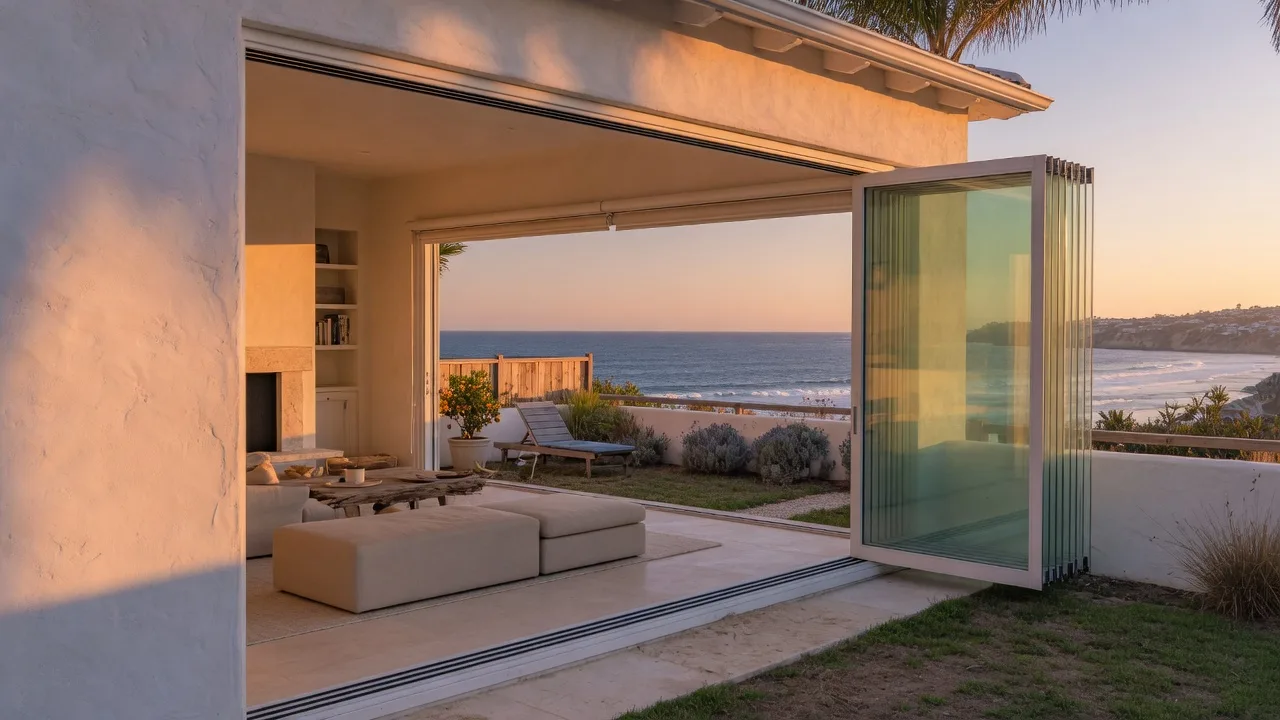
A multi-slide, sometimes sold as a stacking slider or a pocket multi-slide, uses three or more panels. The panels stack against one jamb, or disappear into a wall pocket, so most of the glass wall can open. The product is a moving wall, not a door in a door-sized hole. French doors versus sliding glass doors owns hinged versus slider. This page owns stacking or pocket multi-slide walls versus a standard two-panel sliding glass door.
If the quote says “slider” and the drawing shows four panels stacking to the ocean, you are not comparing the same product. Ask for the panel count, whether the panels stack or pocket, and whether the rough opening matches what is in the wall today.
Replacing a sliding door with a window is a third job, covered on replacing a sliding glass door with a window. Do not mix that conversion into this comparison.
The wall, the header, and the stack space you actually have
A two-panel replacement can often keep the existing header and the existing stucco returns. The new frame sits in the old hole. The track and the rollers change. The wall does not.
A stacking multi-slide needs somewhere for the extra panels to live when the wall is open. That is either a wider opening with a stacking bay at one end, or a pocket built into the wall. Either path can mean a new header, new king and jack studs, and a stucco patch that is a plaster job as much as a door job. This page does not publish header sizes or panel-count limits. Those numbers belong on the shop drawing for that opening.
Stand in the patio and look at the wall. Del Mar, La Jolla, and Rancho Santa Fe west walls are the wide-opening case: people want the glass to disappear toward the water. A two-panel slider will never give that. A multi-slide will not fit that dream if the stack has nowhere to go, or if the existing header is only sized for a six-foot slider.
A Mira Mesa or Chula Vista tract patio is often a standard two-panel aluminum slider in a stucco return. The honest product there is usually another two-panel door, in vinyl or fiberglass, in the same hole. Ordering a multi-slide into that opening is an addition, not a replacement.
Ask the licensed pro to write three things on the quote: panel count, stack or pocket, and whether the rough opening stays. If those three lines are missing, the price is not yet a comparison.
Coastal hardware versus west-facing heat on a wide opening
Oceanside and Imperial Beach beat up rollers. Salt air and sand in the track are why a two-panel slider starts to drag. A multi-slide has more panels, more rollers, and more track to keep clean. The climate does not change because the door got wider. The maintenance surface does. Sliding glass door roller repair owns the two-panel hardware symptom. A stacking wall with a failed roller is the same physics with more moving parts.
Inland patios in Poway and El Cajon are the heat case. A west-facing glass wall dumps solar gain into the room behind it. Title 24 still applies to replacement fenestration. The 2025 Building Energy Efficiency Standards took effect January 1, 2026. San Diego County sits in Climate Zones 7 and 10, where the prescriptive maximum fenestration U-factor is 0.30. The mandatory maximum U-factor is 0.40 in every climate zone. California Energy Code section 150.2(b) allows replacement of vertical fenestration no greater than 75 square feet with a U-factor no greater than 0.40, and a SHGC no greater than 0.35 in Climate Zones 2, 4, and 6 through 15. That exception text was read from the 2022 edition; confirm the current edition with the building department. A multi-slide wall is often larger than 75 square feet. Do not assume the small-area exception covers it.
Do not state prescriptive SHGC by zone. Put the NFRC U-factor and SHGC for that door on the quote. ENERGY STAR is a separate listing. The federal 25C window credit is terminated for property placed in service after December 31, 2025.
A two-panel dual-pane slider with a low SHGC on a Poway west wall can be the quieter energy job. A stacking wall on that same elevation is a comfort conversation as much as a view conversation. Read reducing west-facing heat gain before you order a glass wall into afternoon sun.
When the opening change leaves permit territory
Inside the City of San Diego, window and door replacement can use a No-Plan Building Permit under Development Services Information Bulletin 203 when the new doors or windows are the same size and type, with no change to the opening, in a legally permitted building that passed final inspection. Widening the hole, adding a stack pocket, or changing the header is not that path. Ask Development Services the exact question: does this patio opening stay same-size and same-type, or does the multi-slide need plan review?
IB 203 is a City of San Diego bulletin. It does not speak for Del Mar, Encinitas, Oceanside, or the unincorporated county. Name the city on the quote. Then ask that city’s building department whether changing the rough opening or building a pocket requires a building permit.
Do not publish hazardous-location inch rules. Sliding glass doors next to walking surfaces often involve safety glazing. Ask the plans examiner which panes have to be tempered, and write that on the order. Tempered safety glass is the broader glazing page.
A building 45 years or older, or a designated historic resource, can trigger historic review in the City of San Diego even when the door is a replacement. A multi-slide that changes the elevation is a different historic question than a same-size slider. Ask before the stucco saw comes out.
Which San Diego patio still wants a two-panel slider
Keep the two-panel door when the opening is already that size, the header is staying, and the job is glass, rollers, and a frame that still sits in the old hole. That is most tract patios in Mira Mesa, Kearny Mesa, Chula Vista, and El Cajon. Coastal salt on a two-panel track is a hardware problem, not a reason to invent a stacking wall.
Choose a multi-slide when the wall is the point: a Del Mar or La Jolla west elevation, a Rancho Santa Fe indoor-outdoor room, or a new opening sized on purpose for stacking panels. Then budget for the header, the stack or pocket, and the stucco. That is full-frame territory on the wall, not a pocket swap.
California law requires a contractor license when the aggregate contract price for labor, materials, and all other items is $1,000 or more (Business and Professions Code section 7048, threshold amended effective January 1, 2026). Door and glazing work sits inside the C-17 Glazing Contractor classification under California Code of Regulations title 16, section 832.17. Confirm the company on the CSLB license check. You contract with the licensed independent pro, not with Window Pro SD.
When to call us
Call when one quote is a two-panel slider in the existing hole and the other is a stacking wall, and you cannot tell which opening the house actually has. A licensed door contractor should name the panel count, the stack, and whether the header changes. Call us at (858) 400-6418 and we’ll connect you with a licensed local window and door contractor.