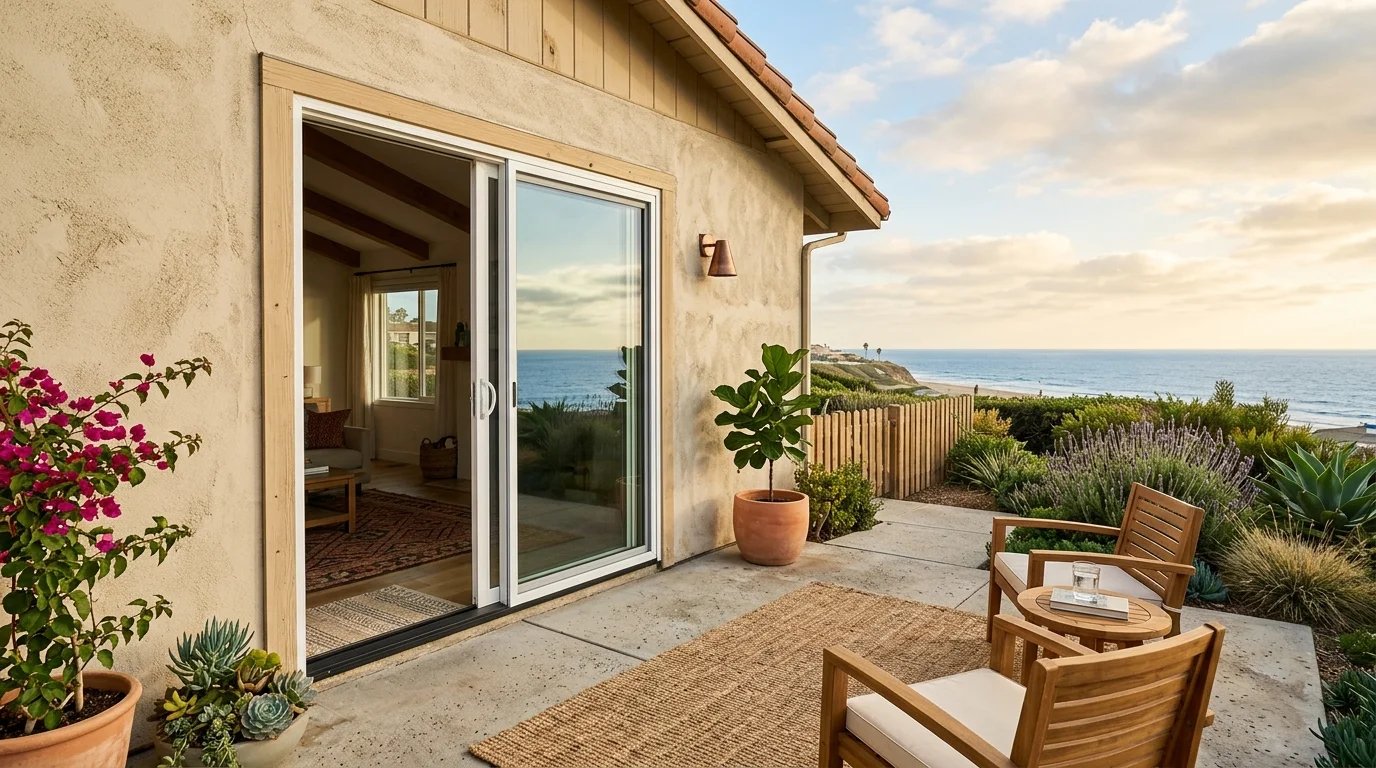
A patio slider is a door-sized glazed unit on a track. It is not a sliding window. Dual-pane sliding glass doors in San Diego put two factory-sealed lites into that big opening so the wall to the patio is an insulated glass unit, not one sheet of glass. If the quote talks about a house-window package, stop and make the pro specify the patio door.
What dual-pane means on a patio door, not a house window
A sliding window lives in a wall opening you can often move with one hand. A sliding glass patio door is a much larger assembly: frame, sill, head, two or more panels, rollers, an interlock, and a lock that has to hold a glass wall shut against wind off the Pacific or a Santa Ana. One panel usually stays fixed. The other rolls. People call that a sliding patio door, a sliding glass door, or a patio slider. Two-panel units are the common OX or XO layout. Three- and four-panel stacks exist on wider walls. They are still exterior patio doors, not closet sliders or room dividers.
Dual-pane, also written double pane, describes the glass, not how many panels slide. Two lites are sealed at the factory into an insulated glass unit (an IGU). A spacer holds the gap. The cavity is air or a fill gas. A Low-E coating may sit on one surface. That whole sandwich sits in the door panel. A single-pane slider is one lite per panel, with no sealed cavity. Storm panels, add-on acrylic, and a second piece of glass in a clip are not a dual-pane IGU. If you can unscrew the extra pane, it is not dual-pane.
The single-pane to double-pane window upgrade is a window job. This is a patio-door job. The glass idea is related. The hardware is not. Rollers, the track, the lock, the interlock, and the weight of a door-sized IGU are why a window-only crew can leave you with a panel that drags. Window Pro SD matches homeowners with licensed, independent local pros. We do not install doors, sell glass packages, or stock frames. The contractor you hire does the work, and you contract and pay that contractor.
On a dual-pane upgrade for a patio opening, the IGU has to fit the panel. Patio IGUs are larger and heavier than house-window units, and they are often tempered. California Building Code Chapter 24 names hazardous locations where safety glass is required, including areas near doors. The exact inch thresholds in the California text were not confirmed for this site, so a quote should not skip the question. Ask the licensed glazing contractor: is this patio door in a hazardous location under CBC Chapter 24, and is the lite tempered or laminated because of that, not only because the catalog says dual-pane.
A glazing contractor’s scope is in Cal. Code Regs. tit. 16, sec. 832.17. It covers selecting, cutting, assembling, and installing glass, and the fabrication and glazing of frames, panels, sashes, and doors, and installing those items in a structure. California Business and Professions Code section 7048 requires a contractor license when the aggregate contract price for labor, materials, and all other items is $1,000 or more, with a narrow exemption that does not apply if someone advertises as a contractor. Check the license on the CSLB license lookup before you sign.
Single-pane sliders still sitting in 1960s-80s San Diego stock
A lot of San Diego County housing from the 1960s through the early 1980s went up with mill-finish aluminum patio sliders. One lite of glass. A skinny frame. A track that fills with grit. You still see that stock in Oceanside tract streets east of the 5, in Carlsbad and Vista, in Clairemont, Linda Vista, Serra Mesa, and Mira Mesa, and inland through El Cajon, La Mesa, and parts of Chula Vista and National City. The door still rolls, some days. The glass is still a single sheet. Afternoon sun on a west wall in Escondido or Poway cooks the room. Night air off the water at Imperial Beach or Ocean Beach moves right through the interlock.
Some of those openings already got a later dual-pane panel dropped into the old aluminum frame. That can be a real IGU, or it can be a cheap glass swap that fogged. Fog between the lites means the seal failed. The dual-pane cavity is no longer a sealed cavity. Replacing only the glass may be enough if the frame, sill, and rollers are still sound. It is not enough if the aluminum frame is racked, the sill is pitted, or the lock no longer meets the strike.
Census ACS figures already used on this site put 49.6% of San Diego housing before 1978. In the City of San Diego, that age also hits historic review. City of San Diego Development Services Information Bulletin 203 says a building permit is required for window replacement. Same-size, same-type replacement can qualify for a No-Plan Building Permit, which is a permit without plan review, not an exemption. IB 203 requires the doors or windows to be the same size and type as the existing ones, with no change to the opening size, and only on structures that were legally permitted, built, and passed final inspection. Historical review is required for a designated historical resource or an adopted historic district. A building 45 years or older requires plans submitted for historic review unless the scope is exempt. Ask Development Services this exact question: does replacement of my sliding glass patio door, same size and type, qualify for a No-Plan Building Permit under Information Bulletin 203, and does my parcel need historic review because the building is 45 years or older? Use the City of San Diego Development Services page for the current bulletin. Permit fees and turnaround were not confirmed. Rules in Oceanside, Encinitas, Escondido, El Cajon, Chula Vista, and the unincorporated county are separate. Name your city, then ask that city’s building department whether a same-size, same-type patio slider replacement needs a permit and whether the door is treated as vertical fenestration under the 2025 Energy Code.
If the house was built before 1978 and the job will disturb painted surfaces, ask the contractor how EPA’s Lead Renovation, Repair, and Painting Rule applies. EPA treats window replacement as a renovation. This ledger does not settle every patio-door edge case, so make the pro say what they will do on your opening.
Coastal tracks versus inland heat on the same door style
From Imperial Beach through Coronado, Ocean Beach, Mission Beach, Pacific Beach, La Jolla, Del Mar, Encinitas, Carlsbad, and Oceanside, the failure on a patio slider is often the bottom of the door, not the glass. Salt air sits on the track. Sand and grit ride in on shoes. Rollers pit. The operable panel starts to hop, then scrape, then need two hands. Dual-pane glass does not fix a dead roller. A new IGU in a salted track is still a salted track. Coastal jobs need the pro to look at rollers, the sill, weep paths, and whether the frame can still shed water toward the patio. This site does not publish a salt-mile cutoff or a year lifespan for coastal hardware. Those numbers are not in the claims ledger. What you can see is residue on the track, a panel that no longer lifts onto the rollers, and a lock that no longer lines up.
Inland, the same door style fails in a different place. West-facing sliders in Escondido, Poway, Santee, El Cajon, Lakeside, and Alpine take afternoon sun on a large glass area. Dual-pane with a Low-E coating is the glass conversation there, not a third lite as a default. A triple-pane patio door shows up in some San Diego searches. Do not buy a third pane on a savings story this site cannot verify. San Diego County sits in Climate Zones 7 and 10. The climate case for a third pane is weak unless you have a documented noise problem (freeway, MCAS Miramar, a flight path, or a busy arterial). For the glass-count comparison on windows, read triple-pane vs double-pane windows in San Diego. For sound, ask for manufacturer STC data on the specific door, not a generic decibel promise.
If you are choosing operation rather than glass, a hinged pair is a different product. French doors vs sliding glass doors in San Diego is that comparison. This page stays on the dual-pane glass package in a slider.
Wildfire rules can also decide the glass. California Building Code section 708A.2 says exterior windows, skylights, and glazed door assemblies must be multi-pane with at least one tempered pane meeting the safety-glazing section, or an assembly tested to SFM Standard 12-7A-2. Both paths have to be stated. Cal Fire’s 2025 maps raised San Diego County Very High Fire Hazard Severity Zone acreage about 26%, from 646,838 acres to roughly 871,000. The California FAIR Plan raised its bar in 2025: homes seeking new coverage in a Very High zone must show multi-pane windows or functional shutters. 10 CCR 2644.9 also lists multi-pane windows as a home-hardening measure for the Safer from Wildfires discount path. Ask the pro whether your parcel is in a Very High zone and which 708A.2 path the patio door meets.
Glass-only, panel swap, or full-frame: three different jobs
Three different jobs get sold as “new dual-pane sliding glass doors.” They are not the same scope. Write the scope on the quote before you compare money.
Glass-only is an IGU swap in the existing panels. The pro pulls the old lites, sets a new dual-pane unit, and keeps the frame, rollers, and lock. That only makes sense if the frame is square, the sill is intact, and the panel still rolls. It is a glass job. It is not a new door.
A panel swap keeps the existing frame in the wall and hangs new panels (new glass, new stiles, often new rollers and lock) in that frame. The opening size stays put. The old aluminum frame may still be the weak part, especially on the coast where the sill took salt for decades.
Full-frame replacement pulls the entire unit, frame and all, and sets a new patio door in the opening. That is the job when the frame is racked, the sill is rotten or pitted, the opening needs new flashing, or you are changing type. Changing type or size is not a same-type replacement under City of San Diego IB 203. For the failed-door path, the sibling post is sliding glass patio door replacement in San Diego. For the product category, start at patio and sliding glass doors.
An in-glass pet door is a hole in the IGU. It changes how the dual-pane unit is built. This site has no verified energy-loss figure for that hole. If you want one, make the quote show how the IGU is manufactured around the pet opening, and how the operable panel still clears the stationary panel.
When the patio door is replaced as vertical fenestration, Title 24 applies. The 2025 Building Energy Efficiency Standards took effect January 1, 2026. Prescriptive maximum fenestration U-factor is 0.30 in Climate Zones 6-10 and 15. San Diego County spans Climate Zones 7 and 10, so 0.30 is the prescriptive number for this county. The mandatory maximum U-factor is 0.40 in all climate zones. California Energy Code section 150.2(b), quoted from the 2022 edition, allows replacement of vertical fenestration no greater than 75 square feet with a U-factor no greater than 0.40 in Climate Zones 1-16, and a SHGC value no greater than 0.35 in Climate Zones 2, 4, and 6-15. A homeowner replacing up to 75 square feet may use that U-0.40 / SHGC-0.35 product rather than meeting the full prescriptive 0.30. Larger jobs meet the prescriptive numbers. Confirm the current edition with your building department. The 2025 verbatim exception text was not reached for this ledger. The California Energy Commission page is at energy.ca.gov.
What a quote has to list so dual-pane is actually dual-pane
Window Pro SD does not set prices, waive fees, or publish a brand range for patio doors. People search for a double-pane sliding glass door cost, an average install cost, and what a big-box store charges. None of those dollar figures are in this site’s claims ledger, so they are not printed here. Compare scope, not a round number you saw on another page.
A dual-pane patio-door quote should list, in writing:
The configuration (two-panel OX or XO, or a three- or four-panel stack), and which panel moves.
That the glass is a factory-sealed dual-pane IGU, not a storm panel or an add-on lite.
NFRC ratings for the whole door, including U-factor. If the job is over 75 square feet of replaced vertical fenestration, the prescriptive U-0.30 for Climate Zones 7 and 10 is the number to match unless the building department says otherwise. If the job is at or under 75 square feet, ask whether they are using the section 150.2(b) path (U-0.40 and SHGC 0.35 in our zones) and have them show that math in square feet.
Whether a Low-E coating is included, and on which surface. Do not accept “energy efficient” with no coating callout.
Whether any fill gas is in the cavity. If they name argon, make them say it is in this door, not in a window brochure.
Tempered or laminated glass, tied to CBC Chapter 24 hazardous-location rules and, in a Very High zone, to section 708A.2’s two paths. No inch rule from memory.
Frame material and finish, rollers, lock, and whether the track is new or reused.
The install method: glass-only, panel swap, or full-frame, plus flashing and sill-pan work on a full-frame job.
Permit responsibility, named to your city. In the City of San Diego, the IB 203 question above. In Oceanside, Encinitas, Escondido, El Cajon, and everywhere else, the same-size, same-type permit question to that city’s building department.
ENERGY STAR is a third-party check against climate-zone criteria. This site does not publish those numeric thresholds. Verify a named product at energystar.gov.
The federal 25C credit is terminated for property placed in service after December 31, 2025. A door or window installed in 2026 does not qualify.
No dealer tie to any factory brand belongs on this page. Ask for the product name and the NFRC label, then read the label.
When to call us
Call when you want dual-pane glass in a real patio slider, not a sliding-window quote, and you need a licensed local pro to say whether the job is glass-only, a panel swap, or full-frame. That is licensed glazing work, not a weekend hardware run. Call us at (858) 400-6418 and we’ll connect you with a licensed local window contractor.