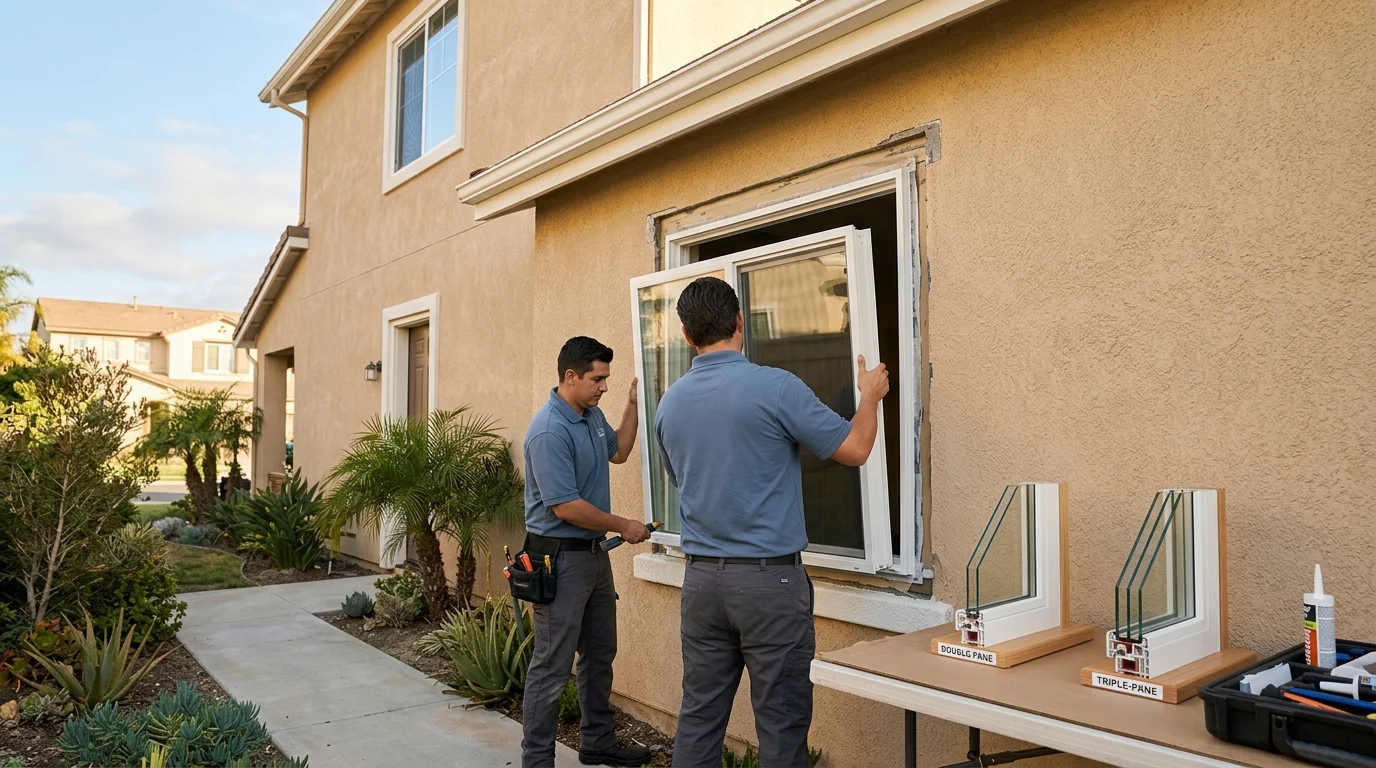
For most San Diego homeowners, double pane windows are the sensible comparison point. Consider triple-pane only when a specific product shows a clear benefit for your opening, noise concern, and installation plan. Pane count alone doesn’t settle the decision.
The current code numbers provide a useful baseline. The California Energy Commission says the 2025 Building Energy Efficiency Standards took effect January 1, 2026. San Diego County spans Climate Zones 7 and 10, where the verified prescriptive maximum fenestration U-factor is 0.30. The 2022 Energy Code §150.2(b) allowed replacement of no more than 75 square feet at U-0.40 and SHGC-0.35. The exact 2025 exception text couldn’t be confirmed from accessible primary code text, so ask the project’s building department whether that exception remains unchanged.
Window Pro SD doesn’t sell or install windows. We connect homeowners with licensed, independent local window replacement professionals. The homeowner contracts with and pays the matched professional directly.
What the third pane buys you, physically
A double-pane assembly contains two panes. A triple-pane assembly adds another pane and another space within the glass unit. That physical difference is easy to understand. Its value in a finished window requires closer inspection.
The pane count doesn’t identify the glass type, pane thickness, spacing, frame, or operating hardware. It also doesn’t establish how the complete window performed during testing. Those details belong to the specific manufacturer and model.
Ask for the product label and supporting performance documents. Compare the complete units, not two generic category names. Useful questions include:
- What U-factor appears on the exact product label?
- Does the quoted configuration match the tested configuration?
- Is any pane laminated or a different thickness?
- Which frame and operating style were included in testing?
- Does the manufacturer approve that size and configuration?
ENERGY STAR certification provides third-party verification against climate-based performance criteria. Specific qualification still depends on the exact product. Check the current Southern climate zone listing instead of relying on a showroom description.
Homeowners replacing original single glass should also compare the basic upgrade path. Our guide to a single-pane to double-pane window upgrade explains the questions that come before a third-pane decision.
A triple-pane label can look decisive. It isn’t a substitute for tested product information. Make the third pane prove its value on the exact window being quoted.
Our climate versus the climates triple-pane was built for
The heading assumes triple-pane windows belong to one type of climate. We couldn’t confirm an approved primary source that makes that universal claim. We also couldn’t verify a rule requiring triple-pane windows throughout San Diego County.
What can be confirmed is more useful. California regulates the finished window’s performance through values such as U-factor and SHGC. It doesn’t reduce the choice to a pane-count slogan. A compliant double-pane product and a compliant triple-pane product may both deserve consideration.
San Diego County also needs a local comparison. A coastal strip project may focus on salt exposure, frame condition, and an existing opening. Inland North County and East County homeowners may put more attention on afternoon sun. Central San Diego and South Bay projects may place noise or opening constraints higher on the list.
Those priorities can change from one side of a house to another. A west-facing living room opening might have a different job than a shaded bedroom window. Ask the contractor to compare each important opening by orientation, room use, existing frame, and measured product performance.
Don’t let a national article make the choice for a San Diego house. Bring the decision back to Climate Zones 7 and 10, the actual product label, and the conditions at the opening. If a seller recommends triple pane, ask which documented result supports that recommendation.
No approved source establishes a universal energy-bill percentage for either option. Actual costs depend on the home, HVAC system, insulation, usage, and window condition. Treat any broad savings percentage cautiously unless its methodology and product match your project.
Weight, frame depth, and retrofit limits
Triple pane changes the glass assembly, but there’s no approved universal figure for its added weight or frame depth. Compatibility depends on the complete window, its size, its hardware, and the manufacturer’s specifications.
That makes the opening assessment important. Don’t assume a triple-pane configuration fits because a double-pane version fits. Ask the licensed contractor to document:
- The dimensions and weight of the quoted unit
- The manufacturer-approved size and operating configuration
- The frame depth required for that exact model
- Whether the existing frame can remain
- Whether the operating hardware supports the configuration
- How the interior and exterior edges will be finished
Installation type matters here. A retrofit window works within an existing frame. A full-frame project removes more of the old assembly. Read our guide to retrofit versus full-frame window installation before treating either method as interchangeable.
The right answer may vary across the same property. An unobstructed opening could accept one configuration. A tight opening beside tile, stucco, trim, or built-ins may need another plan. That doesn’t make triple pane unsuitable. It means the contractor should verify fit before ordering.
Bedrooms add another checkpoint. Ask whether the proposed configuration affects required emergency escape and rescue clearance. Don’t accept nominal window dimensions as proof. The relevant measurement concerns the actual clear opening.
The City of San Diego and the county’s other jurisdictions set their own permit processes. Requirements outside the City of San Diego couldn’t be confirmed in the approved ledger. Ask the authority for the property’s address whether the proposed installation type, opening changes, or window configuration affects the permit path.
Noise: where triple-pane genuinely helps here
Noise decisions need product-level evidence. A universal decibel advantage for triple pane over double pane couldn’t be verified. The manufacturer’s laboratory testing for the exact product establishes its sound rating. Adding one pane also can’t be promised to solve a particular noise problem.
A narrower statement can be supported. Multi-pane windows with laminated or varying-thickness glass can reduce sound transmission compared with single-pane windows. Actual performance depends on the glass construction, frame, installation quality, and frequency of the outside noise.
That means the homeowner should identify the source first. Street traffic near central San Diego isn’t the same listening problem as voices, aircraft, or intermittent activity near a South Bay property. Describe when the noise occurs, where it enters, and which rooms matter most.
Then request the manufacturer’s laboratory-tested STC rating for the exact configuration. Don’t transfer a rating from another product in the same series. Glass type, thickness, frame, and operating style may differ.
A tested double-pane unit with laminated or varying-thickness glass may deserve more attention than an untested triple-pane option. The reverse could also be true for another product. The documents should decide, not the pane count.
Installation also remains part of the comparison. Published glass performance doesn’t establish the result for a finished opening. Ask the contractor how the frame, perimeter, and surrounding conditions will be addressed.
Our guide to window noise reduction in San Diego explains how to prepare that conversation. It also helps separate a specific sound-control goal from a general request for “quieter windows.”
Where the same money does more on a San Diego house
There’s no verified universal price difference between double-pane and triple-pane windows in the approved ledger. Window Pro SD doesn’t set project prices. The independent contractor provides the quote, and product pricing depends on the selected configuration.
Instead of assuming the third pane deserves the budget, compare complete proposals. Ask each professional to separate the product choice from the installation method and any opening work. That makes the tradeoffs easier to see.
For many projects, the better priority list starts with fit. Choose a window approved for the required size and operating style. Confirm the installation plan. Verify the current Title 24 values. Then compare optional glass packages using the manufacturer’s documentation.
Noise-focused projects may direct more attention toward laminated or varying-thickness glass. Openings with damaged frames may need a different installation plan. A house with several priorities might benefit from treating the most troublesome openings first instead of specifying one package everywhere.
If the existing windows are single pane, start by comparing a documented dual-pane upgrade with the triple-pane proposal. Request exact product labels for both. Ask what changes besides the pane count and which tested value supports the added cost.
Don’t include an assumed utility rebate in the comparison. The approved research couldn’t verify an SDG&E per-window rebate figure. Ask the utility whether a current program applies before adding any incentive to the budget.
The federal Section 25C credit also ended for property placed in service after December 31, 2025. Windows installed in 2026 don’t qualify. That makes an honest product-by-product comparison more useful than an outdated rebate claim.
When to call us
Call when product labels, frame fit, noise goals, or installation choices need review by a licensed Window Replacement professional. Window Pro SD can match you with an independent local pro who can inspect the openings and explain the available configurations. Call us at (858) 400-6418 and we’ll connect you with a licensed local window contractor.