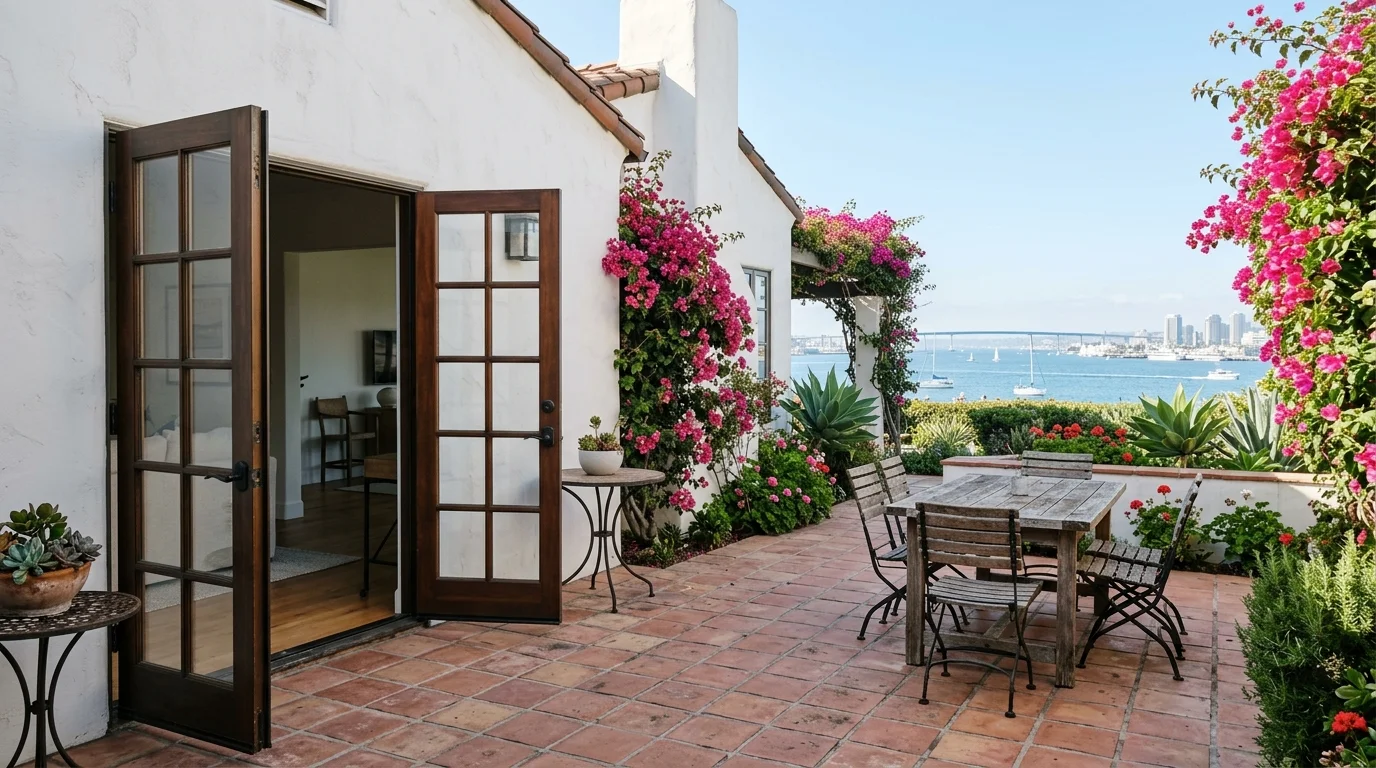
The French doors vs sliding glass doors choice in San Diego is the hole you already have, the swing you can live with, and the hardware that will sit in west sun and salt. A hinged pair needs floor and patio clearance every time it opens. A slider stays in the wall and spends its life on a track. Style comes after that, not before.
This is not a recap of sliding glass patio door replacement. If the slider is staying a slider, that page owns the replacement. It is also not about closing a slider and building a window. Keep the opening a door. Decide how the door moves.
A “French-style” slider with wide stiles and grids is still a sliding door. True French doors hinge. Do not let a catalog mix those two products.
The opening, the swing, and the wall you actually have
The wall already has a hole, a header, and a traffic pattern. The door has to live inside that, not the other way around. Most San Diego tract living rooms and primary bedrooms already have a two-panel slider to a patio. The header, the sill, and the stucco returns were built for a door that slides. A hinged pair in that same hole has to clear furniture inside, or grill and chairs outside, depending on swing.
Inswing French doors need a pie-shaped zone of interior floor that stays empty. A sofa, a table, or a bed in that arc makes the door a daily fight. Outswing doors spend that arc on the patio. A stacked chaise, a built-in barbecue, or a tight Coronado courtyard can block the leaf as surely as a couch. Measure the swing with the furniture where it actually sits, not with an empty showroom.
A slider needs none of that floor. It needs a clear track and a place for the operable panel to stack in front of the fixed panel. You give up roughly half the opening when one panel is parked. You keep the wall and the patio usable. That is why a small concrete pad behind a Mira Mesa or Clairemont rancher usually keeps the slider. The pad was poured for a grill, not for two swinging leaves.
The wall stack matters as much as the furniture. A slider replacement that stays a slider can often keep the existing rough opening. Swapping to French doors in the same width is still a different unit: different sill, different jamb, different fastening, different weatherseal. Widening the hole for a pair of larger leaves is a framing job. That is not a panel swap. Put the finished width, swing direction, and whether the header stays on the quote before anyone orders glass.
Screens follow the operation. A slider usually has a sliding screen in a second track. Hinged doors need a swinging screen, a retractable screen, or no screen. If the patio is how you vent the house on a June evening, that line item is part of the door, not an accessory you remember later.
Glazing of frames, panels, sashes, and doors sits inside California’s C-17 classification. Cal. Code Regs. tit. 16, sec. 832.17 covers selecting, cutting, assembling, and installing glass and glass work, and installing those items in a structure. That section does not make C-17 the only classification that may touch a mixed framing job. Confirm the bidder on the CSLB license lookup. California Business and Professions Code section 7048 requires a valid contractor license when the aggregate contract for labor, materials, and all other items is $1,000 or more.
Published patio-door work on this site is $1,200-$3,500 installed, depending on size and material. We do not publish a separate French-versus-slider adder. Make both bidders price the same opening, the same glass, and the same finish work.
Wind, salt, and hardware on a west-facing patio
A west patio in Coronado or La Jolla loads the hardware with afternoon sun, onshore wind, and salt. An inland patio in Poway or Santee loads it with heat. The door style does not cancel the exposure.
Hinged leaves catch wind. An outswing French door on a coastal west wall can slam if it is not held. The afternoon onshore breeze along the strand is the usual culprit, not a snowstorm from a national blog. Inswing doors slam into the room instead. A slider stays in its track. It can rattle. It does not become a sail. If the patio faces west and sits open to the water or a canyon, ask the licensed pro how the chosen hardware holds a leaf in a breeze, including a hold-open if they offer one. We could not confirm a published wind rating that applies to every French door in the county. The manufacturer of the quoted unit sets that figure.
Salt eats the parts you touch. Hinges, multipoint gear, handles, and keepers on French doors are metal. Rollers, tracks, latches, and keepers on sliders are metal. From Coronado and Imperial Beach through Ocean Beach, Pacific Beach, La Jolla, and north to Oceanside, ask for the finish in writing: stainless, a coastal-rated coating, or whatever the manufacturer actually warrants for salt. Plated steel that looks fine in a Kearny Mesa warehouse will not look the same after a season of marine air. Rinse and the manufacturer’s care sheet still matter. Window Pro SD does not warrant hardware.
Inland west walls in Poway and Santee see less salt and more sun. The failure mode shifts to UV, hot thresholds, and glass that dumps afternoon heat into the room. Hardware still wears, but pitting is not the first thing you inspect. You inspect the sill in the sun, the weatherstrip, and the labeled solar heat gain of the glass. Irrigation hitting the threshold is an inland problem too. A slider track that stays wet from sprinklers fails like a coastal track, without the ocean.
Do not treat “coastal package” as a vibe. The quote should name the hinge or roller material, the lock body, the threshold, and the exterior finish. Photograph the existing hardware before anyone prices a swap. White corrosion, frozen rollers, and rusty hinge pins are evidence. A ZIP code is not.
Energy and security: what changes when doors swing
A swinging leaf changes the seal line and the lock geometry. It does not automatically save energy or stop a break-in. Ignore style claims that French doors “save on the bill” or that sliders are “not energy efficient.” Ask for the NFRC label on the unit being sold.
A hinged door can compress against a continuous gasket when it latches, the way an entry door does. A slider relies on pile weatherstrip and an interlock at the meeting stile. That is a real difference in how the perimeter closes. It is not a percentage of your SDG&E bill. We do not publish energy-bill savings, and we do not state prescriptive SHGC by climate zone. The whole-door U-factor and SHGC on the sticker are the numbers that matter.
California energy code treats these glazed doors as fenestration. The 2025 Building Energy Efficiency Standards took effect January 1, 2026. San Diego County sits in Climate Zones 7 and 10, so the prescriptive maximum U-factor is 0.30. The mandatory maximum U-factor is 0.40 in every climate zone. California Energy Code section 150.2(b), as read from the 2022 edition, lets you replace no more than 75 square feet of vertical fenestration at U-factor no greater than 0.40, with SHGC no greater than 0.35 in the listed zones that include this county. A typical patio door can use a large share of that 75-square-foot exception by itself. Larger glass jobs meet the prescriptive U-factor. Confirm the current edition with the building department, because the 2025 verbatim exception text was not the copy we could reach. The California Energy Commission publishes the standards. If you want a third-party energy mark, look up the unit on ENERGY STAR’s residential windows and doors page rather than taking a brochure logo as law.
West glass is a San Diego problem on both door types. A west-facing patio in La Jolla or Poway takes afternoon sun. Low-E coatings and the labeled SHGC are how you compare two quotes. Frame color and grids change looks. They do not replace the sticker.
Security is hardware, not folklore. French doors can take a multipoint lock that throws bolts into the head and sill, plus a solid strike at the meeting stile. Outswing pairs need hinge-side protection so pins cannot be pulled from outside. Sliders need a latch that actually hooks, anti-lift blocks in the head, and a foot bolt or equivalent on the operable panel. A cheap latch and an empty track are why old sliders feel unsafe. A new slider with those parts is a different door than the 1970s unit it replaces. We could not confirm a crime statistic that makes one style safer in San Diego. Ask each bidder to write the lock model, not “secure.”
If the room is a sleeping room, California Residential Code R310 still applies to the emergency escape opening: 5.7 square feet of net clear opening in general, 5.0 square feet at grade-floor or below-grade openings, at least 24 inches high and 20 inches wide, with the bottom of the clear opening no more than 44 inches above the floor (2022 CRC R310.2.1 through R310.2.3). A patio door usually clears those numbers when it opens. A new French pair with a high threshold, a wide mullion, or a leaf that cannot swing past 90 degrees can still fail the clear opening. Have the pro show the net clear on the submitted unit.
Federal 25C is terminated for property placed in service after December 31, 2025. A 2026 door does not get that credit.
Permits when the opening or the swing path changes
In the City of San Diego, a building permit is required for door and window replacement. Information Bulletin 203 is the No-Plan path for same-size, same-type work. The bulletin’s condition is that the doors or windows must be the same size and type as the existing ones, with no change to the existing opening size. That is a permit issued without plan review, not a pass from permitting. Only structures that were legally permitted, built, and passed final inspection may use that path.
A sliding glass door and a hinged French door are not the same type. Replacing a slider with French doors is not the IB 203 same-type condition. Changing the rough opening, moving the header, or altering the exterior flashing plane is also outside that path. Changing swing on an existing hinged door (inswing to outswing, or the reverse) is a question for the building department, not a guess from a blog. Ask City of San Diego Development Services this exact question: “Does this address and this door schedule still qualify for Information Bulletin 203, or does a type or swing change require plans?”
Historical review is required in the city for a designated historical resource, a parcel in an adopted historic district, and a building 45 years or older unless the scope is exempt. A large share of San Diego housing is already at that age. La Jolla addresses are inside the City of San Diego. Coronado is not. Poway is not. Santee is not. Each of those cities has its own building department. We could not confirm their fee schedules or whether they offer a no-plan equivalent. Do not use a City of San Diego bulletin as a permit for a Coronado cottage or a Santee patio. We do not publish permit fees.
The contractor should write who submits the permit, who posts it, and who calls the inspection. A salesperson who says a type change is “the same hole, so no permit” is not describing City of San Diego rules. Other jurisdictions set their own rules. Have that name on the quote. Our window replacement permits guide walks the city path in more detail.
California Building Code section 708A.2 applies where Chapter 7A wildfire provisions apply. Exterior glazed door assemblies must be multi-pane with at least one tempered pane meeting the safety-glazing section, or an assembly tested to SFM Standard 12-7A-2. Ask whether Chapter 7A applies to the address. We could not confirm California’s hazardous-location inch rules for safety glazing from a source we can publish. Ask the building department whether this patio-door location requires safety glazing and what product documentation they want.
Which San Diego floor plans favor which door
Coronado cottages, La Jolla west walls, and inland Poway and Santee patios do not want the same door for the same reason.
Coronado lots are often tight. The patio may be a courtyard, a side yard, or a small rear pad with a neighbor close. A slider keeps the outdoor furniture where it is. Salt and wind still own the hardware spec. If you want French doors there, outswing usually needs a patio that can give up the arc, and the hinge and lock finish has to be honest about marine air. Inswing needs an interior that can give up the same arc. Many of those floor plans cannot.
La Jolla west elevations add heat on top of salt. Afternoon sun hits the glass. Onshore wind hits the leaf. A slider with the right low-E package and coastal hardware is often the quieter fit. French doors can still be the right look on a larger terrace, if the swing is drawn on the patio plan and the quote names stainless or an equivalent finish. Do not pick the grids first.
Inland Poway and Santee patios are a different house. Lots run larger. Rear yards can absorb an outswing. Salt is not the first inspector. Heat is. The glass package and the overhang matter more than marine-grade hinges. A French pair off a family room can work when the furniture plan and the patio both have room. A slider still wins when the door is the only wall to a tight covered patio, or when the household wants a screen in a track.
Older City of San Diego ranchers in Clairemont, Mira Mesa, and similar tracts usually started with a slider because the production house was built that way. Keeping a slider is the same-type path under IB 203 if size does not change. Switching to French doors is a type change, a different sill, and a furniture problem you should solve on paper first. For the product itself, see patio and sliding door work. For a tired slider that is staying a slider, stay on the replacement guide instead of this comparison.
Window Pro SD does not install doors, pull permits, or warrant the product. We match you with a licensed local pro. You contract with that company.
When to call us
If the patio door you have cannot live with the swing, the salt, or the lock you actually need, that is a licensed glazing job, not a hardware-store handle. Call us at (858) 400-6418 and we’ll connect you with a licensed local window contractor.