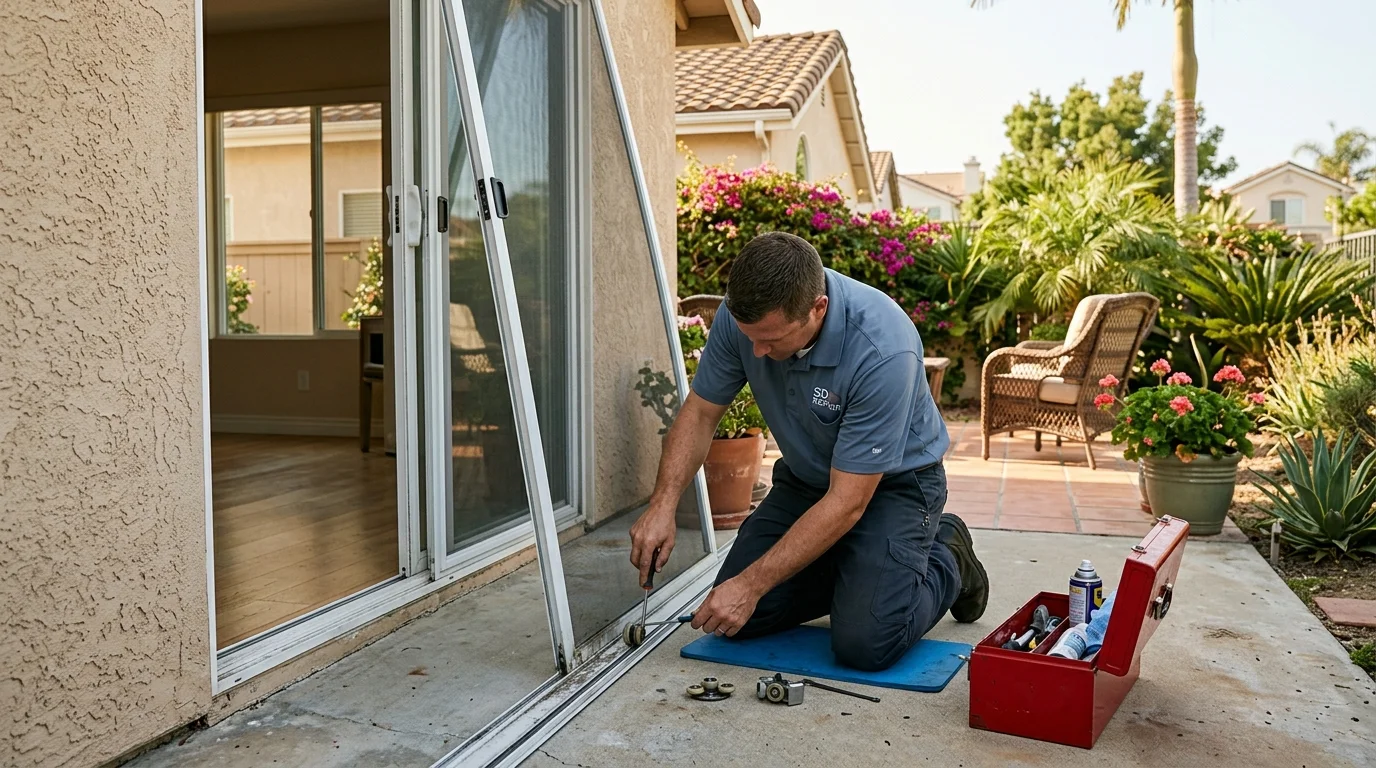
A roller screen door that drags may need cleaning, adjustment, or new rollers. First, identify whether the screen panel or heavier glass panel is sticking. They use separate hardware, so repairing one won’t correct a problem with the other.
That distinction matters before you buy parts or remove anything. The clues below can help you describe the problem accurately to a local pro.
The symptoms that point at rollers, not the track
Watch the bottom edge while slowly moving the affected panel. A roller problem often appears at one corner or changes as the panel moves. The panel may lean, rub the frame, or feel uneven beneath your hand.
Next, check whether the problem follows the door. Move the panel across a clean section of track without forcing it. If the same corner keeps dropping or dragging, inspect that corner’s roller and adjustment. If resistance appears at one fixed place, the track deserves closer attention.
Sound adds another clue, though it doesn’t prove the cause. A repeating click can follow a rotating part. A scrape that continues along the entire opening may come from a low panel, trapped debris, or contact with the frame. Record where the sound begins and whether it repeats.
A roller screen door needs its own diagnosis. Screen panels are lighter and often use different roller assemblies than glass doors. Don’t buy a glass-door roller because both panels share the same opening. Take clear photos of the panel edge, roller area, and any visible label before ordering parts.
Also check the meeting edge where the panels close. A panel that sits higher at one end may have uneven adjustment. A panel that looks level but stops at the same track location points elsewhere. These observations help a technician avoid treating every hard-sliding door as a failed roller.
The same diagnostic approach applies when a window sash drags. Our guide to a sliding window that’s stuck or hard to open explains how sash, track, and frame problems can overlap.
Track damage that rollers cannot fix
New rollers can’t straighten a damaged travel surface. Inspect the full path under bright light. Look for dents, raised edges, deep grooves, loose material, and sections that appear different from the surrounding track.
Then move the panel slowly toward each visible spot. Don’t force it over an obstruction. Note whether the resistance occurs exactly where the track changes. That connection is more useful than assuming worn rollers caused every symptom.
Clean loose debris carefully before judging the surface. Dirt can hide a dent or create a temporary high point. Use a method allowed by the door manufacturer, especially around coated metal, drainage openings, and weatherstripping. Don’t use an unknown chemical or abrasive tool just because the track looks stained.
A straight track can still have a problem below it. Movement in the sill, frame, or surrounding material can affect how the panel travels. That becomes a larger repair decision because a roller swap won’t correct an opening that no longer holds the panel properly.
Pay attention to water evidence without guessing at the source. Staining, damp material, or soft surrounding trim needs separate evaluation. Don’t cover it with a track cap or new roller and assume the underlying issue is solved.
San Diego County location also shapes the inspection. For a Point Loma or Oceanside opening, document any residue on exposed metal. In Escondido or El Cajon, document the dust and debris actually present. National City and Chula Vista homeowners should do the same. Use what you can see rather than assigning the cause from a ZIP code.
A local window repair professional can examine the roller, track, panel, and frame as one system. Window Pro SD makes the connection, while the independent contractor evaluates and performs the work.
Adjustment screws before you buy anything
Some sliding panels have roller adjustment screws. Their location, access, and direction aren’t universal. Check the door’s label, manufacturer instructions, or parts diagram before turning a screw.
Start by photographing the original position. Clear loose debris, support the panel, and make small adjustments. Test the movement after each change. Stop if the screw won’t turn normally, the panel becomes unstable, or the frame starts binding elsewhere.
The goal isn’t simply to raise the panel as high as possible. It should travel without scraping and still meet the side frame correctly. It also needs to engage its existing latch as intended. Fixing the drag while creating a closing problem isn’t a successful adjustment.
Work evenly when the door’s instructions call for adjustment at both ends. A large change at one corner can tilt the panel. It may also hide a damaged roller until the panel drops again. Don’t keep turning a screw once its response becomes unclear.
Avoid removing a sliding glass panel without the right support and instructions. Glass panels can be difficult to control, and removal methods vary. A screen panel may look simpler, but its frame can bend if it’s pulled against a fixed stop.
Before buying a roller screen door part, gather the useful identifiers. Photograph the panel profile, visible fasteners, roller opening, and manufacturer label. Measure only where the maker’s parts guide tells you to measure. Similar-looking rollers can differ in housing, axle, wheel, and adjustment design.
If a basic adjustment restores smooth movement, continue watching the panel. If it quickly loses alignment, the screw may not be the whole problem. Worn hardware, track damage, or panel and frame conditions still need inspection.
Coastal grit and how often these need service
There’s no verified countywide service interval for sliding door rollers. The door manufacturer, hardware maker, site exposure, and observed condition should guide maintenance. Ask for the care instructions tied to your exact product.
That matters across San Diego County. The county includes state climate zones 7 and 10, but those zones don’t create a roller-service calendar. A coastal strip opening, an inland North County opening, and an East County opening shouldn’t receive a made-up schedule based only on location.
Inspect what reaches your track. Note sand, dust, pet hair, plant debris, residue, and moisture. Check whether the opening faces a patio, balcony, yard, or busy walkway. Those observations tell you more than a blanket claim that every door needs service after a fixed period.
For coastal homes from Imperial Beach through the central coast and North County, look closely at exposed hardware and record visible changes. Don’t assign a lifespan to the rollers from distance to the ocean. No approved source establishes a San Diego mileage threshold or replacement interval.
The same rule applies in the South Bay, central city, inland North County, and East County. Check the actual opening. A protected door in City Heights can have different conditions from an exposed door nearby. A San Marcos track can stay cleaner than another track on the same property.
Ask the manufacturer whether the track should be lubricated and which product is approved. Some homeowners apply a general-purpose lubricant without confirming compatibility. That can complicate cleaning or attract more debris. Product-specific instructions are the safer reference.
Keep a simple record of cleaning, adjustment, and recurring symptoms. It gives a local pro a clearer timeline without inventing a service schedule.
When the door itself is the real problem
A roller repair won’t correct every dragging door. Step back and inspect how the panel sits inside the opening. Look for uneven gaps, contact at the top, a bowed edge, damaged corners, or a closing edge that no longer meets the frame evenly.
Check the condition with the door closed and partly open. If alignment changes sharply through its travel, the roller may be only one part of the problem. The track, frame, panel, and surrounding opening need to be considered together.
Glass condition matters too. Cracks, loose components, damaged seals, and movement within the panel shouldn’t be treated as roller-only issues. Don’t attempt to reshape a glass panel or force it into alignment.
Repeated adjustment is another warning. If the same corner keeps dropping, document what changed and stop chasing it with the screw. A technician can determine whether the adjustment mechanism, roller housing, panel, or frame is responsible.
At that point, compare the scope of repair with the larger condition of the unit. Our guide to window repair versus replacement explains how to organize that decision without assuming replacement is always necessary.
Permit questions depend on the final scope and jurisdiction. A roller adjustment isn’t the same project as replacing a door or changing an opening. For work in the City of San Diego, ask Development Services what applies to the contractor’s proposed scope. Homeowners elsewhere should ask the authority for their specific city or unincorporated area.
When hiring, verify the contractor’s current license details through the California Contractors State License Board. Window Pro SD is a referral service. The homeowner contracts with and pays the independent professional directly.
When to call us
Call when adjustment doesn’t hold, the track is damaged, or the panel and frame no longer align. Call us at (858) 400-6418 and we’ll connect you with a licensed local window contractor.