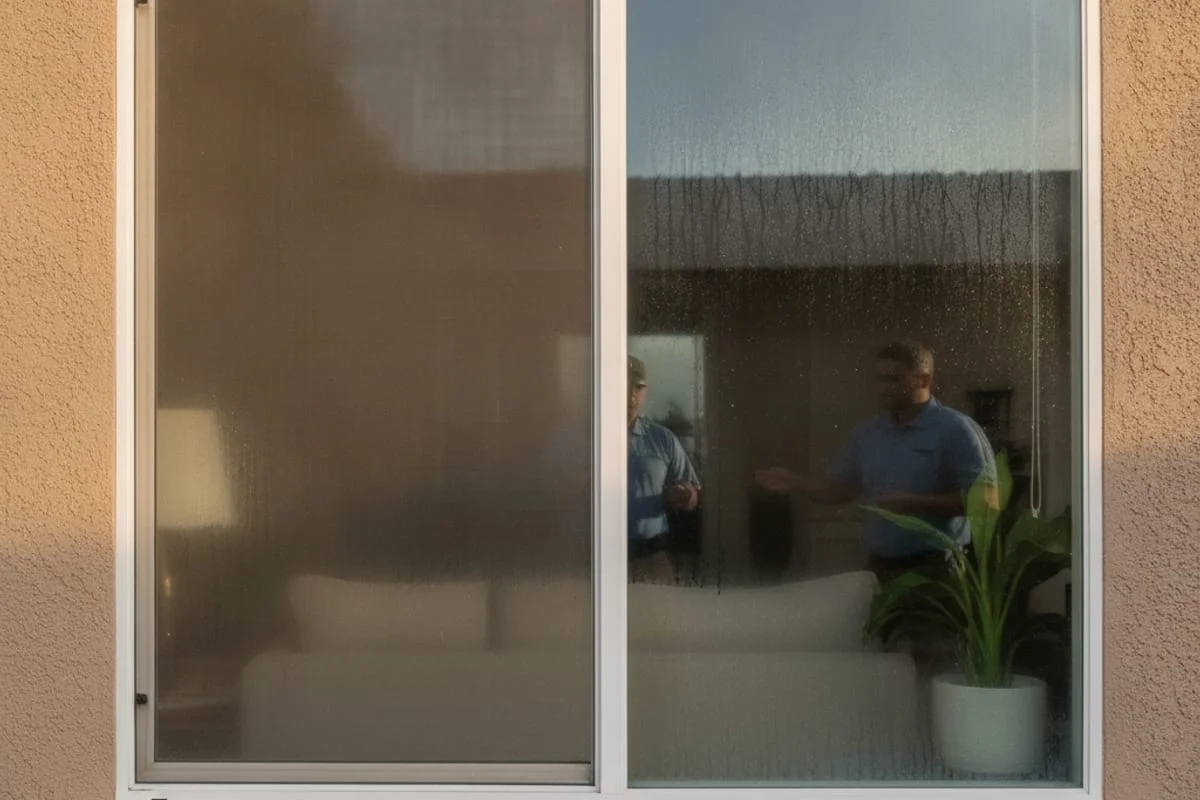
Why stuck sliding windows are so common in San Diego
A sliding window that suddenly takes two hands and a shoulder to open is one of the most common complaints we hear from San Diego homeowners, and it’s rarely one single cause. Stuck sliding windows in San Diego usually come down to something in the track, the rollers, or the frame itself, and the fix depends on which one it is. This guide walks through the actual causes by category, what you can check yourself, and when the sticking is telling you the window has more going on than a dirty track.
Sliding windows are everywhere in San Diego County, especially in 1960s-1980s tract homes across El Cajon, Santee, Spring Valley, and the East County communities, and in coastal builds from Oceanside down through Imperial Beach. The mechanism is simple: a sash rides on rollers inside a track, held in place by the frame. Simple mechanisms fail in a small number of predictable ways, which is good news, because it means most sticking sliders are diagnosable without opening up the wall.
Track debris is the most common and the easiest fix
Dirt, sand, dead insects, paint overspray, and general grit build up in the bottom track over months and years, and that debris is often the entire problem. San Diego’s dry season means dust accumulates for months between rains, and coastal homes add fine sand that blows in on onshore wind.
Check this first: vacuum the track with a narrow attachment, then wipe it down with a damp cloth to pull out the packed-in grit a vacuum misses. If the sash was sticking on debris, it will glide again immediately. This is a five-minute fix and it solves a surprising share of sticking complaints, especially on windows that have gone a year or more without cleaning.
Rollers wear out or come off their track
Every sliding sash rides on small wheeled rollers, usually two per sash, mounted near the bottom corners. These rollers are plastic or nylon on most residential windows, and after enough cycles of opening and closing, especially with grit in the track grinding against them, they wear flat, crack, or seize entirely.
A roller that has seized won’t roll at all, so the sash drags across the track instead of rolling over it. That drag is what feels like the window “fighting” you. You can often tell by lifting the sash slightly while sliding it. If it suddenly moves easier when lifted off the track, the rollers are the problem, not the track or the frame.
Replacement rollers are available for most major manufacturers, including Milgard, Simonton, and Amerimax, and a window professional can usually source and swap them without removing the whole sash from the wall. On older, discontinued window lines, exact-match rollers can be hard to find, and that’s often the point where repair stops being the cheaper option.
Frame expansion and San Diego’s temperature swings
Vinyl and aluminum frames expand and contract with temperature, and inland San Diego sees real daily swings between cool mornings and hot afternoons in El Cajon, Santee, and the valleys east of I-15. That expansion can pinch the track just enough to bind the rollers, especially on south- and west-facing exposures that take direct afternoon sun on the frame itself.
This shows up as a window that’s harder to open in the afternoon than in the morning, or one that sticks in summer but slides fine in winter. If that pattern matches what you’re seeing, the frame material and its fit in the rough opening, not the hardware, is the actual cause, and no amount of roller replacement or track cleaning will fully solve it. Older aluminum frames without a thermal break move the most and are the most likely to show this pattern.
Salt air and corrosion on coastal hardware
Along the coast, from La Jolla and Pacific Beach down through Coronado and Imperial Beach, salt-laden marine air attacks the metal parts of a sliding window faster than it attacks anything else on the house. Steel screws, roller axles, and older aluminum tracks corrode and pit, and that corrosion creates friction exactly where the sash needs to move freely.
A window that slides fine when new but gets progressively stickier over a couple of years in a coastal zone is a strong sign of hardware corrosion rather than debris. Cleaning helps temporarily, but corroded rollers and pitted tracks keep getting worse, not better. This is one of the reasons coastal replacement windows lean toward vinyl or fiberglass frames with stainless or coated hardware instead of bare aluminum and steel.
Foundation settling and a frame that’s no longer square
Homes settle, especially older homes on the clay and expansive soils common through parts of inland San Diego County. When a house settles unevenly, the window opening it sits in can go slightly out of square, even by a fraction of an inch. A frame that’s out of square binds a sliding sash along one side even though the hardware itself is fine.
The tell here is a sash that sticks consistently at the same point in its travel, every time, regardless of season or how clean the track is, especially if you also notice diagonal cracks in nearby drywall or a door in the same wall that has started sticking too. This is a structural sign, not a hardware sign, and cleaning or replacing rollers won’t fix it. A window professional can confirm whether the frame itself needs to be reset or whether the window needs replacing into a corrected opening.
When to fix it yourself and when to call a pro
Track cleaning is a legitimate DIY job for anyone with a vacuum and ten minutes. Roller replacement is doable for a comfortable DIYer on newer, common window lines where parts are easy to source, but it requires removing the sash correctly without cracking the frame, and getting the roller height adjustment wrong can make the problem worse instead of better.
Corrosion, frame expansion issues, and anything tied to a settling foundation are jobs for a professional. An insured local window pro can tell within a few minutes of inspection which category your window falls into, and whether a roller swap solves it or the window itself, or the opening it sits in, needs more than a repair. Verify any contractor you hire holds a current license at cslb.ca.gov before work starts.
The bottom line
Most stuck sliding windows in San Diego come down to one of five things: track debris, worn rollers, frame expansion from heat, salt-air corrosion on coastal hardware, or a settling frame. The pattern of when and how the window sticks usually points to the cause before anyone opens the track. If a five-minute track cleaning doesn’t solve it, the next step is an inspection from someone who can tell a simple roller fix from a window that’s past the point where repair makes sense.
For more on deciding between a repair and a full replacement across all window problems, not just sliders, see window repair vs replacement. If you’re dealing with a slider specifically, our window repair service and patio and sliding door service both cover diagnosis and hardware fixes. It shows up in both inland heat and coastal salt air, so it’s worth checking whether you’re in an inland spot like Bonsall or a coastal one like Encinitas, since the likely cause differs by climate.
Call (858) 400-6418 to connect with a local window professional across San Diego County.
Frequently asked questions
Why is my sliding window suddenly so hard to open?
The most common cause is debris packed into the bottom track, sand, dirt, or grit that builds up over months and creates drag against the rollers. Vacuum and wipe the track first; if that doesn’t fix it, the rollers themselves may be worn or the frame may be binding from heat expansion.
Can I fix a stuck sliding window myself?
Cleaning the track is a straightforward DIY job. Replacing worn rollers is doable if you’re comfortable removing the sash carefully and the replacement parts are available for your window’s make. Anything involving corrosion, a frame that’s out of square, or an older, discontinued window line is usually better handled by a professional.
Why do sliding windows near the coast stick more than inland ones?
Salt-laden marine air corrodes steel screws, roller axles, and aluminum tracks faster than dry inland air does. That corrosion creates friction at exactly the points where the sash needs to slide freely, and it tends to get progressively worse over time rather than staying constant.
Is a sticking sliding window a sign I need a full replacement?
Not always. Track debris and worn rollers are usually repairable. A window that sticks at the same spot every time regardless of season, especially alongside cracked drywall or a sticking door nearby, points to a settling frame, which is a stronger signal that replacement into a corrected opening is the better long-term fix.
How much does it cost to fix a stuck sliding window?
Track cleaning costs nothing beyond your own time. Roller replacement is a parts-and-labor repair, not a full window job, and the exact cost depends on the window brand and how accessible the sash is. A local window professional can give you a real number after a quick inspection.
Do all sliding windows eventually need their rollers replaced?
Most do, especially windows that get regular use. Rollers are a wear item, similar to hinges on a door, and years of daily opening and closing is a normal path toward needing attention, sooner in coastal zones or homes with heavy track debris.