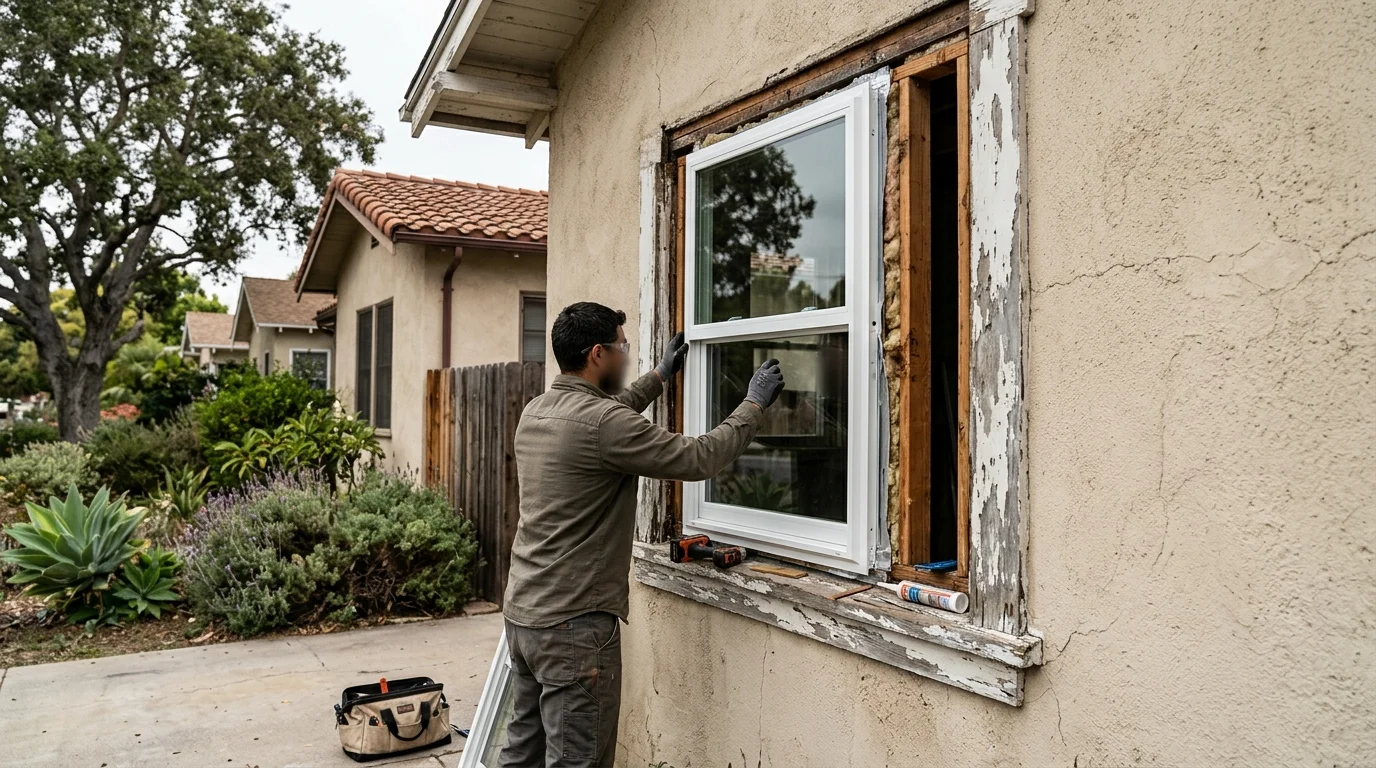
A stain after rain is water at the opening. Fog between the panes is a failed seal. A sill that crumbles under a screwdriver is decayed material. Those three problems can sit on the same San Diego window, and they are three different jobs. Window Pro SD is a referral service. We match you with a licensed local window contractor. We do not cut sills, pull units, or hold an EPA firm certification.
A soft sill is not fog in the glass and not a lock problem
Press a screwdriver into the painted wood at the outside nose of the sill and at the inside stool, the flat board you rest a mug on. Sound wood pushes back. Decayed wood gives, then crumbles or comes up in stringy pieces. That is the named symptom people search. It is not a lock that will not throw, and it is not haze inside an insulated pane.
A water stain on the apron, the plaster, or the stucco below the stool means water is moving at the opening. The path may be the head, the jambs, or the sill itself. Diagnosis of that path belongs on a window leaking around the frame visit, not a can of caulk over soft wood. Fog between panes means the insulated-glass seal has failed. The glass unit can be bad while the sill is still hard, or the sill can be gone while the glass is still clear. Treat them as separate findings.
Hardware is a third bucket. A sash that will not lock, stick, or stay open is often balances, keepers, or a swollen bottom rail. Soft wood under the keeper is still a sill or sash problem. The pro should say which one it is before anyone talks about a patch.
On a wood window, rot likes the outside sill first, then the bottom corners of the frame, then the bottom rail of the sash. Paint can look intact while the fibers under it are mush. Peeling at the same corner after every marine-layer week is a clue. A musty smell at the stool is a clue. None of that tells you how far the decay runs until someone opens the joint.
Do not mix this page with a whole-unit wood replacement. If the sashes, meeting rails, and jambs are already gone, the job is a wood window replacement, not a sill splice. This page stays on the stool and the exterior sill that have gone soft.
Wood stools in the central city versus wet stucco sills in the South Bay
San Diego County is not one housing stock. The sill fails in different ways in North Park than it does in National City.
North Park, South Park, and Golden Hill still carry a lot of bungalow and cottage wood. Original stools, aprons, and sloped sills sit in plaster openings. Water gets in through cracked paint, a dead glaze line, or a head that no longer sheds. Once it is in the stool, it stays. Interior condensation on older single-pane glass runs to the same board. The paint on top can look fine for a long time. The screwdriver test at the inside front edge is how you find it. Those neighborhoods also sit in the City of San Diego, so if the unit later comes out, City permit rules apply to that address. They do not apply by default in Chula Vista or National City.
National City, Chula Vista, and a lot of central-city stucco use a different detail. A retrofit flange or a stucco return holds water against the exterior sill. The marine layer in the South Bay keeps that pocket wet. The wood or composite nosing never gets a full dry-out. You see bubbling paint at the stucco-to-sill joint, dark staining at the bottom corners, and a sill that feels spongy even when the sash still slides. The water is not coming from a wood stool soaking from the room. It is sitting on the outside, against the flange.
Coastal north county adds salt air on top of that. The failure is still water that cannot leave, not a special salt-rot clock. Inland East County sees less marine layer and more hard sun on south and west sills. Paint fails, then water follows the crack. The repair is still: find the wet path, remove the decayed material, and put back a sill that slopes out.
A city-swap paragraph that only changes the place name would miss this. Central-city wood stools trap water inside the finish. South Bay stucco returns hold water on the flange. The pro should say which house you have before quoting a filler stick.
What a pro should open up before quoting a patch
A quote from the sidewalk is a guess. The licensed contractor you are matched with should probe, then open, then talk.
Start at the exterior nose and both bottom corners. Then the inside stool, the stool-to-apron joint, and the bottom of each jamb. Then the bottom rail of the sash. Sound wood in one spot does not clear the rest. If the tip sinks at the corner, the decay often runs back under the sash where you cannot see it with the window closed.
Next is the water path, not the filler. Look at the head flashing, the stucco return, the exterior trim joint, and whether weeps are open. A sill patch over a live leak is a short delay. If water is coming around the frame, that is a frame-leak job first. If the only wet wood is the sill and the rest of the unit is square and solid, a local repair can be on the table.
Then look past the finish into the rough opening when the probe says to. A pack-out that leaves a wet sill plate behind the new wood will rot again. The pro should be willing to pull a small section of stool or brick mold to see the plate, take photos, and show you the line between hard wood and decay. If they will not, they are selling a surface fill.
Do not treat epoxy or a wood hardener as a diagnosis. Those products can consolidate a small, dry, well-defined pocket after the wet wood is gone and the leak is stopped. They do not fix a flange that holds water against stucco in Chula Vista, and they do not save a bungalow stool that has lost its section.
If the work is in the City of San Diego and the unit has to come out, a building permit is required for window replacement. Same-size, same-type replacement can qualify for a No-Plan Building Permit under Development Services Information Bulletin 203, which is a permit without plan review, not a skip. Confirm current IB 203 language with City of San Diego Development Services. Other cities and the unincorporated county are separate jurisdictions. Their permit rules are not confirmed here.
California Business and Professions Code section 7048 requires a contractor license when the aggregate contract price for labor, materials, and all other items is $1,000 or more. Check the license on the CSLB license lookup. Glazing work sits inside the C-17 scope in Cal. Code Regs. tit. 16, sec. 832.17. That does not by itself settle every other classification. Ask the pro which license they will work under.
Pack-out versus pulling the whole unit
A pack-out cuts out the decayed sill or stool and fits new material while the rest of the window stays. It is the right conversation when the rot is local, the frame is square, the sash still works, and the water path will be rebuilt. It is the wrong conversation when the jambs are soft, the unit is racked, several openings are failing together, or the glass seal has already failed.
Pulling the whole unit is a full-frame replacement. The old frame comes out to the rough opening. That is how you see the sill plate, the king studs, and any wet sheathing the screwdriver could not reach. It is also how you stop a retrofit flange from sitting on bad wood. A new insert over a rotten sill leaves the decay in the wall.
Window Pro SD does not publish a pack-out price and does not set contractor prices. There is no verified per-sill dollar figure in our claims ledger, so this page will not invent one. What is published is the per-window range for the unit itself: a retrofit in San Diego is listed at $500 to $950 per window, and a full-frame replacement at $900 to $1,600 per window, from the site’s itemized service ranges. If the sill job turns into a unit replacement, those are the figures to start from. A small local window repair may stay under a full-frame number. A house with many soft stools will not.
Homeowners often ask whether insurance pays for a rotted window sill. Coverage is not a verified claim on this site. Ask your carrier in writing. Name the opening, say whether the water was a sudden event or a long wet stain, and ask how the policy treats gradual decay. Do not treat a blog answer as a coverage decision.
If the unit comes out in the City of San Diego, remember IB 203: same size and type, on a legally permitted structure that passed final inspection, for the No-Plan path. If the clear opening height changes, 2022 CRC R310 still caps the bottom of the clear opening at 44 inches above the floor (R310.2.3), with net clear opening of 5.7 square feet, or 5.0 square feet at grade (R310.2.1), and minimums of 24 inches high and 20 inches wide (R310.2.2). Those numbers matter on bedroom openings. They do not decide the pack-out by themselves.
New vertical fenestration has to meet Title 24. The 2025 Building Energy Efficiency Standards took effect January 1, 2026. San Diego County spans Climate Zones 7 and 10, so the prescriptive U-factor is 0.30. California Energy Code section 150.2(b), as read from the 2022 edition, lets a replacement of no more than 75 square feet use U-factor no greater than 0.40 and SHGC no greater than 0.35 in the listed zones. Confirm the current edition with the building department. Product claims for a specific unit still belong to the NFRC label, not this page.
Lead paint and historic review can sit on the same opening
A lot of San Diego sills sit in houses built before 1978. Census ACS figures already on this site put 49.6 percent of San Diego housing before 1978. Scraping, sanding, or cutting that paint is not a casual DIY weekend.
EPA’s Lead Renovation, Repair, and Painting Rule treats window replacement as a renovation. The minor-repair exemption (6 square feet interior / 20 square feet exterior) does not include window replacement, even if the window itself is smaller than 6 square feet (40 CFR 745.83). Replacing a pane of glass or fixing a broken balancer is not “window replacement” for RRP. It is still covered unless it meets minor repair and maintenance, with no more than 6 square feet of painted surface per room and no prohibited practices. Replacing mil-finish aluminum in a pre-1978 home is not subject to RRP if the work does not disturb a painted surface. Work on newer windows inside a pre-1978 house still needs a determination that the affected components are below 1.0 mg/cm2 or 0.5 percent lead by weight, with records kept.
Window Pro SD does not hold EPA firm certification and does not perform the work. Confirm the contractor’s current firm certification on epa.gov before anyone cuts a pre-1978 stool. Details that belong with the lead job, including how a firm documents the test, sit on lead paint and window replacement.
Historic review can land on the same opening in the City of San Diego. IB 203 requires historical review for a parcel with a designated historical resource or inside an adopted historic district. A building 45 years or older requires plans submitted for historic review unless the scope is exempt. A Golden Hill bungalow stool is often in that age band. A patch that changes the sill profile, or a unit swap that changes the type, is the kind of scope the City will want on paper. Other cities set their own historic rules. Those rules are not confirmed in this ledger.
Lead work and historic review are not reasons to leave a crumbling sill in place. They are reasons the first visit should be a licensed pro who will open the joint, name the water path, and tell you whether a pack-out is still honest.
When to call us
Call when the screwdriver sinks, when the stool is staining after rain, or when a patch quote never mentions the flange, the plate, or the water path. A licensed window contractor should decide repair versus full-frame on the opening in front of them, not from a photo of peeled paint. Call us at (858) 400-6418 and we’ll connect you with a licensed local window contractor.