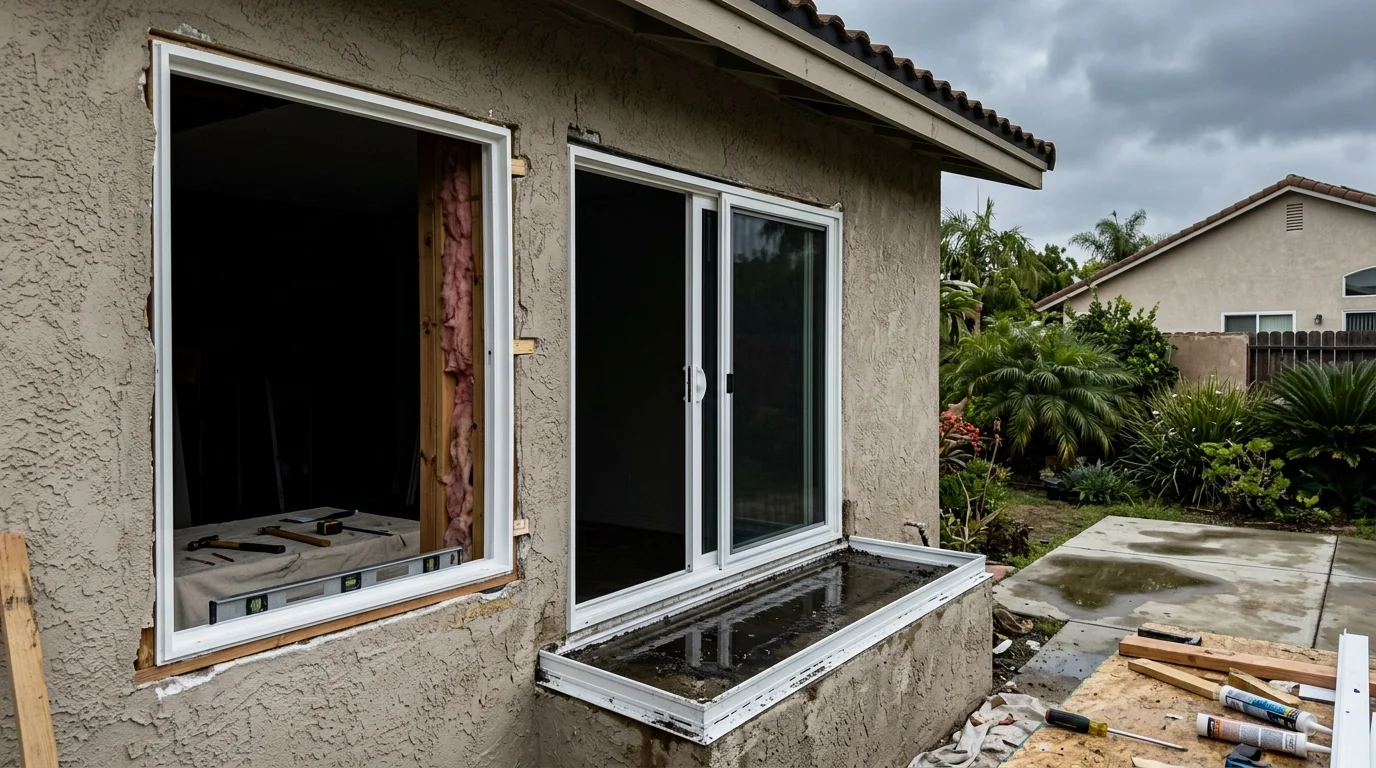
Rain stops over a Chula Vista slider and a puddle is still sitting in the exterior track. Water in the track is a drainage problem. A stain in the wall after rain is a perimeter leak around the frame. Fog between the panes is a failed insulated-glass seal. Those three look similar from the living room. They are not the same repair.
Water sitting in the track is a drainage problem first
A window is built to get wet on the outside. Rain hits the sash, sheets down the glass, and collects in the bottom of the exterior frame. That trough is supposed to empty. Weep holes are the exit. They are small slots or round openings at the bottom of the exterior frame, aimed outside, so water leaves the unit instead of climbing the interior stop.
When those paths clog, the track fills. You see a line of water after a South Bay shower. You see grit floating in it. You may see the screen sitting in a puddle. That is still a drainage symptom until the water leaves the frame and marks the wall, the sill plate, or the drywall paper.
Keep the locations straight. Water sitting in the track, then draining out the face of the frame once you clear the slots, stayed inside the window. Water that darkens stucco below the trim, bubbles interior paint, or wets the stool after the track is empty left the opening. That second pattern belongs on the perimeter-leak page, not here. Fog or a milky film between two panes is a sealed-unit failure. Clearing a weep will not dry that air space.
Sliders show this first because they have a long, open track. Older aluminum sliders along Imperial Beach, Ocean Beach, and Oceanside hold water in a shallow channel that salts over. Vinyl retrofits in Chula Vista and National City do the same when stucco dust packs the slots. A casement or awning weeps too, but the pool is smaller and easier to miss until the sash swells or the operator rusts.
A little water in the exterior track during a storm is normal if it leaves. Water that is still there an hour after the sky clears is not doing its job. That is the test. Not a stain on the glass. Not a draft. Standing water in the track.
How weep paths work on vinyl and aluminum sliders
On a vinyl slider, the bottom exterior frame is a hollow extrusion with a trough under the outside sash. Weep slots are cut through the face of that trough, usually two per opening, sometimes with a small flap or baffle so wind-driven rain does not blow straight back in. Water that sheds off the glass lands in the trough, runs to those slots, and drips onto the exterior sill or the stucco weep screed below.
Aluminum sliders from the county’s mid-century stock use a simpler channel. The weep is often a punched rectangle or a pair of round holes at each end of the sill. There is less plastic baffle and more bare metal. Sand and salt sit in that channel and cake. Once the cake bridges the hole, the channel becomes a trough with no outlet.
Look from outside, at the bottom of the frame, not from the room. Weeps face the weather. Interior holes in a vinyl frame can be assembly ports or weep inlets from the track into the hollow. Poking those from the room side without a path to the exterior just moves grit around. If you cannot see an exterior slot, do not assume the window is missing a drain. Some picture units and some wood double-hungs drain over a sloped sill instead of through a punched hole. A licensed glazing contractor can tell you whether that unit was designed with an internal path. Do not drill new holes in a frame to invent one. That cuts the extrusion, can hit a steel or vinyl reinforcement, and can send water into the wall.
Weeps also need a downhill exit. A retrofit insert set too tight to a flat stucco return, or an exterior sill that was built dead level, can leave the water with nowhere to fall. The slot can be open and the track can still hold a film of water. That is an installation geometry problem, not a toothpick problem.
Never fill a weep with caulk or paint. A perimeter bead belongs at the joint between the frame and the wall. The drainage slots are supposed to stay open. Closing them traps the next storm in the frame.
Coastal grit, stucco dust, and why weeps clog here
San Diego County does not clog weeps the way a wet inland metro does. The mix here is mineral, not leaf litter.
From Imperial Beach through Coronado, Point Loma, Ocean Beach, La Jolla, Encinitas, Carlsbad, and Oceanside, onshore wind throws sand and salt at aluminum sliders all year. The salt dries into a crust on the track. The sand acts like grit in a drain. After a Santa Ana, that crust is harder. After a night of dense marine layer, it wets, then sets again. Coastal aluminum is where you feel the sash drag before you notice the puddle.
Inland a few miles, the load changes. Chula Vista, National City, and San Ysidro are stucco country. So are City Heights, Logan Heights, and Barrio Logan, where a lot of central-city retrofits sit in old aluminum openings with new vinyl inserts. Cutting a retrofit flange, grinding a stucco return, or patching a crack dumps lime dust into the exterior track. That dust hydrates, packs the weep like grout, and stays. A homeowner who just had the house re-stuccoed and then finds a full track is looking at construction dust, not a mystery leak.
East County is drier, but it is not clean. El Cajon and Santee throw fine dust and pollen into the same slots. The water volume is lower than on the coast, so the clog shows up as a sticky track more than a puddle. A sliding window that is hard to open after a windy week is often rolling on that packed trough.
Insects and paint are the other two local packs. Spiders web the baffles on unused weeps. A paint crew covering old aluminum will hit the punched holes unless someone tapes them. Both look like a “leak” the first time a February storm sits on the house.
This is why a page written for another metro fails here. Maple seeds and mulch are not the story. Stucco dust on South Bay retrofits and salt on coastal aluminum are.
What you can clear before a pro visits
Window Pro SD matches you with licensed local pros. It does not clear tracks. You can still do a careful pass before anyone visits, as long as the glass, sash, and frame are intact.
Work from a stable stance at ground-floor windows. Leave second-story weeps for a pro with the right access. Pull the screen. Let the track dry enough that you can see the slots. From the exterior, find the openings at the bottom of the frame.
Lift loose grit with a dry brush or a small vacuum at the track. Do not drive debris deeper. A wooden toothpick or a small nylon brush can pick at the mouth of the slot. Skip metal picks on vinyl, and skip anything that gouges the finish on aluminum. Do not use a pressure washer. It forces water and grit into the hollow and can push moisture toward the rough opening.
If the slot looks open, pour a small cup of water into the exterior track and watch the face of the frame. Water should leave through the weeps, not sit, and not appear on the interior stool. If it still sits, the path is blocked deeper in the hollow, collapsed, or pitched the wrong way. Stop. That is window repair territory, not a longer session with a toothpick.
Mineral film left after water evaporates is a stain on the track, not a wall leak. Wipe it once the metal or vinyl is dry. Interior water stains, swollen casing, or a musty smell at the stool mean water already left the frame. Clear weeps will not reverse that. Do not caulk the interior in a hurry to “seal the leak.” You may trap the next load against the wood.
If the sash is cracked, the glass is loose, the vinyl is split at a corner weld, or the aluminum is white with corrosion and moving, skip the homeowner pass. Photograph the track from a safe spot and wait for a licensed glazing contractor. Cal. Code Regs. tit. 16, sec. 832.17 puts window and glazing work inside the C-17 scope. Confirm any pro’s license on the CSLB license check before work starts.
When standing water means the frame or the pan is done
Clear weeps and a still-full track mean the water has no working exit, or the frame itself is holding it. Vinyl that has spread at a corner, a bowed sill, or a track that is no longer a channel will pond even with open slots. Aluminum that has pitted through at the weep can drain into the wall instead of over the exterior face. At that point you are not maintaining a drain. You are looking at a failed unit.
Water that returns on the interior after the weeps run freely has left the window assembly. That can be a failed perimeter seal, a missed head flashing, or a sill pan that was never there or has rusted out. This site does not carry a verified sill-pan or flashing specification. The building department at the address sets that detail. Ask this exact question: for a replacement at this address, what sill-pan or head-flashing detail do you require, and does same-size, same-type work still need that detail on the permit.
In the City of San Diego, a building permit is required for window replacement. Same-size, same-type replacement can use a No-Plan Building Permit under Development Services Information Bulletin 203 when the opening does not change. A parcel with a designated historic resource, a home inside an adopted historic district, or a building 45 years or older needs historic review unless the scope is exempt. Other incorporated cities and the unincorporated county each run their own counter. Do not treat a City of San Diego rule as a county-wide rule.
If the existing frame is still square and the problem is a packed insert or a worn sash, a retrofit insert can replace the operating unit inside that frame. If the sill is rotten, the aluminum is open to the wall, or the opening itself is the leak path, the matched pro is talking full-frame work, not a cleaned weep. Either way, California requires a contractor license when the aggregate contract price is $1,000 or more (Business and Professions Code section 7048). The customer contracts with that licensed pro directly.
Standing water that has already marked the wall is not a wait-and-see track issue. Treat it as a wet opening until a licensed contractor says otherwise.
When to call us
Call when the track still holds water after a careful clear, when the sash is grinding on packed grit, or when moisture has moved into the wall or the stool. Window Pro SD is a referral service. We match you with licensed, independent local window replacement professionals. Call us at (858) 400-6418 and we’ll connect you with a licensed local window contractor.