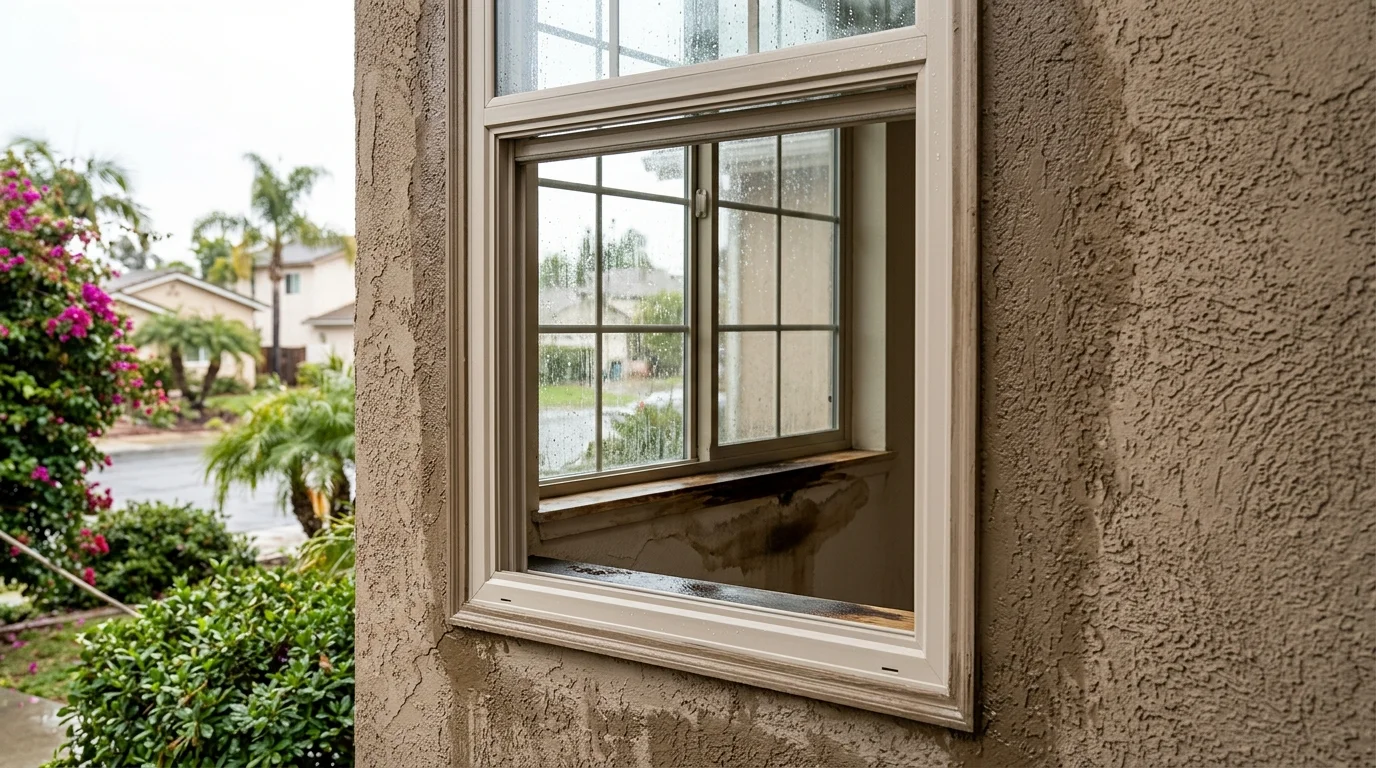
Water on the interior sill after rain is coming around the window, not through the glass. Window leaking around the frame on a San Diego stucco house means the perimeter, the wall, or the way the unit was set is letting water in. That is not fog trapped between the panes, and it is not automatically another tube of sealant. A recessed opening in Chula Vista, National City, or central San Diego fails in a different way than a wood-trim cottage in Encinitas. Name the path first: recaulk, flashing, or a window that has to come out.
Water on the sill after rain is not fog in the glass
Wipe both faces of the glass before anyone talks about caulk. If a cloud stays in the middle, that moisture is locked in the insulated-glass unit. It is a glass failure. It does not wait for a storm. It does not drip onto the stool in a line from the head. Rainwater that shows up on the interior stool, the apron, or the drywall return is a different job.
Watch where the water starts. Beads on the room-side glass that wipe off are indoor humidity hitting cool glass, common on May gray mornings along the coast. Standing water in an exterior track that drains through the weeps is the frame doing its job. Water on the interior stool with a dry track, a stain under the opening, or a drip that shows only when rain is on the wall, points at the perimeter.
Do not fill the small slots in the sill or track. Those are weep holes. They are supposed to dump incidental water back outside. Paint, stucco debris, or a “seal every gap” recaulk that covers them will back water into the frame and onto the stool. A wet interior after rain can be a blocked weep, not a failed window. A licensed pro should confirm which openings are weeps before anyone puts sealant near them.
Photograph the next storm instead of guessing from a dried stain. Note the wall, the wind, whether water shows at the head, the jambs, or only the sill, and whether nearby openings stay dry. Those notes separate a single bad joint from a wall that is wetting from above. Window repair starts with that distinction. Product choice for a bead is a later question, covered in window caulking and sealant.
Stucco cracks, missing pans, and failed retrofit flanges
A stucco-recess opening in Chula Vista, National City, or central San Diego often has almost no projecting trim. The window sits in a plaster return. The visible joint is a thin line between frame and stucco. A hairline there can be the leak. It can also be a surface crack while water is entering at a missing sill pan or a retrofit flange that was never tied into the paper behind the plaster.
A sill pan is the tray under the window that catches water which gets past the exterior and sends it back out. Many older sets and many retrofit inserts never got one. Water then sits on the rough sill, stains the interior stool, and softens the framing. Recaulking the face of that opening does not create a pan. The stain comes back on the next storm that sits on the wall.
Retrofit inserts are a frequent San Diego leak path for a different reason. The old frame stays. The new unit slides inside it. There is no new nail fin woven into the weather-resistive barrier. The exterior seal is a bead against the old frame or the stucco face. When that bead splits, water runs behind the insert, into the host frame, and into the wall. The plaster can look intact. The window unit can still lock. The leak is the installation, not a crack you can point at from the sidewalk.
Paper and flashing behind stucco are supposed to shed like roof shingles: upper layers over lower layers, so water moves down and out. If the barrier was tucked behind the bottom flange instead of lapped over it, the wall itself becomes a funnel. You cannot see that from the living room. A surface bead over a reverse lap traps water in the cavity.
Encinitas wood-trim cottages are not that assembly. They have casing, a head drip, and joints at the miters. The leak is often an open wood joint, a failed drip cap, or paint that has let the casing wick. The diagnosis is still perimeter versus glass versus the wall, but the pieces you photograph are boards, not a stucco return. How those surrounds get scoped on a quote is exterior window trim, not a stucco-recess recaulk.
Coastal wind-driven rain vs East County sun-baked sealant
San Diego County is not one climate, and the same joint does not fail the same way. From Imperial Beach through Point Loma, Ocean Beach, La Jolla, and Encinitas, rain arrives with wind. Water hits the head and the jambs, not just the sill. A bead that looks closed on a calm day can let wind-driven rain ride the frame into the opening. Salt air also wears coastal frames, fasteners, and the exposed joint. It does not, by itself, prove the window unit is the leak.
East County is the other stress. El Cajon, Santee, Lakeside, Ramona, and Alpine bake west and south walls. The frame and the stucco move at different rates. Sealant cooks, hardens, and splits. Then a winter storm finally hits, and the brittle joint is the hole. You may get fewer rain days inland. The days you get are enough when the perimeter has been sitting open since August.
That split is why a one-word “recaulk” quote is weak. A Point Loma opening may need the head and jambs diagnosed for wind-driven entry, plus weeps that salt and sand clog. An El Cajon opening may need the failed joint cut out because the old material has no movement left. Neither case is a published year-count for how long a bead lasts. We could not confirm a lifespan, and a single figure would not fit both walls. The manufacturer data sheet sets product limits. This page is the path, not the tube.
Coastal cottages with wood trim still take wind-driven rain at the head. Inland stucco tracts still take UV at the perimeter. Compare the wet opening with a sheltered one on the same house. If only the west wall leaks after a hot stretch and a storm, sun-baked sealant is a live suspect. If every windward opening leaks and the beads look intact, look past the caulk line.
What a pro should open up before quoting a recaulk
A recaulk quote from the driveway is a guess. The licensed pro should say what they will look at before they sell a bead, and they should put the finding in writing. Window Pro SD does not do that inspection. The matched local contractor does.
They should identify the weeps and leave them open. They should wipe the glass so IGU fog is not billed as a perimeter leak. They should look at the interior stool, the paint, and the drywall under the opening for brown tracks, soft gypsum, or a musty smell at the apron. Exterior, they should map both edges of the joint: frame-to-sealant and sealant-to-stucco, plus the head, the lower corners, and any crack in the return.
They should say whether the unit is an original nailed-fin window or a retrofit insert sitting in a host frame. That one fact changes whether a new bead can even reach the weather barrier. They should say whether they can see a sill pan, or whether the opening was set without one. If the stucco is hollow, stained, or soft at the sill, they should say how far they will open the finish to look, and who patches it. A window contractor and a plastering contractor are not the same person unless the quote names both scopes.
Do not treat a garden hose as a guaranteed isolation test. Stucco is porous. Spraying the wall can soak the plaster, start a new stain, and still not name the path. Some licensed pros use a controlled water test, working from the sill upward. That is their method on the job, not a weekend checklist. Your job is the rain log: photos, which opening, which storm, wind direction, and whether water shows at the head or only the stool.
Ask for a written diagnosis that picks one of three jobs: recaulk the accessible joint, open the exterior and repair flashing, or pull the window. If the answer is only “we’ll caulk it,” the opening has not been diagnosed. Confirm the person at the door on the CSLB license lookup. In California, this kind of window and glass work sits inside the C-17 Glazing Contractor classification. Cal. Code Regs. tit. 16, sec. 832.17 covers selecting, cutting, assembling, and installing glass and glass work, and installing those items in a structure. That does not make C-17 the only possible class. California Business and Professions Code section 7048 requires a valid contractor license when the aggregate contract for labor, materials, and all other items is $1,000 or more.
When the window has to come out to stop the leak
Keep the unit only if the unit is still a window. Soft wood at the sill, crumbled vinyl welds, a host frame that is already rusted or rotten under a retrofit, stain lines in the drywall, or a musty smell at the stool means water has been in the opening. A perfect new bead on a failed frame still leaks. A missing pan cannot be installed from the living room.
This is the line that stucco-only advice blurs, and that window-only recaulk advice blurs from the other side. If the glass is clear, the sashes still lock, and the leak is in the paper and flashing, the window may stay while the wall is opened and re-lapped. If the retrofit never had a pan, the host frame is wet, or the unit itself is out of square, the honest repair is to take the window out and rebuild the opening. That is retrofit versus full-frame installation, not another insert caulked to wet stucco.
Full-frame is how a new flange, a pan, and a shingle-lapped barrier get into an opening that never had them. Retrofit is the cheaper path only when the existing frame and the hidden water details are still sound. This site publishes vinyl retrofit at about $650-$1,200 installed per window, dual-pane insert work at $400-$900, and full-frame at $900-$1,600. Use those bands, then the written quote. We do not publish a recaulk price. That figure is not in the verified set, and a bead is not the same job as opening a wall.
In the City of San Diego, replacing the window itself is permitted work. Development Services Information Bulletin 203 says a building permit is required for window replacement. Same-size, same-type replacement of doors and windows, with no change to the existing opening size, can use a No-Plan Building Permit. That is a permit issued without plan review, not a pass from permitting. Only structures that were legally permitted, built, and passed final inspection may use that path. Historical review is required for a designated historic resource or an adopted historic district, and a building 45 years or older requires plans submitted for historic review unless the scope is exempt. That 45-year trigger is City of San Diego Information Bulletin 203. A large share of housing inside the City hits it. Encinitas is a separate city with its own building department. Confirm the City of San Diego path with Development Services. Confirm Encinitas with Encinitas building. We could not confirm permit fees or turnaround times, and the other incorporated cities plus the unincorporated county each set their own rules.
If the new windows are a fenestration replacement, California energy code applies. The 2025 Building Energy Efficiency Standards took effect January 1, 2026. San Diego County sits in Climate Zones 7 and 10, so the prescriptive maximum U-factor is 0.30. The mandatory maximum U-factor is 0.40 in every climate zone. California Energy Code section 150.2(b), as read from the 2022 edition, lets you replace no more than 75 square feet of vertical fenestration at U-factor no greater than 0.40, with SHGC no greater than 0.35 in the listed zones that include this county. Larger jobs meet the prescriptive numbers. Confirm the current edition with the building department, because the 2025 verbatim exception text was not the copy we could reach. The California Energy Commission publishes the standards.
Window replacement is not minor repair under EPA’s Lead Renovation, Repair, and Painting Rule. On a pre-1978 house, that work is a renovation. The minor-repair exemption does not include window replacement, even if the window is smaller than 6 square feet (40 CFR 745.83). Mil-finish aluminum with no painted surface disturbed is not RRP. Newer windows in a pre-1978 house still need a lead-free determination on the affected components. Bedroom openings still have to meet California Residential Code R310 if they are the emergency escape opening: 5.7 square feet of net clear opening in general, 5.0 square feet at grade-floor or below-grade openings, at least 24 inches high and 20 inches wide, with the bottom of the clear opening no more than 44 inches above the floor (2022 CRC R310.2.1 through R310.2.3). Keep the operation the same unless a licensed pro and the building department are in that conversation.
When to call us
Water on the sill after rain is a leak path, not a glass-cleaning problem. If the opening is wet, the stucco return is cracked, a wood surround is open, or a prior bead did not hold, you need a licensed window pro to say whether this is sealant, flashing, or a window that has to come out. Call us at (858) 400-6418 and we’ll connect you with a licensed local window contractor.