Lead paint window replacement in a San Diego house built before 1978 is a paint-disturbance job, not just a glass order. EPA’s Lead Renovation, Repair, and Painting Rule treats window replacement as a renovation. The minor-repair exemption does not cover it, even when the window itself is smaller than 6 square feet (40 CFR 745.83). Window Pro SD is a referral service. We do not hold an EPA firm certification. The matched licensed local pro does the work, and that firm is the one that has to be certified.
Why pre-1978 glass is a paint problem, not just a window problem
The lite is the easy part. The regulated part is the paint on the stool, the stops, the sash, and sometimes the exterior trim.
Federal lead-based paint rules use 1978 as the line because that is when the United States banned consumer lead paint. A Clairemont, Linda Vista, North Park, La Mesa, or El Cajon house from the 1950s, 1960s, or 1970s can still have that paint on the wood around the opening, even if someone swapped the glass in the 1990s. New vinyl in an old opening does not make the old paint go away.
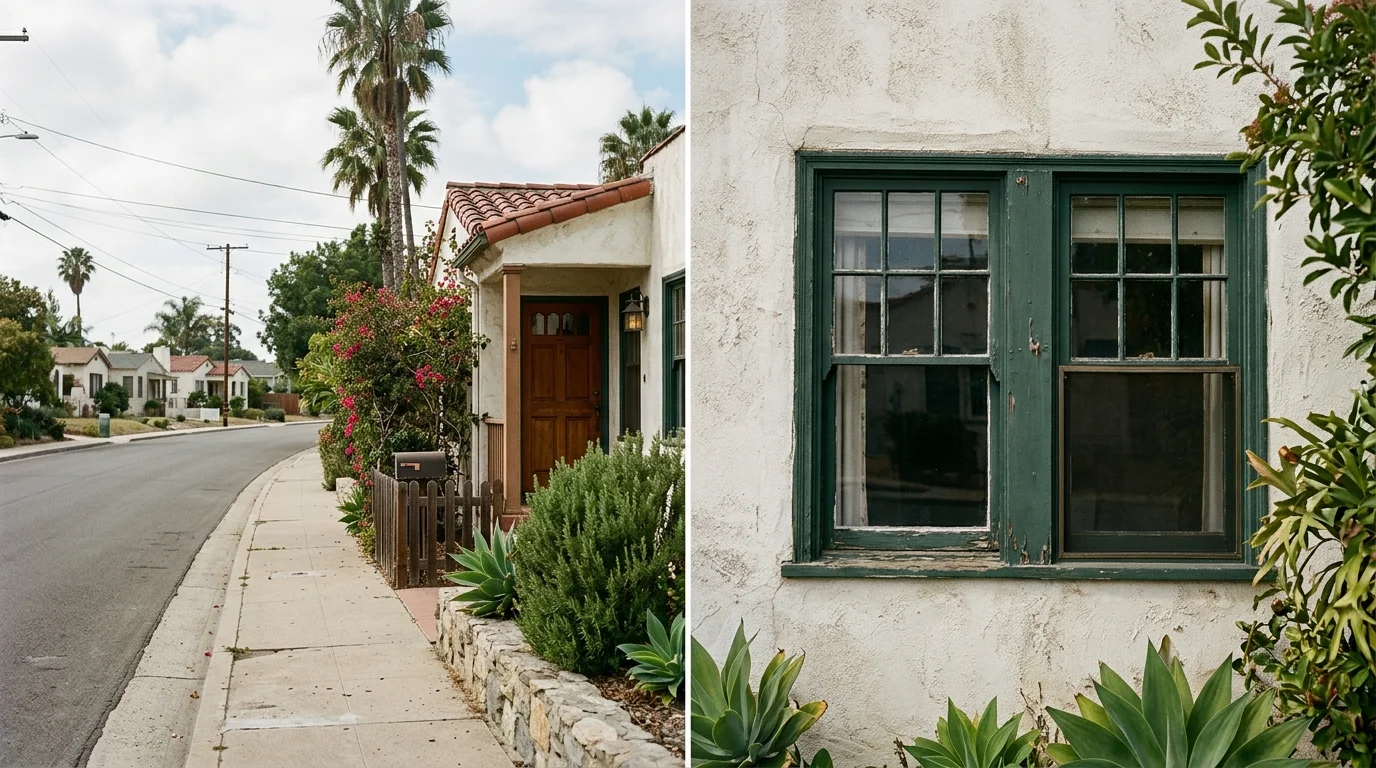
San Diego’s typical pre-1978 window is not a wood double-hung from the East Coast. It is often a mil-finish aluminum slider in a stucco wall, with painted wood on the interior. The aluminum itself may be bare. The stool you rest a plant on is usually painted. The interior stops that hold the frame are usually painted. Scoring those surfaces to pull the unit is how dust gets into the room.
A glass-only swap can still disturb painted glazing compound or painted stops. A retrofit insert still works against those interior surfaces. Full-frame replacement goes further: the whole unit comes out to the rough opening, and more painted wood comes with it. None of those methods is “just glass” once a painted surface is cut, sanded, or broken.
If the house year is fuzzy, treat 1978 as the federal question and get the year from the property record, not from a listing that calls the house “updated.” A remodeled kitchen does not date the window openings.
The federal renovation rule and who has to follow it
EPA writes the rule. The current program page is on epa.gov. The Lead Renovation, Repair, and Painting Rule, often called RRP, covers renovation work in pre-1978 housing when that work disturbs painted surfaces.
Window replacement is a renovation under that rule. EPA’s own reading of 40 CFR 745.83 is blunt: the minor-repair exemption (6 square feet interior / 20 square feet exterior) does not include window replacement, even if the window is smaller than 6 square feet. A small bathroom slider still counts as window replacement.
Three distinctions matter on a real San Diego house, and they come from EPA’s own FAQs.
Replacing a pane of glass, or fixing a broken window balancer, is not “window replacement” for RRP. That work is still covered unless it stays inside minor repair and maintenance: no more than 6 square feet of painted surface per room, and no prohibited practices. A whole-unit swap is not that path.
Replacing mil-finish aluminum windows in a pre-1978 home is not subject to RRP if the work does not disturb a painted surface (EPA FAQ 23002-31781). That is the exception people quote for 1960s San Diego sliders. It only holds if nobody scores painted interior wood, painted exterior trim, or any other painted component. Bare aluminum plus painted stools is not a no-paint job.
Newer windows in a pre-1978 house still need a lead-free determination. RRP still applies to work on windows installed in the last 20 years inside a pre-1978 unit unless a certified inspector or risk assessor, or a certified renovator using an EPA-recognized test kit or paint-chip sample, determines the affected components are below 1.0 mg/cm2 or 0.5% lead by weight. Keep those records. A 2004 vinyl insert in a 1968 College Area house does not skip the rule on a handshake.
Who has to follow it: the firm doing the renovation. Window Pro SD matches homeowners with licensed independent window professionals. We are not the contractor. We do not hold an EPA firm certification. The matched pro does. Ask that firm to put its EPA certification and the name of the certified renovator on the written scope before anyone scores paint.
License is a separate check. In California, this kind of glass and frame work sits inside the C-17 Glazing Contractor classification. Cal. Code Regs. tit. 16, sec. 832.17 covers selecting, cutting, assembling, and installing glass and glass work, and installing those items in a structure. Confirm the business on the CSLB license lookup. California Business and Professions Code section 7048 requires a valid contractor license when the aggregate contract for labor, materials, and all other items is $1,000 or more. CSLB does not replace EPA. EPA does not replace CSLB.
We do not publish fine amounts, certification fees, or clearance-test prices. EPA sets the federal program. If a quote uses a dollar figure for any of those, ask where it came from.
What a contained job looks like on a San Diego stucco house
You should be able to see the setup before anyone cuts paint. If the crew scores the stool with the hallway open and a shop vac from the hardware store, that is not a contained job.
On a typical San Diego stucco house the dust starts inside, not in the stucco. The interior stool, apron, and stops are painted wood. The exterior is often a stucco return with little or no painted brickmold. Full-frame work still means cutting that return and pulling the frame. Retrofit work still means working against the painted interior. Either way, the room on the inside of that opening is where paint chips land.
A contained job looks like a sealed work area around that opening. Floor and furniture in the room are covered. The path to the door is controlled so painted debris does not ride out on boots and drop cloths. Cut pieces of stool and stop leave in bags, not in an open tub carried through the kitchen. The certified renovator should be able to walk you through that setup on this house, not recite a brochure.
Do not take a list of plastic widths or vacuum types from this page. EPA publishes the lead-safe work practices. Read them on epa.gov, and ask the renovator which of those practices they will use on your openings. If they cannot name the method before they score, stop.
Stucco adds a local mess that is easy to confuse with the paint problem. Cutting a stucco return makes grit. That grit is not the same as lead dust, and it is not a substitute for containing the painted wood. A crew that tapes the stucco and leaves the interior stool raw has contained the wrong side of the wall.
Coast and inland do not change the federal rule. A Point Loma mil-finish slider and an El Cajon painted wood sash sit under the same EPA program if painted surfaces are disturbed. The house year and the surfaces they cut are the inputs, not the ZIP code.
Historic review can stack on top of lead-safe work in the City of San Diego
Lead-safe work is federal. Historic review is a City of San Diego permit question. They can both apply to the same opening, and settling one does not settle the other.
Inside the City, a building permit is required for window replacement. Same-size, same-type work can use a No-Plan Building Permit under Information Bulletin 203, which is still a permit. Historic review is a separate trigger on designated resources, adopted historic districts, and buildings 45 years or older unless the scope is exempt. The 45-year path, and what to ask Development Services, is on our historic home window replacement guide. The broader City permit path is on our San Diego window permit guide.
Do not copy Information Bulletin 203 onto the County, Chula Vista, or any other jurisdiction. Those agencies write their own rules. Lead-safe work still follows EPA wherever the house sits in San Diego County, because that part is federal.
A City historic reviewer is not an EPA renovator. An EPA test kit is not a historic approval. If the building is in the City and older than 45 years, ask both questions in writing: who contains the paint, and who confirms the historic-review path for this parcel.
Questions to put in writing before anyone scores the paint
Get the answers on the quote, not in the driveway after the first cut.
- Is your firm EPA-certified under the Lead Renovation, Repair, and Painting Rule, and will a certified renovator be on this job?
- How will you determine whether the affected components are below 1.0 mg/cm2 or 0.5% lead by weight, and who keeps that record?
- If these are mil-finish aluminum units, will any painted surface be disturbed, including interior stops and stools?
- Is this a pane or balancer repair, or a window replacement? Window replacement is not minor repair.
- How will you contain this room on this stucco house before you score the paint?
- Who pulls the permit, and have you checked whether City historic review applies to this address?
- What is the CSLB license number, and does the scope sit inside C-17 glazing work?
Window Pro SD does not hold the EPA firm certification. The matched pro does. Put that firm’s name, certification, and containment plan on the paper you sign. Confirm the license on the CSLB lookup. Confirm the current federal program on epa.gov.
When to call us
If the house predates 1978 and someone is about to score paint around a window, you need a licensed window professional who can speak to EPA’s renovation rule on that opening. Window Pro SD can match you with an independent local pro. We do not perform the work, we do not hold an EPA firm certification, and we do not issue permit decisions. Call us at (858) 400-6418 and we’ll connect you with a licensed local window contractor.