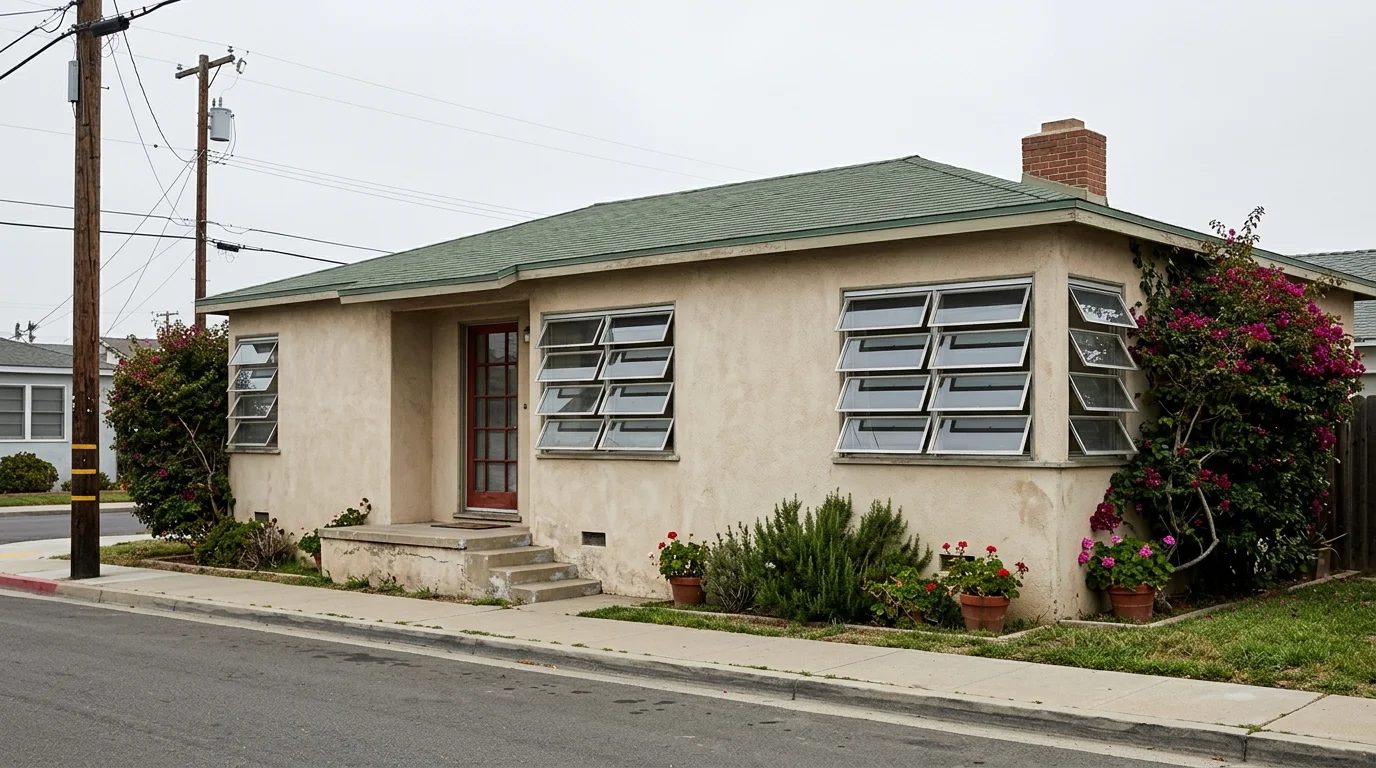
Jalousie window replacement in San Diego is almost always a new frame. Those stacked glass slats sit in a metal rack that is the window, not a pane you pop out. Pull the rack, flash the opening, and set a sealed unit. That is the job on 1940s-to-1960s cottages in Pacific Beach and Ocean Beach, and on some South Bay in-law conversions that still run the original louvers.
What a jalousie is, and why mid-century San Diego used them
A jalousie, also sold as a louvered window, is a stack of glass slats in an aluminum rack. A crank or lever tilts the slats like blinds. Closed, they overlap. Open, they scoop air through the whole opening. There is no sash compressing against weatherstripping. There is no sealed cavity between two lites. The rack, the clips, and the slats are the entire window.
That design made sense here before air conditioning was common. A 1940s or 1950s beach cottage wanted cross-breeze, not a tight envelope. Pacific Beach and Ocean Beach stock from that era used jalousies in kitchens, baths, and sleeping porches because they moved a lot of marine air on a small wall. Some South Bay in-law conversions kept the same hardware: a cheap, wide opening that could dump heat from a rear unit without a ducted system.
You still see them on low, horizontal openings in Kensington, Normal Heights, and older East County ranches. The window styles guide for San Diego homes maps how those elevations usually read. This page stays on the louver itself. A jalousie is not a slider with extra glass. It is a rack of movable single lites.
Salt air is hard on the operator. Coastal clips seize. Pivot pins corrode. A slat that will not close is not a glass problem. It is a rack problem. Inland, the same hardware bakes on a west wall in El Cajon or Santee, then sits cold at night. The metal expands and relaxes. The slats rattle. None of that is unique to one ZIP code. It is what a mid-century louver does after decades in this county.
Window Pro SD does not install these units. We match you with a licensed local glazing pro. The contract is with that pro, not with this site.
Air, security, and the energy hole they leave
Even a freshly cranked-shut jalousie leaks. Each slat is a separate lite with a gap at the edge. Marine-layer mornings in Ocean Beach push damp air through those gaps. Afternoon wind in Pacific Beach does the same from the other direction. You feel it at the stool. You smell it when the house is closed. Screens sit on the room side, so they do not stop that air. They only keep bugs off the slats.
Security is the same geometry. A louver rack is a set of small, removable pieces. A determined person can work a slat out of a tired clip. A modern sash locks as one panel. A jalousie does not. That is not a scare line. It is why in-law bedrooms and alley-facing baths in National City or Imperial Beach often keep a stick in the operator, which is not a lock.
The energy hole is physical, not a slogan. An original jalousie is not an insulated glass unit. There is no dry cavity, no low-E coating in a sealed space, and no rated whole-window U-factor on a 1958 rack. Aluminum conducts. Each slat is a single lite. When you replace the opening, the new window has to meet current California energy rules. It cannot be another unrated louver stack sold as a “repair.”
The 2025 Building Energy Efficiency Standards took effect January 1, 2026. San Diego County sits in Climate Zones 7 and 10. The prescriptive maximum fenestration U-factor is 0.30. The mandatory maximum is 0.40 in every climate zone. California Energy Code section 150.2(b), as read from the 2022 edition, lets you replace no more than 75 square feet of vertical fenestration at U-factor no greater than 0.40, with SHGC no greater than 0.35 in the listed zones that include this county. Confirm the current edition with the building department. This page does not invent a prescriptive SHGC by zone. The Title 24 window guide is the code walk-through. The point here is simpler: the old louvers are the hole you are closing.
Replacement usually means a new frame, not a glass swap
You cannot drop a dual-pane unit into a louver rack. The rack is the operating hardware. The slats are the glass. There is no rectangular sash with glazing stops waiting for a new insulated unit. Ordering “just the glass” leaves the leaks, the clips, and the crank in the wall.
That is why jalousie work is full-frame replacement in almost every opening. The pro removes the rack down to the rough opening, checks the sill and the weather barrier, flashes the hole, and sets a new window with a nailing fin or equivalent. Stucco around the opening gets cut and patched. Interior stool and casing come off and go back. Retrofit versus full-frame installation is the method comparison. Retrofit needs a sound existing frame to pocket into. A jalousie does not give you that frame.
A licensed C-17 glazing contractor is the trade that selects, cuts, assembles, and installs glass and glass work, and installs those items in a structure (Cal. Code Regs. tit. 16, sec. 832.17). California Business and Professions Code section 7048 requires a valid contractor license when the aggregate contract for labor, materials, and all other items is $1,000 or more. Confirm the person at the door on the CSLB license lookup. Window Pro SD does not hold that license and does not pull the permit.
Inside the City of San Diego, replacing the window is permitted work. Development Services Information Bulletin 203 says a building permit is required. Same-size, same-type replacement of doors and windows, with no change to the existing opening size, can use a No-Plan Building Permit. That is a permit issued without plan review, not a pass from permitting. A style change from jalousie to a slider or casement may or may not count as same-type. Ask Development Services that question on the address before anyone orders units. Only structures that were legally permitted, built, and passed final inspection may use the No-Plan path.
Historical review is required for a designated historic resource or an adopted historic district. A building 45 years or older requires plans submitted for historic review unless the scope is exempt. A 1940s or 1950s Pacific Beach cottage is well past that age. Confirm current process with City of San Diego Development Services. We could not confirm permit fees or turnaround times. Other incorporated cities and the unincorporated county each set their own rules. Do not take a City of San Diego answer and apply it to a Chula Vista in-law.
Window replacement is not minor repair under the federal renovation rule. Mil-finish aluminum with no painted surface disturbed is outside that paint rule. Newer windows going into a pre-1978 house still need a lead-free determination on the painted parts of the opening. Fine amounts are not published here. Ask the matched pro how they will handle painted wood stools and casing on a 1950s cottage.
Safety glass and egress when the opening sits in a risky spot
Many surviving jalousies sit in the rooms that code watches. Baths. Kitchens beside a door. In-law sleeping rooms off an alley. The California Building Code flags certain spots near doors, tubs, and walking surfaces as hazardous locations for glazing. This page does not publish those inch measurements. The approved record does not confirm the current California distances. Have the contractor and the building department confirm each opening before glass is ordered.
The new lite does not inherit a pass from the old slats. A stack of small pieces is not the same product as one large pane in a modern sash. If the opening is next to a door, over a tub, or along a walking surface, ask this: does the current adopted California code require safety glazing at this opening, and what test will the inspector use? Put the answer on the window schedule.
Sleeping rooms add emergency escape. 2022 California Residential Code section R310 requires a net clear opening of 5.7 square feet in general, and 5.0 square feet at grade-floor or below-grade openings (R310.2.1). Minimum net clear height is 24 inches and minimum net clear width is 20 inches (R310.2.2). The bottom of the clear opening can sit no more than 44 inches above the floor (R310.2.3). An in-law bedroom in a South Bay conversion has to meet that if it is a sleeping room. Changing from louvers to a slider cuts the open area in half, because one panel stays closed. A casement can open the full sash. Measure the net clear on the proposed operator, not on the old cranked-open slats.
Wildfire-hardening scopes are a separate rule. California Building Code 2022, Chapter 7A, section 708A.2 requires exterior windows, skylights, and glazed door assemblies to be multi-pane with at least one tempered pane meeting the safety-glazing section, or an assembly tested to SFM Standard 12-7A-2. Both paths count. The tempered-pane route alone is not the whole code.
Do not DIY a louver rack out of a stucco wall. The opening, the flashing, and the glass type have to land together.
Styles that keep a vintage elevation without the drafts
The original jalousie was a wide, short opening that read as a horizontal band in a low cottage wall. Keep that proportion. Do not drop a tall double-hung into a slot that was drawn for louvers unless the elevation can take it. The window styles guide is the catalog. The matching problem here is narrower.
A horizontal slider keeps the band. So does a picture window with a short awning over or under it, if you still want a slice of ventilation. A casement in that same wide hole can look busy if the sash is too tall, but a pair of casements can recover the scoop of air the louvers were for, with a real lock and a real weatherseal. Grids are optional. Use them only if the cottage already has divided lites elsewhere. Do not add farmhouse bars to a 1954 Pacific Beach stucco box because a showroom board had them.
Same size helps the permit path. Same type is the question to ask, not a slogan on the quote. If the elevation review on a 45-year-old City of San Diego cottage cares about the void in the wall, bring photos of the existing louvers and a drawing of the proposed unit. The matched pro should not guess the historic desk’s taste from a vinyl color chip.
Product energy claims are not ours to invent. Look up the proposed unit on the NFRC-rated path the inspector will see, and confirm U-factor against the 0.30 prescriptive number or the 150.2(b) exception if that exception applies. We do not publish energy-bill percentages. We do not publish national “jalousie replacement” price lists. The written quote from the licensed pro is the number that matters.
When to call us
If the slats still crank and the house still breathes through them, you are looking at a full window, not a glass order. Call us at (858) 400-6418 and we’ll connect you with a licensed local window contractor.