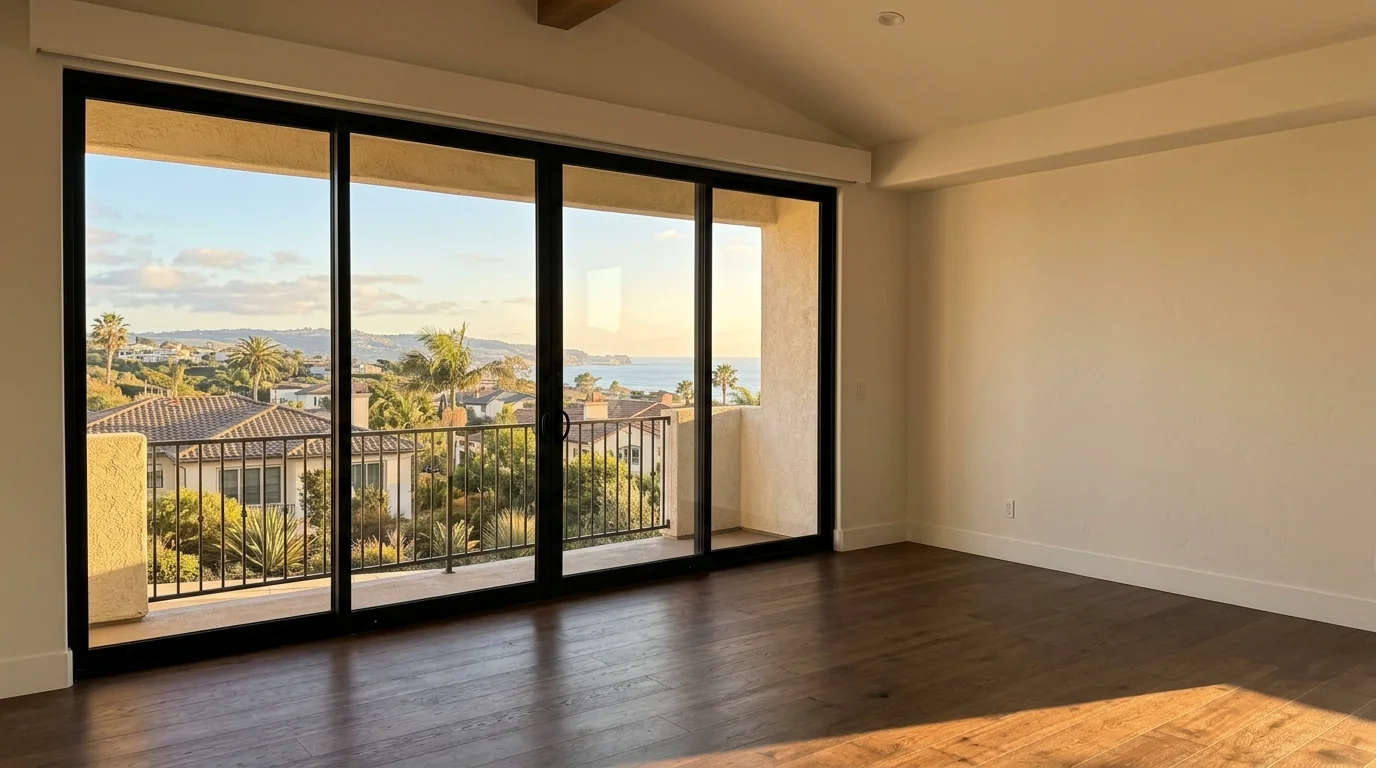
Low-E windows are worth it in San Diego when the coating on the glass actually moves the numbers on the NFRC label for the wall you sit against. The coating is a thin metal layer that reflects heat. It is not a tint, and it is not a gas fill. In this county, that coating is usually the lever to argue about, not a brochure name.
California’s 2025 Building Energy Efficiency Standards took effect January 1, 2026. San Diego County sits in Climate Zones 7 and 10. The prescriptive maximum fenestration U-factor is 0.30 in Climate Zones 6 through 10 and 15, so 0.30 is the prescriptive number here. The mandatory maximum U-factor is 0.40 in every climate zone. California Energy Code section 150.2(b), as read from the 2022 edition, lets you replace no more than 75 square feet of vertical fenestration at U-factor no greater than 0.40, with SHGC no greater than 0.35 in the listed zones that include this county. Confirm the current edition with the building department. That is the legal floor. It is not a shopping list. The Title 24 window guide and the 75-square-foot exception cover the code path. This page is about whether a better coating is worth choosing above that floor.
What the coating does to heat and light, in plain words
Low-E means low emissivity. A coated lite radiates less longwave heat than clear glass. Short version: more of the room’s warmth stays on the room side of the glass at night, and more of the sun’s heat can be turned around before it becomes the sofa’s problem in the afternoon.
Visible light is a different band. The coating is built to let a large share of daylight through while interfering with infrared. That is why a low-E window can still look like a window, not like a pair of sunglasses. A dark tint is not the same product. Tint can cut light without doing the heat job you think you bought. If the room goes gloomy and still cooks, you got the wrong spec.
Where the coating sits in the insulated unit changes the bias. A solar-control placement is aimed at bouncing incoming sun. A winter-biased placement is aimed at holding indoor heat. Manufacturers put those layers on different surfaces of the two lites. You do not need the surface-number lecture. You need the finished ratings for the unit in your opening. Ask which coating family is on the quote, then look at U-factor and SHGC on the label that belongs to that exact unit.
Do not treat “low-E” as a finished specification. Two products can both say low-E and behave differently on a west wall in Mission Valley versus a north wall in Point Loma. The coating is a tool. The label is the measurement.
Window Pro SD does not sell glass packages. We match you with a licensed local window contractor. The homeowner contracts with that pro.
Climate Zone 7 on the coast vs Zone 10 inland
San Diego County is not one climate. Climate Zone 7 is the coast: Imperial Beach, Ocean Beach, La Jolla, Encinitas, Carlsbad, Oceanside. Marine layer sits on the glass for hours. Summers are milder. The discomfort is often glare, damp air, and a west room that still heats once the cloud burns off. Climate Zone 10 is inland: El Cajon, Santee, Lakeside, Ramona, Alpine, Escondido. Afternoons run hotter. Nights drop more. The glass on a west or south wall is a heat source, not just a view.
The U-factor floor is the same in both zones. Prescriptive work in this county is still 0.30. Mandatory is still 0.40. Zone 7 versus Zone 10 does not give you a different U-factor to shop against. What changes is which rating you should care about first after that floor is met.
On the coast, a coating that keeps the room from dumping heat on a cool night still matters, but the daily fight is often solar control on the walls that see afternoon sun. Inland, that fight is louder. A west living room in Santee or a home office in Escondido can feel done by 3 p.m. even when the thermostat is behaving. That is a glass and exposure problem. Our guide to reducing west-facing heat gain stays on that wall. This page stays on the coating.
Do not assign your climate zone by whether the breeze “feels coastal.” Confirm the zone for the address with the permitting authority. The California Energy Commission publishes the standards and the zone maps.
Prescriptive SHGC by San Diego zone is not a figure this site has verified from the tables. Competitors will invent a number and call it code. One common invented figure is SHGC 0.23. Do not copy it onto a quote. Ask the building department this: what SHGC does the current Title 24 path require for this address, this fenestration schedule, and this compliance method? Write the answer next to the product label.
Low-E vs argon vs a second pane: which lever matters here
Three different parts get sold as “the efficient window.” They are not interchangeable.
A second pane creates the sealed cavity. That is the jump from an old single lite, or from a jalousie rack, to an insulated glass unit. Without that cavity, there is nowhere honest to put a protected coating or a gas fill.
The low-E coating is on a lite. It changes how that glass handles infrared and, depending on the product, how much solar heat gets through. That is the lever that shows up in both U-factor and SHGC.
Argon is a fill in the cavity. It can help the unit’s U-factor when the rest of the package is already built for it. It is not a coating, and it is not a second pane. We already covered fill science in argon gas windows in San Diego. This page will not restate it. If two quotes differ only by the word argon, compare the labels. If the U-factor does not move, you are buying a name.
In this county, the comparison order is usually: get a sealed dual-pane unit, specify the coating for the exposure, then see whether fill changes the rated assembly enough to care. Coastal Zone 7 houses often feel the coating first, especially on west glass. Inland Zone 10 houses still start there. Nobody should skip the second pane and try to “add low-E” to a single sheet as a magic film and call it a replacement window.
We do not publish savings percentages. We do not publish utility-bill claims. Comfort in the room, and the numbers on the sticker, are what you can check.
How to read the NFRC sticker without the sales script
The National Fenestration Rating Council label is the whole-window test, not a center-of-glass brag. Compare U-factor to U-factor on the same operating style and a similar size. A picture window and a sliding window are different products even if both say low-E.
U-factor is heat transfer through the rated unit. Lower means less transfer. For larger replacement jobs in this county, the prescriptive ceiling is 0.30. The mandatory ceiling is 0.40. A sticker at 0.41 does not get there by talking.
SHGC is the share of solar heat the window admits. Lower means less solar heat through the glass. That number is how you compare two low-E packages on a west wall. It is not a U-factor. Do not let a salesperson trade a pretty U-factor against a worse SHGC and call both “more efficient.” Ask for both values on every configuration.
Visible transmittance, when it is on the label, is how much daylight the unit lets through. You can use it to catch a coating that solves heat by making the room a cave. Air leakage, when shown, is a tested assembly figure. It is not a promise about the installer’s caulk line.
An ENERGY STAR mark is a certification against that program’s rules. It is not proof the unit meets your Title 24 path. We do not publish ENERGY STAR Southern numeric criteria. Check a specific model on the ENERGY STAR residential windows page, then match the NFRC values to the schedule the building department accepted.
Leave the temporary label on through inspection if the department wants to see it. Photograph it before anyone peels it. The brochure is not the sticker.
Title 24 already sets a floor. This is about choosing above it
Replacement fenestration in this county already has to clear a performance floor. That is why “is low-E worth it” is the wrong first question on a permitted job. A unit that meets the 0.30 prescriptive U-factor, or the 150.2(b) exception if that exception applies, is already in efficient-window territory. The real choice is whether a more solar-control coating on the hot walls is worth specifying above the minimum the inspector will accept.
That choice is local. A north bedroom in Encinitas under the marine layer does not need the same SHGC conversation as a west great room in El Cajon. You can mix packages by orientation if the contractor and the schedule allow it. You can also run one spec through the house for simplicity. Neither path is a code trick. Both still have to meet the floor.
The 75-square-foot exception is a small-job path, not a reason to buy a weaker coating on a wall that already overheats. If the exception applies, you may be allowed U-0.40 and SHGC-0.35 under the verified 2022 text. You can still choose a tighter U-factor or a lower SHGC than that. Ask whether this job is using the exception or the prescriptive path, then pick the coating against the rooms, not against the loosest legal number.
The federal 25C window credit ended for property placed in service after December 31, 2025. A 2026 install does not get that credit. Judge the coating on the label and the room.
For product-level options, start at energy-efficient windows. Window Pro SD does not select glass, install units, or warrant coatings. The matched licensed pro does the work under their own contract.
When to call us
If a west room already cooks, or two quotes both say low-E and the stickers do not match, you need a licensed pro to put ratings on a window schedule. Call us at (858) 400-6418 and we’ll connect you with a licensed local window contractor.