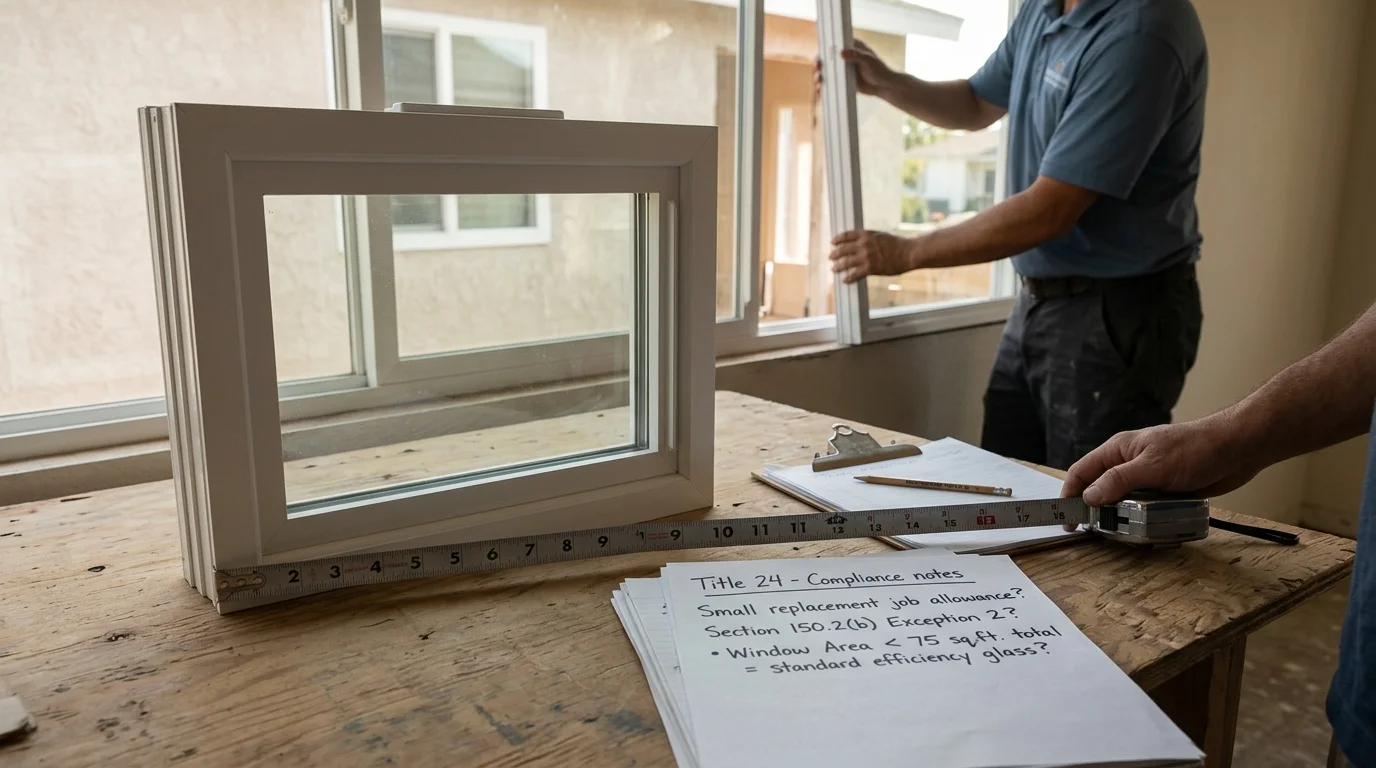
California’s 2022 Energy Code section 150.2(b) allows replacement vertical fenestration totaling no more than 75 square feet to use a maximum U-factor of 0.40. San Diego County spans Climate Zones 7 and 10, where that exception also sets a maximum SHGC of 0.35. The 2025 Standards took effect January 1, 2026, so confirm the exception against the current edition with your building department before choosing a window.
The number most homeowners never hear: 75 square feet
The 75-square-foot figure changes which performance threshold may apply to a small replacement project. It covers the replacement vertical fenestration included in the job, not an automatic allowance for every individual window.
The verified 2022 section 150.2(b) language covers:
“Replacement of vertical fenestration no greater than 75 square feet”
That same exception permits a U-factor no greater than 0.40 across Climate Zones 1 through 16. It also permits an SHGC no greater than 0.35 in Climate Zones 2, 4, and 6 through 15. San Diego County’s two climate zones, 7 and 10, fall within that SHGC group.
This is an exception within the Title 24 window replacement requirements. It isn’t an exemption from the energy code. It also doesn’t establish whether a permit is required for a particular address.
One qualifier matters for projects starting now. The quoted exception was verified in the 2022 edition. California’s 2025 Standards became effective January 1, 2026. The current exception’s verbatim text could not be confirmed from the primary source available for this page.
Give your permitting authority the complete window schedule. Ask: “Does the current section 150.2(b) exception apply to this entire replacement scope, and how will your office calculate the 75 square feet?” That gets a project-specific answer before products are ordered.
What the prescriptive U-factor is in San Diego County
San Diego County spans California Climate Zones 7 and 10. The verified prescriptive maximum fenestration U-factor for Climate Zones 6 through 10 and 15 is 0.30. That makes U-0.30 the prescriptive number for both San Diego County zones.
The statewide mandatory maximum is U-0.40 across all climate zones. Those two figures often appear together, but they serve different purposes. U-0.30 is the prescriptive maximum for this county. U-0.40 is the mandatory ceiling and the value named in the verified small-project exception.
Projects exceeding 75 square feet meet the prescriptive values. A project at or below the threshold may qualify for the section 150.2(b) exception, subject to confirmation under the current code edition.
Don’t apply a climate zone based only on whether a property feels coastal or inland. Confirm the assigned zone for the project address with the permitting authority. The California Energy Commission publishes the state’s Building Energy Efficiency Standards and related resources.
The approved record doesn’t include San Diego’s prescriptive SHGC values. Those figures shouldn’t be guessed or copied from a product advertisement. Ask the building department which current SHGC limit applies to the address and compliance path.
For the broader code framework, read our San Diego Title 24 window guide. This page stays focused on the narrower 75-square-foot threshold.
What the exception allows instead, and where it applies
For qualifying replacement work no greater than 75 square feet, the verified 2022 exception allows U-0.40 in every California climate zone. It allows SHGC-0.35 in Climate Zones 2, 4, and 6 through 15. That includes San Diego County’s Climate Zones 7 and 10.
The exception doesn’t say a U-0.40 window is automatically cheaper than a U-0.30 window. No approved local price comparison supports that conclusion. Product design, installation scope, frame material, and other choices can affect a proposal, so compare the actual documents supplied by each contractor.
It also doesn’t remove local permit requirements. Within the City of San Diego, window replacement requires a building permit. Same-size, same-type replacements can qualify for a No-Plan Building Permit under Information Bulletin 203. No-Plan means the permit is issued without plan review. It doesn’t mean no permit is needed.
That City process is limited to structures that were legally permitted, built, and passed final inspection. Historic review can also apply to a designated historical resource, a property within an adopted historic district, or a building 45 years or older unless the scope is exempt. Our window replacement permit guide explains those verified City rules.
Requirements outside the City of San Diego weren’t confirmed for this page. Homes in other incorporated cities or unincorporated areas follow their own permitting authority. Ask that office whether the current exception applies, which climate zone governs, and what documentation must accompany the permit.
How to measure whether your job is under the threshold
Start with a simple worksheet, but don’t treat it as the building department’s final calculation. The approved record doesn’t confirm whether every local authority uses frame dimensions, rough-opening dimensions, glass area, or another documented measurement.
For a preliminary total:
- Record the width and height of every window in the proposed scope.
- Convert each measurement to feet.
- Multiply width by height for each opening.
- Add every opening’s area together.
For example, a window measured at 3 feet by 4 feet produces a planning area of 12 square feet. Six windows at those dimensions total 72 square feet. Seven total 84 square feet. The first example falls below 75, while the second exceeds it, assuming the permitting authority accepts those dimensions and treats the listed windows as the full scope.
Section 150.2(b) says “no greater than 75 square feet,” so exactly 75 is within the quoted 2022 language. Measurement method still matters near the line. A small difference between glass, frame, and opening dimensions could change the preliminary total.
Don’t assume separate orders or project phases create separate allowances. That treatment wasn’t verified in the approved record. Instead, show the authority the full planned scope and ask this exact question:
“For the current section 150.2(b) exception, which dimensions should I use, and does your office total every replacement window covered by this project?”
Keep the written answer with the window schedule. A licensed contractor can then compare the confirmed scope with products carrying the required ratings.
NFRC labels and proof for inspection
The claim that an NFRC label is the only proof every San Diego inspector accepts could not be confirmed from the approved primary-source record. Local documentation rules may depend on the permitting authority and the project’s compliance path. Don’t rely on an unsupported blanket statement.
What matters is getting the accepted proof identified before ordering. The exception turns on two product values, U-factor and SHGC. Ask the permitting authority which label, product data sheet, compliance form, or other record it accepts for each value.
Use a short checklist with the contractor:
- Which document shows the exact U-factor?
- Which document shows the exact SHGC?
- Must labels remain attached through inspection?
- Should product documents be submitted with the permit?
- Do model numbers on the order need to match the inspection documents?
Keep photographs of labels and copies of product records until the permit is closed. That’s a practical safeguard if packaging or temporary stickers are removed during installation.
Don’t treat an ENERGY STAR logo as automatic proof that a window meets this project’s Title 24 path. The approved ledger doesn’t contain current Southern-zone ENERGY STAR numerical criteria. Verify a specific product through the official ENERGY STAR windows resource, then confirm the required code documents with the permitting authority.
The safest sequence is simple: confirm the code path, confirm accepted evidence, then order the matching product.
When it is worth exceeding the minimum anyway
The exception sets a compliance option. It doesn’t decide which window is right for the home. A qualifying project can still compare products rated at U-0.30 with products rated at U-0.40.
That comparison can make sense when this small job is one phase of a larger replacement plan. It can also help when a homeowner wants consistent specifications across rooms. Coastal North County, inland North County, central San Diego, East County, and the South Bay don’t present one identical comfort decision. The project’s exposure and room use still deserve attention.
Don’t assume the U-0.40 option costs less. The approved evidence contains no verified price difference between U-0.40 and U-0.30 windows. It also contains no percentage or dollar estimate for energy savings. Ask the contractor to separate code compliance from sales claims and provide product-specific documentation for any performance statement.
When comparing energy-efficient window options, request the exact U-factor and SHGC for each proposed model. Then place those ratings beside the confirmed requirements for the address. A window can satisfy the exception without being the homeowner’s preferred choice for the rest of the property.
The threshold is most useful as a planning tool. It tells you that a small replacement scope may have a distinct compliance path. It doesn’t replace product comparison, permit confirmation, or current-edition review.
When to call us
Call when you need a licensed Window Replacement pro to measure the full scope, confirm the applicable climate zone, and match product documents to local requirements. Call us at (858) 400-6418 and we’ll connect you with a licensed local window contractor.