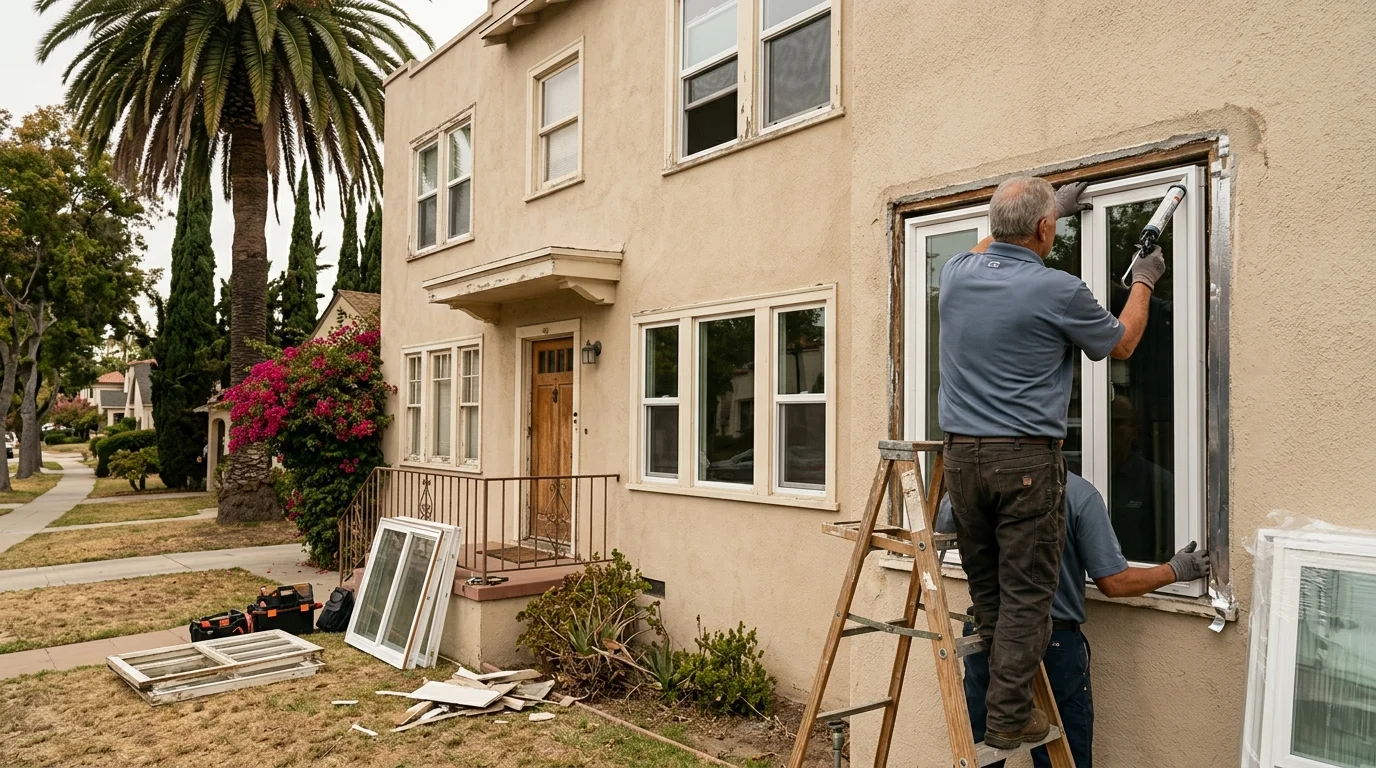
Historic home window replacement in San Diego can involve more than matching an opening. City of San Diego Information Bulletin 203 says a building 45 years or older requires plans submitted for historical review unless the scope is exempt.
A building permit is also required for window replacement in the City. Same-size, same-type work can qualify for a No-Plan Building Permit, but that’s still a permit. The No-Plan label doesn’t erase the separate 45-year historical review trigger.
Why the age of your house changes the permit path
A straightforward window order can become complicated when the building crosses the City’s 45-year threshold. The age question belongs near the start of the project, not after a contractor has measured every opening.
Information Bulletin 203 allows same-size, same-type replacement under the No-Plan Building Permit path. That permit is issued without regular plan review. The opening size can’t change, and the replacement must remain the same type as the existing window.
The same bulletin adds another layer for older buildings. Plans must be submitted for historical review when a building is 45 years or older, unless the proposed scope is exempt. That means “same size” doesn’t answer every permit question on an older property.
No-Plan eligibility also depends on the structure’s history. The bulletin limits that path to structures that were legally permitted, built, and passed final inspection. Don’t assume an existing window proves the surrounding work was approved.
Start by confirming which agency governs the property. These rules apply to the City of San Diego. Window permit rules for the county’s other incorporated cities and its unincorporated areas couldn’t be confirmed from Information Bulletin 203. Ask the authority governing the property for its current requirements.
For the broader City permit process, read our San Diego window permit guide. You can also take the address and proposed scope directly to City of San Diego Development Services. Ask whether the building’s age requires historical review and whether any exemption applies to that exact scope.
What historical review is, and what triggers it in the City of San Diego
For this permit path, historical review is a City review tied to the property and proposed work. Information Bulletin 203 confirms three triggers relevant to replacement windows.
The first is building age. A building that’s 45 years or older requires plans submitted for historical review unless the scope is exempt. The second is a parcel containing a designated historical resource. The third is a property inside an adopted historic district.
These triggers aren’t interchangeable. A building can meet the age threshold without being a designated resource. A newer building could sit on a parcel with a designated resource. District status creates another reason to stop and confirm the review path.
A universal exemption for ordinary replacement windows couldn’t be confirmed from City of San Diego Information Bulletin 203. The bulletin also doesn’t provide one window specification that will pass every historical review. Ask City of San Diego Development Services a focused question:
“Does this proposed same-size, same-type window replacement require historical review, and what documents should be submitted for this parcel?”
Give staff the property address, the building’s recorded age, and a precise description of the proposed windows. Say whether the opening, frame, operating type, exterior appearance, or installation scope would change.
Keep the answer tied to the proposed work. Approval for one scope shouldn’t be treated as approval for a different product or opening change. If the design changes later, confirm whether the earlier response still applies.
Designated resources and adopted historic districts
Information Bulletin 203 identifies designated historical resources and adopted historic districts as separate historical review triggers. Either status matters even before you settle on a replacement product.
Don’t judge status from the home’s appearance. A remodeled exterior doesn’t answer whether the parcel contains a designated resource. A row of older homes also doesn’t prove the property sits inside an adopted district.
Use the parcel address when contacting Development Services. Ask staff to confirm both points separately:
- Does the parcel contain a designated historical resource?
- Is the property inside an adopted historic district?
- Does the proposed window scope require historical review?
- What plans, photographs, or product details should accompany the request?
- Would changing the opening or operating type alter the review path?
These questions are more useful than asking whether “historic windows” need permits. The City’s triggers concern the building, parcel, district, and proposed scope.
This is also where the City boundary matters. The Information Bulletin 203 rule belongs to the City of San Diego. It shouldn’t be presented as a countywide rule. A project elsewhere in San Diego County needs an answer from the authority governing that address.
Save the City’s written guidance with your project records. Give the same scope and guidance to each contractor you consider. That keeps product discussions anchored to one description of the work.
How much of San Diego’s housing this actually covers
Older housing isn’t a narrow issue in San Diego. Census ACS data already published on this site puts 49.6% of San Diego housing before 1978.
That figure shows why the 45-year question comes up so often. It doesn’t tell you how many current projects need historical review. Housing units and buildings aren’t the same count, and the figure doesn’t identify exemptions, designated resources, or district boundaries.
Use it as context, not as a parcel decision. The City makes the relevant determination from the building, property status, and proposed scope. Your address still needs its own answer.
The threshold also moves with time. Don’t rely on an old real estate listing that calls the property “newer” or “mid-century.” Ask which construction date the City uses for review. If records conflict, ask what documentation resolves the difference.
Apartment and condominium owners should be equally careful. The trigger is written around the building’s age, not the date someone bought or remodeled an individual unit. Information Bulletin 203 doesn’t settle who may authorize work within a shared building. Owners should confirm the property’s approval process before ordering.
The practical lesson is simple. Treat age as a permit input whenever you plan window replacement within the City. Confirm it before product selection becomes a purchase.
What it means for the windows you are allowed to choose
The City guidance establishes the review trigger. It doesn’t establish one approved material, frame profile, color, glass package, or operating style for every older San Diego home.
That gap matters. Don’t let a salesperson turn a general preference into a claimed City rule. Ask the reviewer how the proposed product affects this particular parcel and scope.
Bring enough detail for a meaningful answer. Useful material can include clear exterior photographs, close views of the existing frames, opening measurements, the current operating type, and manufacturer product information. Ask the City what it actually wants before assembling a submission.
Keep these decisions separate:
- Whether the property triggers historical review.
- Whether the proposed scope is exempt.
- Whether the project qualifies for a No-Plan Building Permit.
- Whether the chosen window is acceptable for the reviewed scope.
- Whether changing the opening requires a different permit path.
A window style guide can help you compare operating types. It can’t decide what the City will accept for a particular older property.
If the reviewed scope points toward full-frame window replacement, make sure the contractor’s proposal matches the scope discussed with the City. Don’t substitute a different installation approach without checking whether the change affects review.
California’s C-17 glazing scope appears in 16 CCR 832.17 and includes window and glazing work. That doesn’t prove a particular contractor holds an active license or the proper classification for your project. Check the business through the CSLB license lookup and ask the contractor to explain its proposed permit path.
The order to do things in so you do not order glass twice
The safest sequence begins with the property, not the product. This is a practical ordering process, not a quoted City procedure.
First, confirm that City of San Diego Development Services governs the address. If another jurisdiction controls the permit, ask that authority for its current window replacement rules. The City’s 45-year rule shouldn’t be copied onto another jurisdiction.
Second, confirm the building age used by the City. Ask whether the parcel contains a designated historical resource or sits within an adopted historic district.
Third, document the existing windows. Photograph the exterior and interior. Record the opening, frame, and operating type. Note every proposed change. “Like for like” isn’t useful when different people mean different things by it.
Fourth, describe the project to Development Services. Ask whether historical review is required, whether the scope is exempt, and whether a No-Plan Building Permit applies. Remember that No-Plan means a permit without regular plan review. It doesn’t mean no permit.
Fifth, collect the product and installation details requested for review. Don’t assume the City will approve a material or style because it appears on another older home.
Sixth, compare proposals from licensed independent window contractors. Give each one the same City guidance and project scope. Ask who will prepare any required documents and how later product changes will be handled. Window Pro SD makes referrals, but the homeowner contracts and pays the selected professional directly.
Finally, order the windows only after the permit and historical review path is settled for the chosen scope. Custom glass ordered too early can become a costly mismatch if the accepted design differs from the first selection.
When to call us
Call when an older City of San Diego property needs a licensed window professional to review the scope, product details, and permit path. Window Pro SD can match you with an independent local pro, but we don’t perform the work or issue permit decisions.
Call us at (858) 400-6418 and we’ll connect you with a licensed local window contractor.