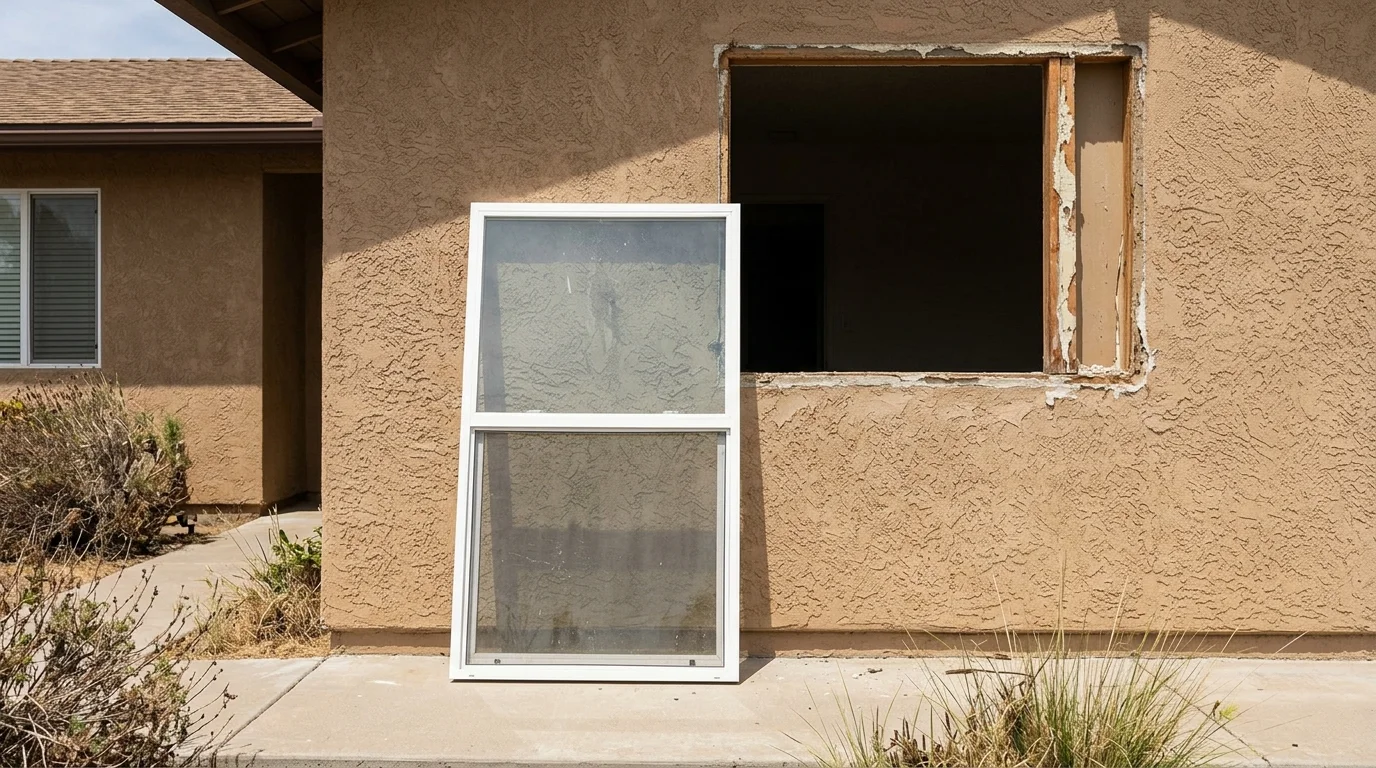
Fog between the panes on an El Cajon ranch, or a cracked lite on a west wall in Santee, is usually a sealed-glass problem, not a whole-window problem. IGU window replacement cost is the price of that sandwich: two lites, a spacer, a seal, cut to the sash you already have. Window Pro SD does not sell glass. We match you with a licensed local window contractor who prices the unit as its own line item.
An IGU is the sealed glass sandwich, not the whole window
An insulated glass unit, the IGU, is two lites of glass held apart by a spacer, dried by desiccant in that spacer, and locked with an edge seal. The cavity between the lites is air or an inert gas. That assembly is one part. The sash, frame, balances, rollers, and trim are another. Searches for insulated glass unit replacement cost and double pane glass replacement cost often land on whole-window averages. Those averages describe a different job.
When a pro writes IGU replacement, they mean this sequence. Pull the failed sealed unit. Measure the rebate. Order a new unit to that opening. Glaze it back into the existing sash. The vinyl, aluminum, or wood around it stays. That is the job this page prices in words, because we do not publish an IGU dollar figure.
A manufactured replacement window arrives with glass already in it. The published ranges on this site for that work live in the service catalog. Retrofit openings run $500 to $950 per window. Full-frame openings run $900 to $1,600 per window. Those are whole windows. Ten to 15 windows at the retrofit range is roughly $5,000 to $14,000. At the full-frame range it is roughly $9,000 to $24,000. None of those numbers is an IGU price. Our window replacement cost in San Diego guide is the place for that whole-unit math. This page is glass only.
A dual-pane upgrade on a single-pane house is also a different scope. That job is a new window, or a new sash system, not a sealed unit dropped into glass stops that already exist. If your opening is already dual pane and only the sandwich failed, you are on this page.
The wear is not the same across the county. In El Cajon, Santee, and Ramona, inland heat by day and cooler nights work the edge seal over and over. Dark stucco and west glass take the worst of it. From Imperial Beach through Coronado and up to Oceanside, salt sits on the edge. A coastal unit can look fine in the middle of the lite and still be failing at the spacer. Same product name. Different climate load.
Glazing work sits inside California’s C-17 classification. Cal. Code Regs. tit. 16, sec. 832.17 says a glazing contractor “selects, cuts, assembles and/or installs all makes and kinds of glass, glass work, mirrored glass, and glass substitute materials for glazing; executes the fabrication and glazing of frames, panels, sashes and doors; and/or installs these items in any structure.” Look up the person who will order your glass on the CSLB license check. California Business and Professions Code section 7048 requires a contractor license when the aggregate contract price for labor, materials, and all other items is $1,000 or more. The small-job exemption does not apply if someone advertises as a contractor or employs others.
Failed seals versus a cracked lite: two different glass jobs
A failed IGU seal looks like fog, haze, or water beads between the panes. The glass itself is often intact. Moisture got past the edge, the desiccant loaded up, and the cavity is no longer a dry insulating space. You cannot wipe that out and put the old unit back in service. The sealed sandwich comes out as one piece. Our foggy double-pane windows page is the diagnosis walk-through. This page is the cost question that follows.
A cracked or broken lite is a different failure. One sheet took impact, thermal stress, or a nick at the edge. The replacement is still a sealed pair. You do not glaze a single new pane onto a surviving lite and call it an IGU. Inland thermal stress on El Cajon and Ramona west walls is a common crack path. Coastal impact, from a patio chair in Imperial Beach or a ladder nick in Oceanside, is another. Either way, the shop is building a new unit.
Do not mix glass with hardware. A sash that will not stay up is often a balance. A slider that sticks is often a roller or a dirty track. Those belong under window repair. Ordering an IGU will not straighten a racked sash or rebuild a rotten sill.
EPA’s Lead Renovation, Repair, and Painting Rule treats whole-window replacement as a renovation. The minor-repair exemption (6 square feet interior, 20 square feet exterior) does not include window replacement, even if the window itself is smaller than 6 square feet. Replacing a pane of glass, or fixing a broken window balancer, is not “window replacement” under that rule. It can still be covered if painted surface is disturbed beyond those minor-repair limits. On a pre-1978 house in City Heights, Logan Heights, Barrio Logan, National City, or San Ysidro, ask the pro in writing whether the IGU swap disturbs paint and whether they will follow RRP. Replacing mil-finish aluminum windows without disturbing a painted surface is a different EPA case. Keep those records.
Tempered versus annealed changes both shop time and the ticket. California Building Code names hazardous locations where safety glazing is required, including areas near doors, tubs, showers, and stairs. We do not publish the inch measurements. The pro has to read the opening. If the lite coming out is tempered, the unit going in usually has to follow that path. Do not shop an annealed unit to win a bid on a bath or a patio door lite.
Obscure glass, internal grids, Low-E coatings, and argon fill are make-up choices on the order, not repairs of what leaked out. Once the seal is open, the old gas is gone. A new cavity is specified from scratch.
What drives the price when a published figure is not available
There is no verified IGU dollar range in our claims ledger, and no verified per-square-foot figure for double-pane glass on this site. National round numbers for “how much a double glazed pane costs” are not El Cajon shop tickets. Treat them as noise. Ask for a written IGU line item.
These are the drivers a local pro will actually price.
Size. The unit is a custom piece. A small hopper in an El Cajon bath is not a picture lite in a Lakeside family room, and it is not one half of a 6-foot slider. Measure the glass width and height the way the pro marks them, usually the rebate, not the outside of the frame. A sixteenth off and the unit will not set.
Glass makeup. Clear annealed is the baseline. Tempered, laminated, obscure, and Low-E each add process steps. Low-E on a west wall in Santee or a dark stucco ranch in Ramona is a solar-control choice. We do not publish Energy Star Southern-zone numeric thresholds. Check a named product on the ENERGY STAR windows page.
Cavity and spacer. Air versus argon. Aluminum spacer versus a warm-edge spacer. Those lines belong on the order form. They are easy to bury in a lump sum if you do not ask.
Shape and grid. A rectangle is shop-standard. An arch, a trapezoid, a garden-window angle, or a matching internal grid is not. HOA streets in East County and coastal tracts from Imperial Beach to Oceanside often need the pattern to match the rest of the elevation.
Access. A first-floor slider that tilts out of an El Cajon ranch is one labor hour. A second-story picture window on a Mount Helix slope, or a stucco return that has to be cut back in Ocean Beach, is another. No one here promises same-day glass. Custom IGUs are built, then delivered, then set.
Count. One unit can carry a shop minimum. Four matching sliders on the same wall can share a template and a delivery. Ask for that split on the quote.
Title 24 still applies when fenestration is replaced. The 2025 Building Energy Efficiency Standards took effect January 1, 2026. San Diego County sits in Climate Zones 7 and 10, so 0.30 is the prescriptive maximum U-factor for this county. The mandatory maximum U-factor is 0.40 in every climate zone. California Energy Code section 150.2(b) lets replacement of vertical fenestration no greater than 75 square feet use a U-factor no greater than 0.40, and a SHGC no greater than 0.35 in Climate Zones 2, 4, and 6-15. The verbatim exception text was read from the 2022 edition. Confirm the current edition with the building department. The California Energy Commission publishes the standards. A glass-only swap is still new glass in that opening. Ask which U-factor they are ordering, and whether the job is under or over 75 square feet.
The federal 25C window credit ended for property placed in service after December 31, 2025. An IGU installed in 2026 does not qualify. Do not shop glass around a credit that is closed.
If a quote is only a lump sum, have them split the glass, the glaze labor, and any frame work. That is how you compare two bids without a fake average.
When the frame is sound enough to keep
Glass-only is the cheaper path only if the frame can still hold the unit. Walk the opening before anyone orders glass.
Look at the sash corners. Vinyl that has chalked is one thing. Vinyl cracked at the weld is another. Aluminum with white corrosion in the sill track will not drain. Wood fails at the bottom rail first, both on older East County stock and on coastal cottages from Imperial Beach to Oceanside. If the rebate that seats the IGU is rotten or bent, a new sealed unit will leak around the edge on week one.
Check operation. A racked sash puts the new glass in a parallelogram. The seal is under stress before the first heat wave. That shows up on west walls in El Cajon, where afternoon sun expands dark frames, and on salt-weakened weeps along the coast.
Check the stops and setting blocks. An IGU is heavier than old single pane. If the last unit was a thin dual pane and you want a thicker Low-E package, the rebate depth has to fit. That number belongs on the order sheet, not in someone’s head.
When the frame is done, stop treating it as an IGU job. Use the glass-only versus full window decision, then price a retrofit or full-frame unit. Same-size, same-type window replacement in the City of San Diego requires a building permit. City of San Diego Development Services Information Bulletin 203 says same-size, same-type replacement qualifies for a No-Plan Building Permit. That is a permit issued without plan review, not a skip. Only structures that were legally permitted, built, and passed final inspection may use it. Historical review is required for a designated historical resource, a parcel inside an adopted historic district, and a building 45 years or older unless the scope is exempt. El Cajon, Santee, and Ramona are their own jurisdictions. Their desks set their own rules. Ask the named city whether a same-size IGU in the existing sash needs a permit. Do not borrow the City of San Diego answer. City of San Diego Development Services is at sandiego.gov/development-services.
A sound frame, a matching IGU, and a clean glaze can keep original trim on a ranch that still looks right from the street. That is the reason to price glass before you price a whole window.
What to put in writing before anyone orders glass
A custom IGU is cut to the sixteenth. Once it is built, it is yours. Do not start that order on a verbal “about this much.”
Get these items on paper.
Overall glass width and height, and which dimension is width. Sightline if the sash has a pattern you need to keep.
Make-up: lite thickness, tempered or annealed on each lite, Low-E yes or no and on which surface, cavity width, air or argon, spacer type.
Grid pattern, if any, and whether grids sit inside the airspace or on the room side.
Obscure pattern name on a bath or door lite. “Frosted” is not a shop spec.
Quantity, rooms, and which floor.
Labor: remove, dispose, set, reseal. A separate call-out for second-story or tight access.
Whether painted surfaces will be disturbed on a pre-1978 house, and the RRP plan if they will.
U-factor of the unit they will order, and whether they are using the 150.2(b) 75-square-foot path or the prescriptive 0.30.
Permit responsibility in your city. In the City of San Diego, name Information Bulletin 203. In El Cajon, name the Building Division and ask the direct question: does a same-size IGU in the existing sash need a permit.
Who warranties the sealed unit, and for how long. That warranty is the glass fabricator’s and the installing contractor’s. Window Pro SD is a referral service. We do not glaze, we do not stock IGUs, and we do not back a seal.
Payment tied to the unit arriving the right size. A deposit against a shop order is normal. Paying the glass line before measurements are verified is not.
If two quotes disagree on tempered glass, stop. Have both walk the opening. The cheaper annealed unit is not a savings if the opening needs safety glazing.
A home-center dual-pane panel is a catalog rectangle. Most San Diego sashes are not that size. A made-to-measure IGU, ordered by the window contractor from a glass shop, is the usual path. That is the real answer behind whether a big-box aisle sells insulated glass units. A standard panel may sit on a rack. Your El Cajon slider almost certainly does not match it.
When to call us
Call when the fog is between the panes, a lite is cracked, or you want a written IGU line item instead of a whole-window pitch. Call us at (858) 400-6418 and we’ll connect you with a licensed local window contractor.