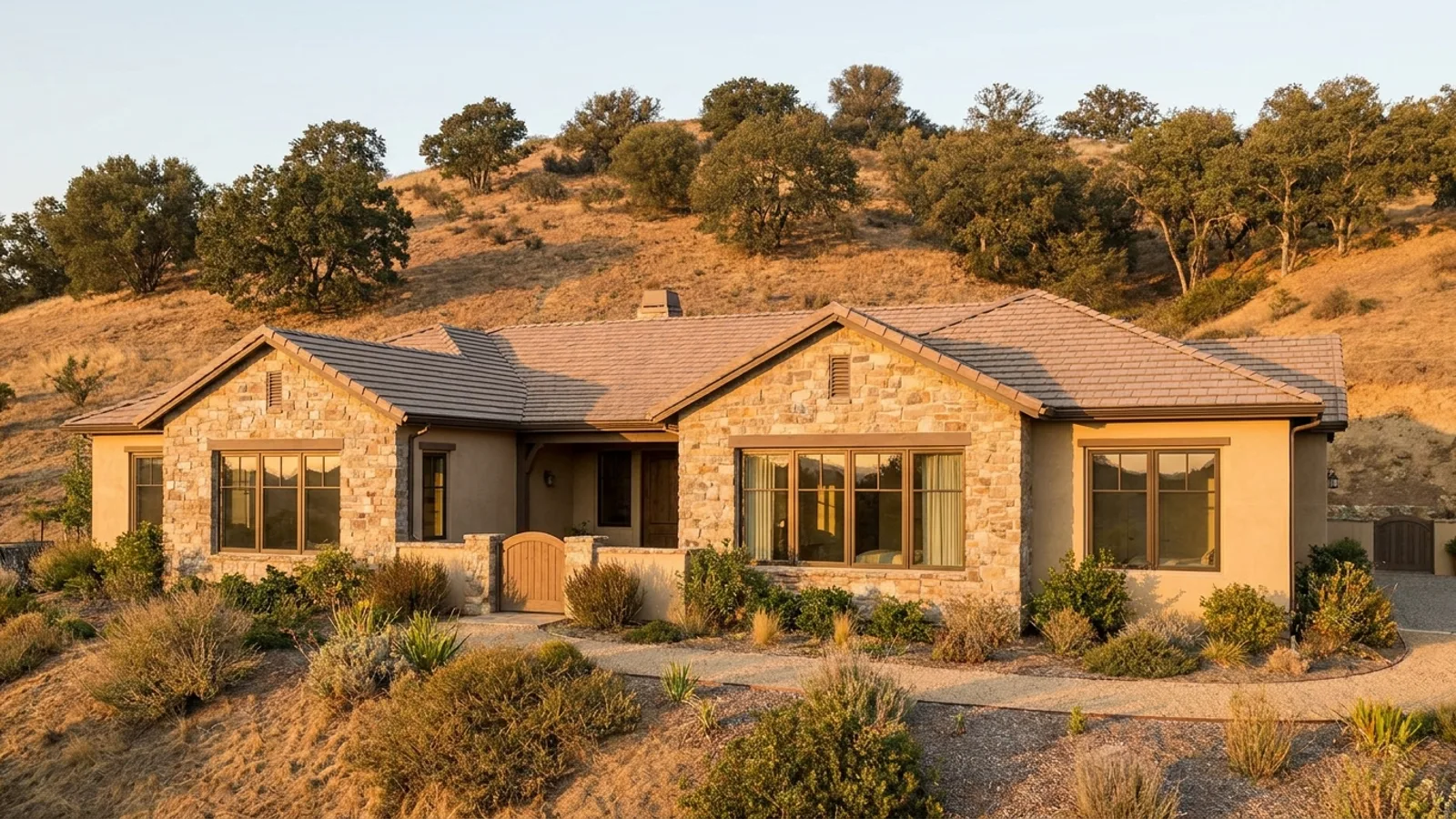
California requires insurers to discount premiums for documented wildfire mitigation, and multi-pane windows are one of 12 measures that qualify under state Regulation 2644.9, the Safer from Wildfires framework. For a home in Alpine, Ramona, Julian, or any other San Diego backcountry community sitting in a Very High Fire Hazard Severity Zone, replacing old single-pane glass with dual-pane windows isn’t just an energy upgrade. It’s paperwork you can hand your insurance agent.
Does upgrading windows actually lower a California insurance bill?
It can, and the mechanism is a state regulation, not a marketing claim from a window company. Section 2644.9 of Title 10 of the California Code of Regulations, known as the Safer from Wildfires regulation, took effect in October 2022 and required every admitted property insurer that factors wildfire risk into its pricing to file a rate plan that credits homeowners for documented mitigation work. The regulation lists 12 measures across three categories: two community-level designations, five defensible-space measures, and five home-hardening measures. Multi-pane windows sit inside that home-hardening group, alongside things like enclosed eaves and non-combustible siding at the base of exterior walls.
Assembly Bill 1, the Insurance and Wildfire Safety Act, took effect January 1, 2026. It requires the Department of Insurance to revisit the Safer from Wildfires rules by January 1, 2030 and every five years after that, and to consider adding building-hardening measures as the science moves. That means the list and the credit amounts aren’t frozen. A homeowner who checked this two years ago and found nothing worth acting on should check again.
How much of a discount are we actually talking about?
Documenting all 12 mitigation measures can reduce the wildfire-rated portion of a Dwelling Fire policy by up to 16.4%, based on the framework the California Department of Insurance publishes for Safer from Wildfires. That percentage applies to the wildfire slice of the premium, not the entire bill, and windows are one of five home-hardening measures inside that total, not the whole discount by themselves. Every carrier files its own rate plan, so the exact credit for windows alone varies. Ask your agent for the itemized mitigation schedule attached to your specific policy rather than assuming a flat number, since two neighbors with the same insurer can see different figures depending on their full mitigation profile.
Does the FAIR Plan require new windows to get covered at all?
For some homes, yes, and this is the sharper edge of the issue. The California FAIR Plan, the state’s insurer of last resort for properties that admitted carriers won’t write, raised its underwriting bar in 2025. Homes seeking new FAIR Plan coverage in a Very High Fire Hazard Severity Zone now have to show multi-pane windows or functional shutters as a condition of eligibility, not just as a discount. For a homeowner who has already been dropped by a standard carrier and is applying to the FAIR Plan, single-pane original windows can be the specific line item standing between them and a policy.
Which San Diego areas are actually affected?
More of the county than most homeowners assume. Cal Fire and San Diego County updated their Fire Hazard Severity Zone maps in 2025 for the first time in 15 years, and the acreage mapped as Very High countywide grew about 26% from the 646,838 acres carried on the 2011 map. Alpine, Descanso, Julian, Pine Valley, Fallbrook, Ramona, Warner Springs, Jamul, Potrero, Boulevard, Campo, and Dulzura sit almost entirely inside Very High zones, and the 2025 update pulled in additional canyon-adjacent and foothill neighborhoods that weren’t previously mapped that way. If it’s been a few years since you checked, your address may carry a different designation now than it did the last time you looked.
Single-pane to dual-pane: what changes for wildfire resistance
Original single-pane glass fails fast under radiant heat and ember exposure. It cracks, and once it cracks, embers and hot gas have a direct path into the house. A dual-pane unit behaves differently: the outer pane absorbs and radiates heat first, which slows how fast the inner pane heats up and gives the assembly meaningfully more time before failure. That’s the physical reason multi-pane glass made the state’s list of home-hardening measures in the first place, and it’s also why an insurer wants to see it documented, not just installed.
| Glass type | Wildfire resistance | Meets Safer from Wildfires credit | Meets Chapter 7A (WUI new construction/remodel) |
|---|---|---|---|
| Single-pane | Fails quickly under radiant heat and embers | No | No |
| Standard dual-pane | Outer pane shields inner pane, notable improvement | Yes | Not on its own |
| Dual-pane with one tempered lite | Same as above, tempered pane resists thermal breakage | Yes | Yes |
Chapter 7A of the California Building Code is the stricter, separate standard that applies to new construction and many remodels inside a designated Wildland-Urban Interface fire area. Section 708A.2 requires exterior glazing to be either multi-pane with at least one tempered pane meeting the safety-glazing section, or an assembly tested to SFM Standard 12-7A-2. Most homeowners meet it the first way. A homeowner simply chasing the insurance discount only needs multi-pane glass. A homeowner pulling a permit for work in a WUI zone needs to confirm the tempered-glass requirement with their installer before ordering windows, since it’s a code question, not just an insurance question.
What to check before you call your insurer
- Confirm your Fire Hazard Severity Zone. Look up your specific address on the current Cal Fire or San Diego County map rather than assuming based on your city, since the 2025 update changed boundaries in places.
- Get the multi-pane documentation. Ask your window installer for the NFRC label details and an invoice that specifies dual-pane (or better) glass for every window being replaced.
- Ask your carrier for the itemized mitigation discount schedule, not just a general statement that discounts exist. Regulation 2644.9 requires insurers to disclose which of the 12 measures apply to a given property.
- If you’re on or applying to the FAIR Plan in a Very High zone, confirm in writing whether multi-pane windows or shutters are required for the specific coverage you’re seeking, since eligibility rules are stricter than the standard-market discount rules.
Homeowners weighing the cost of the work itself can start with what window replacement costs in San Diego and the single-pane to dual-pane upgrade guide, which covers the exact glass swap this insurance credit is built around. For homes where a bedroom or ADU conversion also needs egress windows alongside fire-rated glazing, see egress window requirements in San Diego. And if the goal is lower energy bills on top of the insurance angle, energy-efficient windows and the Title 24 guide explain the separate energy code that also applies.
Window Pro SD connects homeowners across San Diego County, including backcountry communities like Alpine, Ramona, and Julian, with local crews for dual-pane upgrades. Call (858) 400-6418 and leave a message. Bring your address’s current fire-hazard zone so the installer can spec glass against the insurer’s list. Window Pro SD does not write the quote.