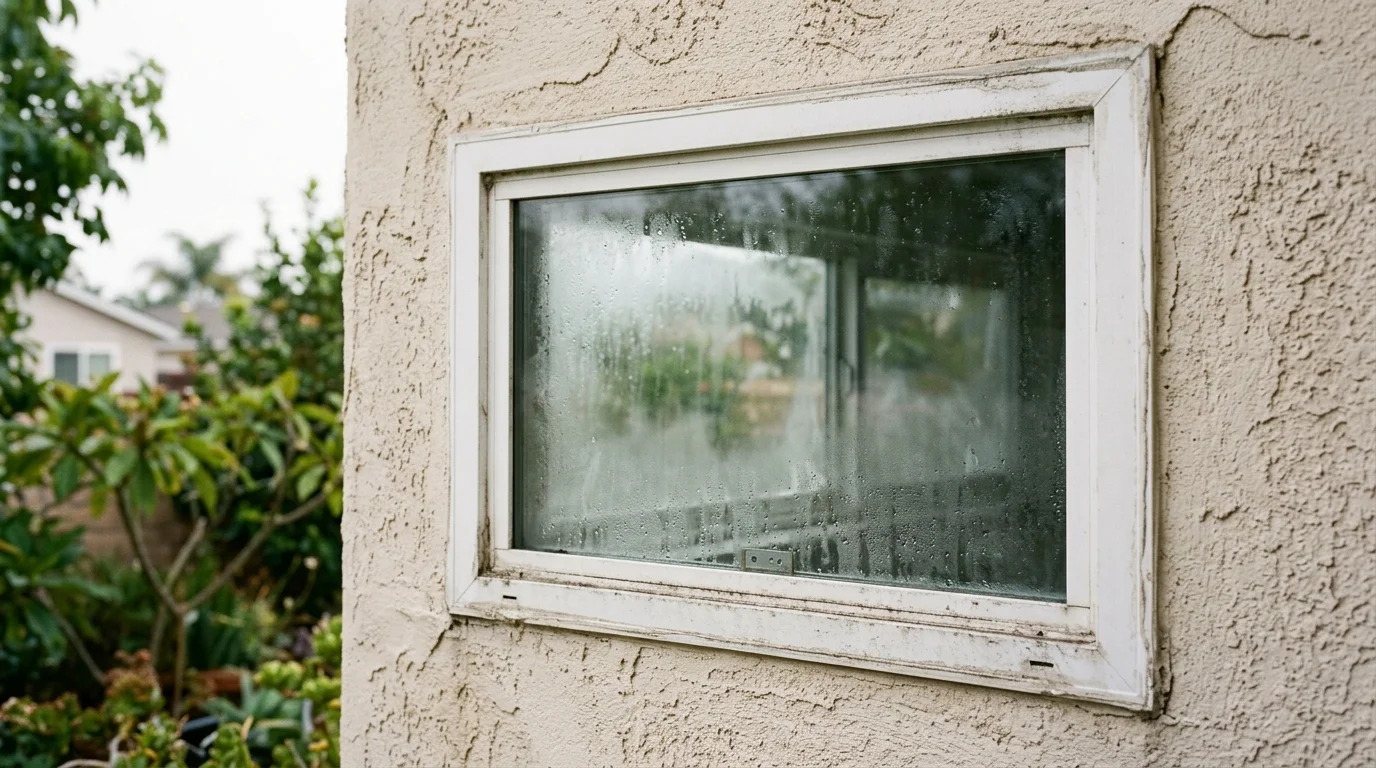
The haze will not wipe off because it is not on the glass you can reach. Fog between the panes of a double-pane window means the insulated-glass seal has failed, and moisture is sitting in that sealed cavity. That is not indoor humidity beading on the room-side face, which we cover in window condensation on the inside of the glass. Wipe both faces first. If the cloud stays put, you are looking at condensation between window panes.
Fog between the panes is a failed insulated-glass seal
A dual-pane window is an insulated glass unit, often called an IGU. Two lites of glass sit on a spacer. A perimeter seal closes the edge. The cavity is dry, and it is often filled with air or an inert gas. The spacer usually holds a desiccant that catches trace moisture from the factory. That sandwich is supposed to stay closed.
When the perimeter seal opens, air moves in and out as the glass heats and cools. San Diego does that every day. A west wall in Clairemont or Mission Valley can bake after 2 p.m., then drop after sunset. A north wall in Point Loma can sit in marine-layer shade until late morning. The cavity expands and contracts. Humid air enters. The desiccant cannot keep the space dry once that leak is established. Water vapor condenses on the cooler lite. You see fog, a milky film, or droplets that run and dry into stains.
You cannot reach that surface with a rag. That is why dual pane windows fog. Not because dirt snuck into the middle. Because the sealed space is no longer sealed.
New caulk on the frame and hardware-store silicone around the glass do not close an IGU. Those products sit outside the factory seal. They do not pull water out of the cavity. They do not restore a gas fill.
Drill-and-vent kits show up in the same search for how to remove fog in double-pane windows. They punch the unit on purpose. They may change how the glass looks for a while. They do not rebuild a sealed insulating cavity. We could not confirm an independent test showing those kits restore the thermal performance of a new IGU. Ask a licensed glazing contractor what they will actually stand behind on your sash. Window Pro SD does not warrant that work. Only the matched local pro can, if they offer a warranty on their own labor and product.
Cloudy double pane windows that look etched, white, or permanently filmed are often past a simple moisture layer. A pro can say whether a new IGU still fits the sash, or whether the glass itself is marked.
In California, this kind of glass work sits inside the C-17 Glazing Contractor classification. Cal. Code Regs. tit. 16, sec. 832.17 covers selecting, cutting, assembling, and installing glass and glass work, and installing those items in a structure. Confirm the person at your door on the CSLB license lookup. California Business and Professions Code section 7048 requires a valid contractor license when the aggregate contract for labor, materials, and all other items is $1,000 or more.
Room-side fog is humidity, and that is a different problem
Do the wipe test before anyone talks about glass. Run a dry cloth on the room side, then on the outside. If the beads come off, the IGU is still closed. You have indoor moisture hitting cool glass.
That pattern is common in San Diego bathrooms, kitchens, and bedrooms with the door shut. Showers, cooking, and a tight house put water vapor in the air. The AC or a cool night then chills the inner lite. Dew forms on the face you can touch. It often shows up on the bottom rail first. It clears as the room dries.
That is not a failed window seal. Treating it like one wastes a glass order. Run the exhaust fan longer. Crack the bathroom door. Stop blocking the weep holes on the exterior track. If the frame is still dry and the sashes still move, you do not start with a dual-pane swap.
The mix-up happens most on May gray mornings along the coast, and on hot inland evenings when the AC has been running for hours. The glass looks wet either way. Only the wipe test tells you which side of the lite is wet.
If moisture has been sitting on wood stools or drywall returns, that is a house-humidity problem plus a possible leak path, not proof the IGU failed. A licensed pro should still look at the sill, the exterior caulk line, and the weep system. Standing water in a vinyl track is not the same as fog locked between the panes.
Keep the two jobs separate. Room-side fog is indoor air. Fog between the panes is a broken IGU. One needs ventilation and maybe window repair at the hardware or weep holes. The other needs new glass or a new unit.
Why the marine layer and AC make both more common here
San Diego County is not one climate. From Imperial Beach through Ocean Beach, La Jolla, Encinitas, Carlsbad, and Oceanside, the marine layer sits on the glass for hours. Night and morning air is damp. The outer lite stays cool. If the IGU seal is already tired, that cool skin is where trapped vapor condenses. Homeowners in Pacific Beach and Point Loma often notice the cloud at breakfast, then watch it thin by afternoon when the sun finally hits.
Inland is a different stress. El Cajon, Santee, Lakeside, Ramona, and Alpine swing harder from afternoon heat to a dry night. West and south walls take a long sun load. The IGU cavity pumps as the glass expands and relaxes. That movement is hard on an old perimeter seal. You may not see fog every day. You see it on the first cool morning after a hot stretch.
Air conditioning adds a third pattern. Inland houses run AC through a long summer. The inner lite gets cold while the room still holds shower and kitchen moisture. That makes room-side beads, which wipe off. The same cold inner lite can also make a failed cavity more obvious, because vapor already inside the IGU now has a cold surface to condense on.
Salt air along the strand is a separate wear factor on frames, hardware, and exterior sealant. It does not, by itself, prove the IGU failed. It does mean a coastal vinyl or aluminum sash should be checked for cracked welds, stuck weep holes, and white corrosion at the locks before anyone orders glass. A clear IGU in a failing coastal frame is still a failing window.
None of this comes with a published year-count for when seals die. That number is not in our verified claims set, and a single figure would not fit both a shaded Encinitas bungalow and a west-facing Ramona two-story. What you can see is the symptom: a cloud that will not wipe, often worse on the sun-cycled walls, and often first on the oldest dual-pane openings in the house.
When glass-only replacement can work
Fogged double-pane windows can often be fixed without tearing out the frame. The repair is a new insulated glass unit set into the existing sash. The cloud goes away because the wet cavity is gone, not because someone cleaned between the lites.
That path only works if the frame and sash can still do their job. The opening should be square. The vinyl, fiberglass, or wood should be solid, not soft, split, or crumbling at the corners. Sashes should still open, close, and lock. Exterior trim and the stucco or siding return should be dry. Weep holes should drain, not sit as a full trough after every fog drip.
If those things are true, the licensed pro we connect you with can pull the failed IGU, keep the frame, and glaze in a new sealed unit. That is the job we map in window glass replacement vs a full window. It is the usual answer to how you get the cloudiness out of double-pane windows: you replace the sealed glass, you do not wash the inside of a closed cavity.
Do not treat glass-only as a DIY cut-out. An IGU is heavy, the setting blocks matter, and the glazing stops have to go back weathertight. Bedroom openings still have to meet California Residential Code R310 if they are the emergency escape opening: 5.7 square feet of net clear opening in general, 5.0 square feet at grade-floor or below-grade openings, at least 24 inches high and 20 inches wide, with the bottom of the clear opening no more than 44 inches above the floor (2022 CRC R310.2.1 through R310.2.3). A glass swap that changes how far a sash opens can break that. Keep the operation the same unless a licensed pro and the building department are in that conversation.
Product claims are not ours to invent. If you want third-party energy labeling on the new glass, look up the unit on ENERGY STAR’s residential windows page rather than taking a brochure number as law. We do not publish energy-bill percentages for a new IGU. Those depend on the rest of the house.
If several openings have failed at once, chasing one lite at a time may not be the cleaner path. A dual-pane upgrade is how homeowners replace a run of tired IGUs with new sealed units instead of living with a patchwork of cloudy and clear glass.
When the frame is done and the whole unit has to come out
Keep the frame only if the frame is still a window. Soft wood at the sill, swollen particle-board stools, cracked vinyl welds, a sash that will not stay in the track, rusted aluminum that has lost its corners, or stain lines in the drywall under the opening: those are whole-unit problems. A perfect new IGU in a rotten sash still leaks.
Water that has been in the wall is the line that ends glass-only work. Fog between the panes is inside the IGU. Brown tracks on the interior paint, spongy stucco at the sill pan, or a musty smell at the stool mean the weather barrier around the frame needs a look. The licensed pro should pull enough interior stop or exterior trim to see, not guess from the living room.
In the City of San Diego, replacing the window itself is permitted work. Development Services Information Bulletin 203 says a building permit is required for window replacement. Same-size, same-type replacement of doors and windows, with no change to the existing opening size, can use a No-Plan Building Permit. That is a permit issued without plan review, not a pass from permitting. Only structures that were legally permitted, built, and passed final inspection may use that path. Historical review is required for a designated historic resource or an adopted historic district, and a building 45 years or older requires plans submitted for historic review unless the scope is exempt. A large share of San Diego housing predates 1978, so that 45-year trigger is not rare. Confirm current process with City of San Diego Development Services. We could not confirm permit fees or turnaround times, and the other incorporated cities plus the unincorporated county each set their own rules.
If the new windows are a fenestration replacement, California energy code applies. The 2025 Building Energy Efficiency Standards took effect January 1, 2026. San Diego County sits in Climate Zones 7 and 10, so the prescriptive maximum U-factor is 0.30. The mandatory maximum U-factor is 0.40 in every climate zone. California Energy Code section 150.2(b), as read from the 2022 edition, lets you replace no more than 75 square feet of vertical fenestration at U-factor no greater than 0.40, with SHGC no greater than 0.35 in the listed zones that include this county. Larger jobs meet the prescriptive numbers. Confirm the current edition with the building department, because the 2025 verbatim exception text was not the copy we could reach. The California Energy Commission publishes the standards.
Exterior windows in wildfire-hardening scopes have a separate rule. California Building Code 2022, Chapter 7A, section 708A.2 requires exterior windows, skylights, and glazed door assemblies to be multi-pane with at least one tempered pane meeting the safety-glazing section, or an assembly tested to SFM Standard 12-7A-2. Both paths count. The tempered-pane route alone is not the whole code.
A full unit is also the moment to stop feeding a failed seal one opening at a time. If the cloudy glass is in a sash that is already out of square, the honest repair is a new window, not a new lite in a dying frame.
When to call us
Fog between the panes will not wipe off, and a failed IGU is a glazing job, not a weekend caulk project. If the cloud sits inside the glass, or the frame is soft, stained, or out of square, you need a licensed window replacement pro to say whether a new glass unit still fits. Call us at (858) 400-6418 and we’ll connect you with a licensed local window contractor.