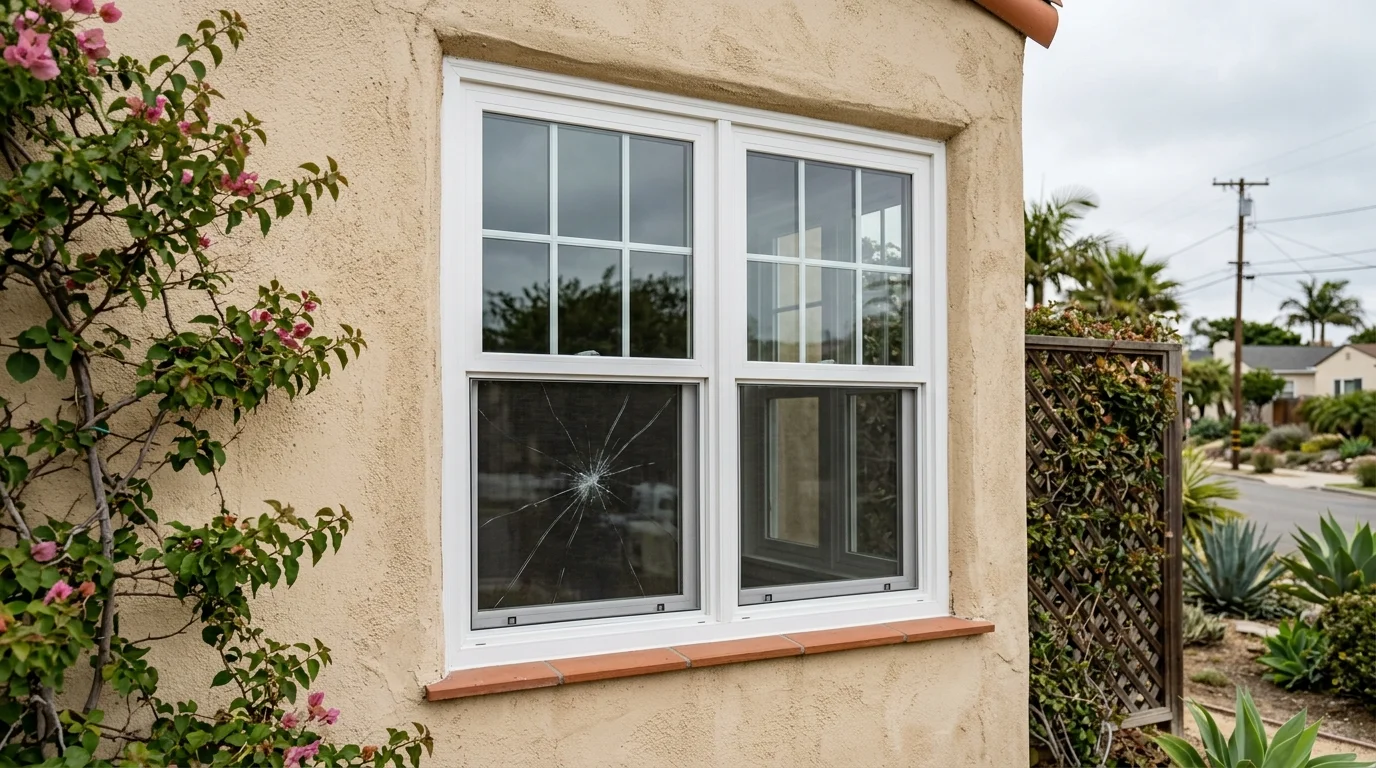
A baseball, a gravel nick, or a heat run from El Cajon to Alpine can leave a line in the glass overnight. That crack is not fog between panes and not water at the stucco. Most cracked window glass is not glued back into a sound pane. The real call is whether a licensed glazing pro can pull the lite and leave the frame, or whether the sealed unit or the whole window has to come out.
Window Pro SD matches you with licensed, independent local window contractors. We do not cut glass, we do not board openings, and we do not warrant the work. The contractor you hire does.
A crack in the glass is not fog and not a frame leak
Fog sits in the air space of a double-pane unit after the edge seal fails. You still have two intact lites. A crack is a break in the glass itself. You can often see the start point: a chip at the edge, a star from an impact, or a long run that caught the afternoon sun on an inland west wall.
A frame leak is different again. Water shows up at the sill, the stucco return, or the interior drywall, and the glass may still be whole. If the wet is around the frame, that is a flashing and sealant problem, not a pane problem. Do not treat all three as the same window repair ticket.
Inland East County glass fails in heat more often than people expect. El Cajon, Lakeside, Ramona, and Alpine swing hard from cool mornings to hot stucco walls. A tiny edge nick from a screen clip or a pebble becomes a run once the lite expands. Coastal glass from Imperial Beach through Coronado, Pacific Beach, and Oceanside takes more impact and more salt at the edge. Wind-blown grit, sports in the yard, and salt that sits in the gasket all start chips that later run.
If only one lite of a dual-pane unit is cracked, the other lite can still look fine. The sealed unit is still compromised. Air and moisture can move through the fracture. Fog may show up later. That later fog is a failed insulated unit, which is a different page: foggy double-pane windows. This page is about the break you can see today.
Tape, film, nail polish, and store kits can slow a run in annealed glass for a short stretch. They do not restore a sealed air space. They do not put a diced tempered lite back together. They do not answer whether the replacement glass must be safety glazing. A hardware-store kit or a cut pane sold over a counter is not a glazing inspection. Ask a C-17 glazing contractor, not the aisle display, what you actually have in the opening.
California Code of Regulations title 16, section 832.17, is the C-17 glazing contractor scope. That classification covers selecting, cutting, assembling, and installing glass and glass work in a structure. Confirm the person bidding the crack holds an active license on the CSLB license check. California Business and Professions Code section 7048 requires a contractor license when the aggregate contract for labor, materials, and all other items is $1,000 or more, with a narrow exemption that does not apply if someone advertises as a contractor.
How annealed window glass and tempered patio glass fail differently
Annealed glass is the common lite in many older single-pane sashes and in some insulated units. It cracks in lines. A star, a long diagonal, or a run from a corner can stay in one sheet. You can still see through most of it. That is why people reach for tape. The pane is still a single plate under stress. It can keep running, and it can still cut.
Tempered glass fails as a field of small chunks. One hit, or one nick at the edge, and the whole lite lets go. You do not get a repairable crack. You get a bag of cubes in the track or on the patio. Sliding glass doors, many patio panels, and a lot of glass near doors are built this way on purpose. If the lite has already diced, there is nothing to glue. The opening needs a new tempered lite or a new door panel, sized and labeled to match what came out.
California Building Code flags glass in hazardous locations, including glass near doors, tubs, showers, and walking surfaces. The exact inch measurements for those locations are not confirmed in this site’s claims ledger, so they are not stated here. Do not guess them from a blog. Have the contractor confirm whether the replacement lite must be tempered or laminated, and put that call in the bid. For how tempered glass is used in homes here, read tempered safety glass in San Diego windows.
Patio and slider glass is the usual tempered failure in this county. A rock from a mower in Santee, a chair on a Mission Beach deck, or a closing door that slams the lite will take the whole panel. Bedroom and living-room picture lites are more often annealed. A crack there can look small and still be the outer skin of a dual-pane unit.
If the cracked lite is in a bedroom emergency-escape opening, size still matters after the glass is replaced. 2022 California Residential Code section R310.2.1 requires a net clear opening of 5.7 square feet, or 5.0 square feet at grade-floor or below-grade openings. R310.2.2 requires 24 inches of net clear height and 20 inches of net clear width. R310.2.3 caps the bottom of the clear opening at 44 inches above the floor. A thicker IGU, a different sash, or a tempered pane with a different frame stop can steal clear opening. Measure the opening that remains after the new glass is in, not the old rough hole.
Do not assume a bathroom lite, a sidelite, or a pane beside a sliding door can be replaced with ordinary annealed glass because that is what broke. The broken lite may already have been the wrong product. The contractor should say so in writing before anyone orders glass.
When the pane can come out and the frame stays
Some openings are glass jobs. The sash or the frame is square, the weep holes still drain, and the break is in the lite. A wood single-pane sash with glazing compound is the classic case. The contractor can pull the old glass, bed a new lite, and leave the frame in the wall. Some aluminum sliders hold glass with a vinyl gasket. If the frame is not racked and the rollers still work, the lite can come out of the panel.
A dual-pane crack is usually not a one-lite patch. An insulated glass unit is two lites plus a spacer, built as one sealed sandwich. Shops replace that sandwich. They do not typically pop the cracked skin, leave the spacer, and recap the unit in the field like a windshield chip. If a bid says “glass only,” ask whether that means a new insulated unit in the existing sash, or a true single lite in a single-pane frame.
That glass-only versus full-window fork is its own decision when the glass is intact and you are choosing where to spend. A crack forces the same fork under time pressure. Use window glass replacement versus a full window when the frame is still sound and you need the difference spelled out. This page is only about the break.
Lead rules change with the scope. EPA’s Lead Renovation, Repair, and Painting Rule treats whole-window replacement as a renovation. The minor-repair exemption (6 square feet interior or 20 square feet exterior) does not cover window replacement, even if the window itself is smaller than 6 square feet (40 CFR 745.83). Replacing a pane of glass, or fixing a broken balancer, is not “window replacement” for RRP. It is still covered unless the work stays inside minor repair and maintenance: no more than 6 square feet of painted surface per room, and no prohibited practices. On a pre-1978 house in City Heights, North Park, or southeastern San Diego, ask the contractor in writing whether the glass pull disturbs paint, and whether RRP applies.
If the existing windows are mil-finish aluminum and the work does not disturb a painted surface, EPA’s RRP FAQ (23002-31781) says that replacement is not subject to RRP. A cracked lite in a painted wood sash is a different fact pattern. Do not mix them.
In the City of San Diego, Information Bulletin 203 is the window-replacement permit rule, not a glass-kit rule. A building permit is required for window replacement. Same-size, same-type replacement can qualify for a No-Plan Building Permit, which is still a permit, issued without plan review. The doors or windows must be the same size and type, with no change to the existing opening. Only structures that were legally permitted, built, and passed final inspection may use a No-Plan path. If the contractor is only swapping a lite inside an existing, legal sash, ask them and City of San Diego Development Services whether that scope is replacement or glazing repair. Do not assume a hardware-store pane skip the permit question. Other cities and the unincorporated county each set their own rules. Those rules are not in this ledger.
When the whole unit has to come out
The frame has to go when it cannot hold new glass. Rotten wood sills in older coastal cottages, racked aluminum in 1960s ranch sliders, and vinyl that has crept out of square after years of East County heat will not clamp a new IGU the way a shop drawing expects. If the contractor has to enlarge or shrink the opening, or change the window type, that is no longer a pane swap.
A cracked dual-pane unit with a failed spacer, rusted grid, or fog already in the air space is a unit replacement, not a crack fill. If the operating sash is also off track, or the balances are shot, you are in repair versus replacement territory. Fixing the glass and ignoring a dead sash wastes the order.
Tempered patio panels often come out as a door glass or a whole sliding panel, not a household window lite. Ask whether the bid is for glass in the existing panel, a new panel in the existing frame, or a new door. Those are three different products.
City of San Diego historic review applies when the work is window replacement on a parcel with a designated historical resource, inside an adopted historic district, or on a building 45 years or older unless the scope is exempt. Census figures already used on this site put 49.6% of San Diego housing before 1978, so a 45-year trigger is common in the central city, not a rare overlay. Glass-only in an existing opening may or may not trip that review. Have the contractor name the path before anyone pulls a sash.
If the opening becomes a new window, energy rules attach. The 2025 Building Energy Efficiency Standards took effect January 1, 2026. San Diego County sits in Climate Zones 7 and 10. The prescriptive maximum fenestration U-factor in Climate Zones 6 through 10 and 15 is 0.30. The mandatory maximum U-factor is 0.40 in every climate zone. California Energy Code section 150.2(b), as read from the 2022 edition, lets replacement of vertical fenestration no greater than 75 square feet use a U-factor no greater than 0.40 in Climate Zones 1 through 16, and an SHGC no greater than 0.35 in Climate Zones 2, 4, and 6 through 15. Confirm the current edition with the building department. Larger jobs meet the prescriptive numbers. A single cracked lite that becomes a whole-house window package is not the 75-square-foot exception by default. Count the square footage in the contract.
Published per-window ranges on this site apply when you are replacing windows, not when you are buying a cut pane. Retrofit work is listed at $500 to $950 per opening. Full-frame work is listed at $900 to $1,600 per opening. Those figures live in the site’s service detail file. Glass-only prices are not in that file, so they are not published here. If the frame is finished, you are in replacement math. If the frame stays, you need a glass line item, not a guessed pane cost.
The federal 25C window credit is terminated for property placed in service after December 31, 2025. Glass or windows installed in 2026 do not qualify.
What to put in writing before anyone orders glass
Order glass against a written scope, not a hallway guess. The bid should say annealed or tempered, single lite or insulated unit, and whether the existing frame stays. It should name low-e coating if the old unit had it, and which surface the coating sits on if the shop can read it. It should say whether the air space will be air or a gas fill. Do not assume argon returns just because the old sticker mentioned it.
Ask for separate lines: glass or IGU, labor to pull and set, disposal of the broken lite, any paint disturbance work, and permit or historic-review fees if those apply. If a cost driver is not in this site’s claims ledger, describe it on the bid and have the contractor price it. Do not accept a round “glass repair” number with no lines.
Put the safety-glazing call in the same sheet. Near a door, a tub, a shower, or a walking surface, the contractor should state whether the new lite must be tempered or laminated. If they cannot say, they have not looked at the opening.
If the job is whole-window replacement in the City of San Diego, the bid should state same size and same type, or it should state the opening change. IB 203 only gives the No-Plan path when size and type stay the same. A cracked lite is not a license to widen a bedroom window without plans.
License and contract terms belong on the page you sign. Check the license number on the CSLB site before a deposit. California’s $1,000 aggregate threshold in BPC 7048 is the line for licensed contracting. Window Pro SD does not hold a trade license and does not warranty glass. Any warranty is the contractor’s, in their packet.
EPA RRP recordkeeping matters on pre-1978 painted sashes. If a certified renovator tests the paint, keep the kit result or the paint-chip report. EPA’s FAQ on newer windows inside a pre-1978 unit (23002-15694) still applies RRP unless testing shows the affected components are below 1.0 milligrams per square centimeter or 0.5 percent lead by weight.
Do not let anyone start with “we will see once it is out.” The crack already told you the glass failed. The writing is there so the replacement lite matches the opening, the code path, and the frame you still have.
When to call us
Call when the lite is cracked, diced, or spidered, and you need a licensed local window contractor to say whether the pane comes out or the unit does. That is glazing and window work, not a kit from the hardware aisle. Call us at (858) 400-6418 and we’ll connect you with a licensed local window contractor.