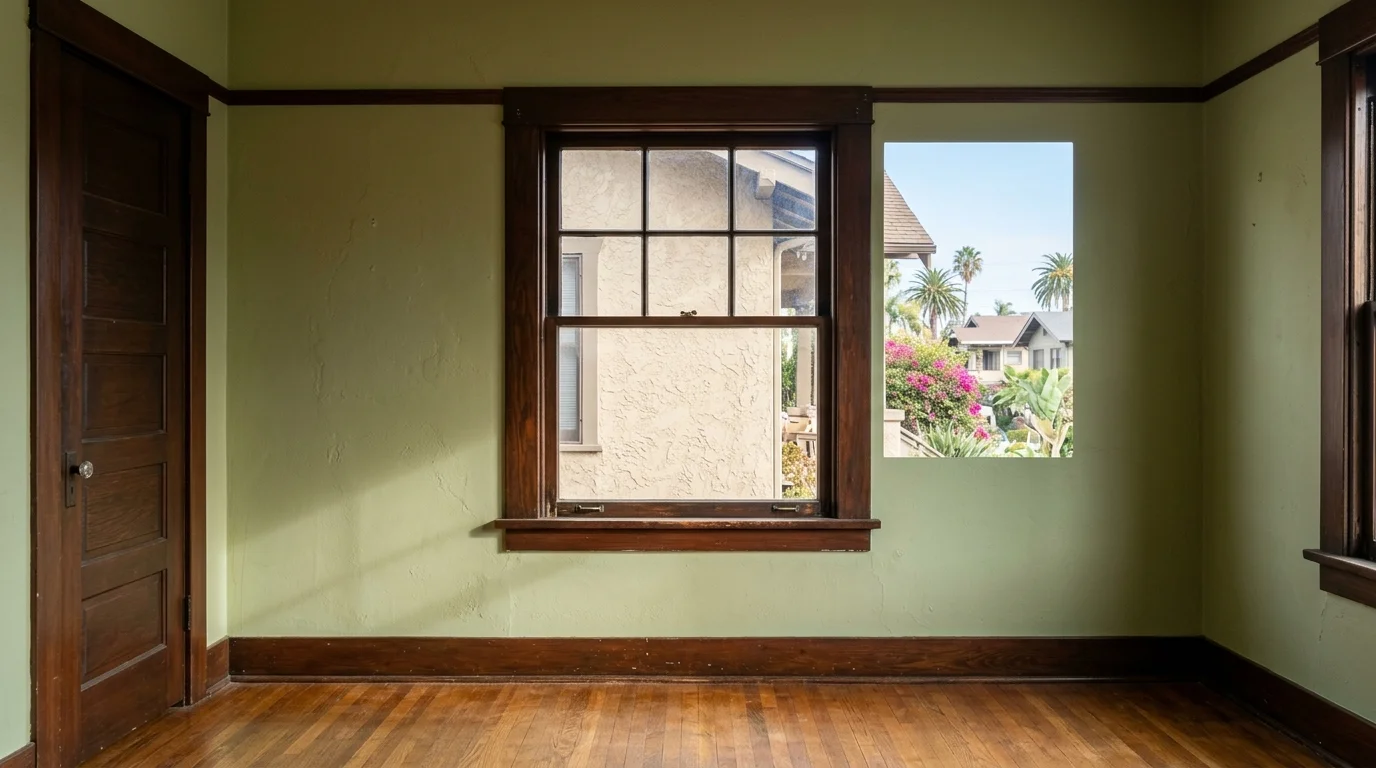
A sash that drops when you let go is a failed window balance on a house hung window. Window balance replacement is residential hardware in the side jambs, not a car-door glass regulator. Those auto-glass pages show up in the same search. This is the house version: a single-hung or double-hung sash in South Park, North Park, Golden Hill, or a pre-war coastal cottage that will not stay open. It is not a Mira Mesa aluminum slider stuck in a track.
A sash that slams shut is usually a failed balance
Lift the sash and take your hands off. If it slides down, slams, or will not hold at the height you left it, the counterweight in the jamb has failed. That part is the balance. It is supposed to carry the sash so you are not holding the glass up with your arms.
One side can fail first. The sash then racks, hangs low on one corner, or binds as it drops. Both sides can fail together, and the sash feels like a dead weight. A sash that shoots upward on its own is the other failure: the spring is too strong for the glass, or someone put the wrong part in after a glass change. Either way, the hardware in the jamb is no longer matched to the sash.
This is not a dirty-track problem and it is not a lock problem. The lock holds the window shut. The balance holds it open. If the sash stays up when you catch it with a stick or a book, you have confirmed the symptom, not a repair. A slamming sash can pinch fingers and crack glass. Stop forcing it. Do not tension a hidden spring with pliers as a weekend fix.
Window Pro SD does not sell the part and does not do the swap. The licensed pro we connect you with matches the hardware to the sash. Window repair is the service path when the frame is still sound. Names for the surrounding pieces are in parts of a window. This page is the slam, not the glossary.
How hung windows in older San Diego stock are built
A hung window moves up and down. The lower sash is the one you lift. On a double-hung, the upper sash moves too. On a single-hung, the upper glass stays fixed. The moving sash rides in channels in the side jambs. The balances live in those channels, or, on the oldest wood units, in pockets behind the jamb with a cord or chain over a pulley.
That layout is the older central-neighborhood stock. South Park, North Park, and Golden Hill still have wood double-hung openings from the bungalow and craftsman streets. Later tract housing often used sliders instead. Pre-war coastal cottages keep the same idea, often with weight pockets instead of a modern spring. Later vinyl hung windows in those neighborhoods tilt in for cleaning. The balance is then a shoe in the channel that a pivot bar on the sash clips into.
The meeting rail is where the two sashes meet when the window is closed. If the lower sash drops, that rail no longer lines up with the lock. Drafts at the middle of a hung window after a slam are often the sash sitting low, not a failed insulated-glass seal. Keep those jobs separate.
Mira Mesa, Kearny Mesa, and a lot of East County tract stock used aluminum sliders instead. Those sashes move sideways on rollers. They have no balance because gravity is not trying to shut them. If your window slides left to right, you are on the wrong page.
Shoe, spiral, and block-and-tackle: what the pro replaces
The pro replaces the hardware that was carrying the sash, not “the window” as a single part. Three modern systems show up on San Diego hung units. If you are not sure of the name, do not guess it on a parts website. Photograph what is in the jamb and show that to the contractor.
A shoe system uses a take-out shoe in each side channel. The bottom of the sash has a pivot bar that clips into that shoe. Coil or constant-force springs in the jamb carry the load. When the shoe is cracked, the spring has lost tension, or the pivot bar has jumped out, the sash drops. Tilt the sash in, if it is designed to tilt, and photograph the shoe, the channel, and any number stamped on the metal.
A spiral balance is a tube with a spiral rod inside. You will see a round metal or painted tube in the jamb, not a flat channel with a cord. Those tubes are sized to the sash weight. The rod has to be tensioned to the manufacturer’s turn count. That is why this is a trade job, not a hardware-store guess at spring turns. A tube that is the right length and the wrong strength still lets the sash fall.
A block-and-tackle balance is a metal channel with a cord, pulleys, and a spring. Look for a nylon cord in a long channel rather than a round tube. The stamped number on the channel, if there is one, is what the pro uses to match the replacement. Photograph the full length of the channel with the sash out of the way, plus any color on the plastic ends.
Pre-war cottages may still have cast weights in the pockets and a cord or chain over a pulley. That is a balance in function, not a spiral tube. The pro may replace the cord or chain, or they may say the pocket and sash are past a hardware-only repair. Do not pull a weight out of the jamb to identify it. Take photos of the pulley, the cord, and the edge of the sash, and let the contractor name the system.
EPA’s Lead Renovation, Repair, and Painting Rule treats fixing a broken window balancer as hardware work, not “window replacement.” On a pre-1978 house in South Park, North Park, Golden Hill, or a coastal cottage, the work is still covered unless it meets the minor-repair limits: no more than 6 square feet of painted surface per room, and no prohibited practices. Confirm that with the contractor before anyone scores paint off a wood jamb. Window replacement is a different RRP trigger, covered below only if the unit has to come out.
When the sash or frame is the real problem
A new balance in a dead sash still slams, or it holds a sash that will not lock. The licensed pro should look at the sash and the frame before ordering hardware. Soft wood at a stile or rail, a split meeting rail, a cracked vinyl weld, or a sash that is out of square will not carry a new spring the way the factory intended.
Painted-shut channels on older wood hung windows fake a balance failure. The sash was never free. Forcing it shears the old cord or jumps the shoe. An opening that has settled, common on hillside bungalows, binds one jamb. The sash drops on the loose side and sticks on the tight side. Cleaning the channel does not square the house.
Glass changes the weight. If someone swapped an insulated unit into a sash that still has the original balances, the springs may no longer match. The sash creeps down, or it is hard to pull closed. That is a hardware mismatch, not proof you need a new frame, and not proof the glass swap was wrong. The pro weighs the sash, or reads the stamp, and matches the part. If the sash itself is cracked from the drop, the conversation moves to a new sash or a new window.
Compare that path with window repair versus replacement before anyone orders a whole unit because one shoe broke. Hardware-only work stays on the table when the frame is solid, the opening is square, and the part can be matched. We do not publish a parts price for a balance. The installer quotes the opening in front of them.
Replacement belongs on the table when the wood is soft, the vinyl is brittle, several hung openings in the same wall have failed, or the line is discontinued and no match exists. This site publishes vinyl retrofit at about $650-$1,200 installed per window, dual-pane insert work at $400-$900, and full-frame at $900-$1,600. Use those bands only if the unit is coming out. In the City of San Diego, replacing the window is permitted work under Development Services Information Bulletin 203. Same-size, same-type replacement can use a No-Plan Building Permit when the bulletin’s conditions are met. A building 45 years or older may need historic review unless the scope is exempt, which is common on the bungalow streets named above. Confirm current process with City of San Diego Development Services. Other cities and the county set their own rules. We could not confirm their fees or clocks.
Window replacement is not minor repair under EPA RRP, even if the opening is small (40 CFR 745.83). Bedroom openings still have to meet 2022 CRC R310 if they are the emergency escape opening: 5.7 square feet of net clear opening in general, 5.0 square feet at grade-floor or below-grade openings, at least 24 inches high and 20 inches wide, with the bottom of the clear opening no more than 44 inches above the floor. Keep the operation the same unless a licensed pro and the building department are in that conversation.
In California, window and glass work sits inside the C-17 Glazing Contractor classification. Cal. Code Regs. tit. 16, sec. 832.17 covers selecting, cutting, assembling, and installing glass and glass work, and installing those items in a structure. That does not make C-17 the only possible class. Confirm the person at the door on the CSLB license lookup. California Business and Professions Code section 7048 requires a valid contractor license when the aggregate contract for labor, materials, and all other items is $1,000 or more.
How this differs from a stuck aluminum slider
A hung sash fights gravity. A slider does not. If the moving panel travels left and right, the hardware is rollers in a track, not a balance in a jamb. Sand, a flat roller, a corroded axle, or a frame pinched by inland heat will make a slider hard to open. It will not slam shut from the top of the opening. That job is stuck sliding windows.
Mira Mesa, Clairemont, and a lot of 1960s-1980s aluminum stock are sliders. South Park hung windows are not. Mixing the two on a parts order wastes a visit. A slider has no shoe, no spiral tube, and no block-and-tackle cord. A hung window has no bottom rollers. Tell the contractor which way the glass moves, and send a photo of the full opening with the sash lifted a few inches, or with the slider moved a few inches, so the hardware is visible.
If you have both styles on the same house, treat them as two repairs. A failed balance on the cottage hung windows in front does not diagnose the aluminum slider on the addition. The licensed pro should write the part and the opening separately.
When to call us
A sash that slams shut is a balance job on a house window, not a car-door regulator. If the sash drops, racks, or the frame is soft, you need a licensed window pro to match the hardware or say the unit is done. Call us at (858) 400-6418 and we’ll connect you with a licensed local window contractor.