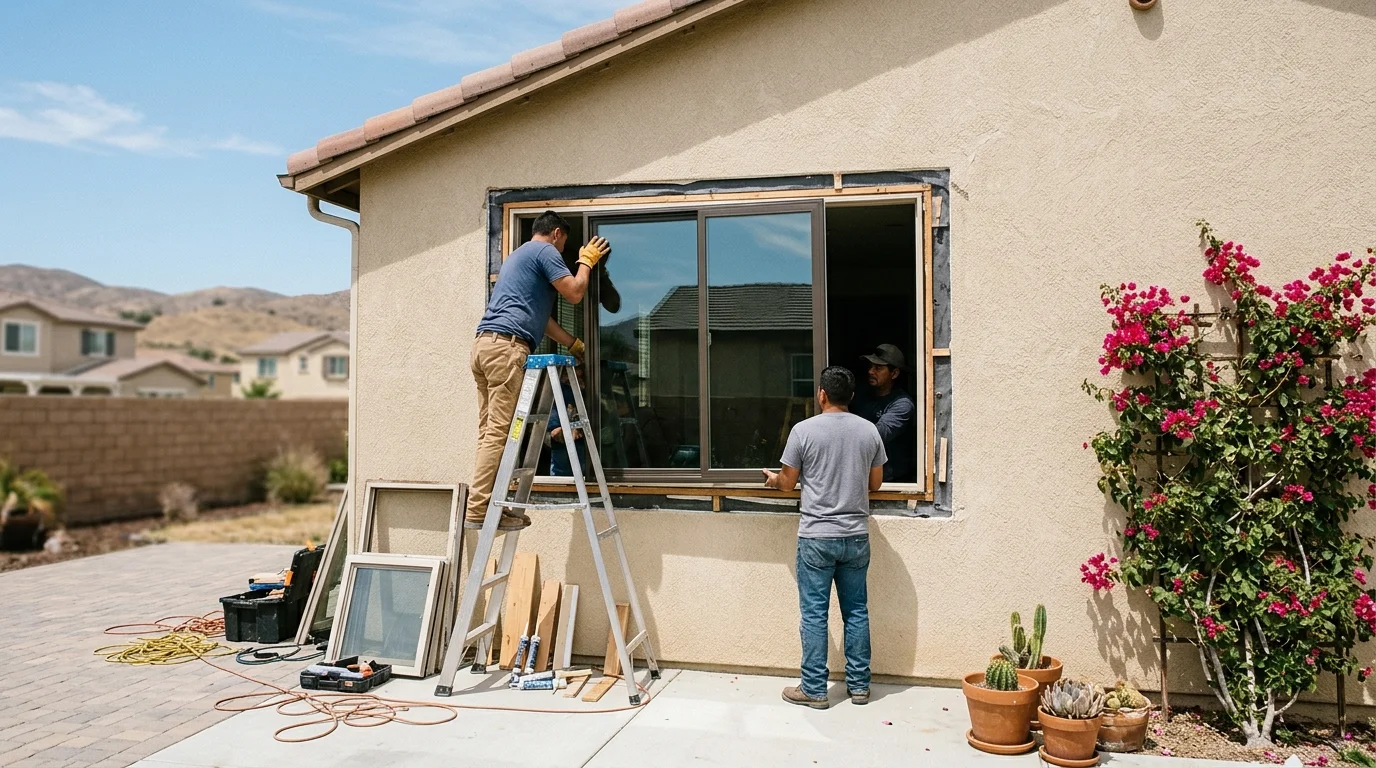
A west slider in Poway at 4 p.m. can make a room unusable. Film on the glass changes the light that comes through. It does not turn a tired, leaky unit into a new window.
If you already know the heat pattern on a west wall, start with our guide to reducing west-facing heat gain in San Diego. That piece covers shades, overhangs, and glass. This one is the buy decision: solar film versus pulling the unit and putting in a new one.
Window Pro SD matches homeowners with licensed local window replacement pros. We do not sell film, and we do not install it. If the glass and frame still do their job, a film shop is the right call. If the unit is fogged, drafty, or out of square, you need a replacement contractor.
Film changes the light. It does not turn a tired unit into a new window
Window film is a thin layer bonded to the glass you already have. It can cut glare, take the edge off sun on your skin, and slow fading on floors and furniture. The frame, the weatherstrip, the balances, and the sealed air space stay exactly as they were.
A replacement window is a new assembly. New glass, new spacer, new sash, new weatherstrip. On a full-frame replacement, the pro also opens the wall enough to reset the opening. That is a different job from a roll of film.
The disadvantage of film is simple. It only treats the lite you can still see through. Fog between panes stays. A failed seal stays. A warped aluminum slider still sticks. Air still leaks at the sash if the weatherstrip is shot. Film cannot restore an insulating gap that has already gone to air.
Another downside sits in the paperwork. Many window makers exclude aftermarket film from the glass warranty. That is a manufacturer rule, not a city code. Read the warranty on your existing units before anyone applies film. If the maker will not cover film, you are trading remaining coverage for a change in light.
Film also changes how the house looks. Some products read dark. Some read reflective from the street. HOAs in Poway and Santee often care about that street view. Confirm the look from outside before you commit a whole west wall.
None of that makes film a bad product. It makes it the wrong product when the unit itself is the problem. Treat film as a coating on glass. Treat replacement as a new window. Window tint vs new windows is not a quality ranking. It is a diagnosis.
West walls in East County versus filtered coastal sun
San Diego County is not one climate with one window problem. The west wall in East County and the west wall in Pacific Beach ask for different answers.
In Poway, Santee, El Cajon, and Escondido, the marine layer burns off. Afternoon sun hits west glass with little fog in the way. Ranch houses and 1970s tracts out there often carry large aluminum sliders on the patio. That glass is the heat case. The room spikes. The floor by the door gets harsh. People reach for film because they want the view and they want the room back.
On the coast, La Jolla and Pacific Beach still get strong light. The complaint is often glare and fade more than a cooking room. Salt air is also in the mix. Frames and hardware take a beating even when the interior stays milder. Film can help with glare on a sound dual-pane unit facing the water. It will not stop a coastal aluminum frame from oxidizing. It will not reseal a unit that has already gone cloudy.
Orientation still matters on both sides of the county. A north bedroom in El Cajon is a different problem from a west living room in the same house. Film on one hot opening can be enough if that unit is tight. Replacement on the whole west elevation is the move when the frames are the weak point.
Housing stock splits the decision too. Inland, you will see a lot of original aluminum and early vinyl. Coastal, you will see mixed stock: older wood in pockets of La Jolla, aluminum in mid-century blocks, and newer vinyl in condos. Walk the glass. If you can wipe the haze off, it is surface dirt. If the haze sits between panes, the sealed unit has failed. Film on failed glass is a cosmetic layer on a unit that is already done.
For heat on a west wall, film is a light-control tool. Replacement is a building-envelope tool. Inland west glass that dumps heat through tired aluminum usually needs the envelope. Coastal glare on a healthy dual pane often does not.
Title 24 still applies when the unit comes out
Here is the line that decides the paperwork. Film stays on the glass you already have. California’s fenestration rules kick in when that glass comes out and a new unit goes in.
The 2025 Building Energy Efficiency Standards took effect January 1, 2026. They are the edition in force now. The prescriptive maximum fenestration U-factor is 0.30 in Climate Zones 6 through 10 and 15. San Diego County spans Climate Zones 7 and 10, so 0.30 is the prescriptive number for this county. The mandatory maximum U-factor is 0.40 in every climate zone.
There is a replacement exception, and it is the one homeowners actually use. California Energy Code section 150.2(b) lets you replace vertical fenestration no greater than 75 square feet with a U-factor no greater than 0.40 in Climate Zones 1 through 16, and a SHGC no greater than 0.35 in Climate Zones 2, 4, and 6 through 15. Larger jobs meet the prescriptive numbers. The verbatim 150.2(b) text we cite is from the 2022 edition. Secondary reporting says the 2025 edition carries the same exception. Confirm the current edition with your building department before you order product. The California Energy Commission publishes the standards.
Do not treat film as a Title 24 fenestration replacement. Film is not a new window. It does not get you into, or out of, section 150.2(b). If the unit stays in the wall, you are not on that replacement path. If the unit comes out, the new glass has to meet the code path your permit uses.
In the City of San Diego, a building permit is required for window replacement. Same-size, same-type replacement can qualify for a No-Plan Building Permit under Development Services Information Bulletin 203. That is a permit issued without plan review, not a skip on the permit. The opening has to stay the same size and type. Historic review applies to designated resources, adopted historic districts, and buildings 45 years or older unless the scope is exempt. Other cities in the county set their own rules. A permit fee and a turnaround time could not be confirmed from the sources we use, so ask the counter before you pay.
The federal 25C energy-efficient home improvement credit is terminated for property placed in service after December 31, 2025. Windows installed in 2026 do not qualify. Do not budget a tax credit into a 2026 replacement.
For the code path on new glass, read our Title 24 window guide for San Diego and look at energy-efficient windows as the product side of the same decision. ENERGY STAR is a separate product label. We do not publish the Southern-zone numeric criteria here because those tables are not in our verified set.
When film is the right next step
Film is the right next step when the window is still a window. The sash moves. The lock hits. There is no moisture between panes. The frame is square. The only fight is the sun coming through glass that is otherwise sound.
That is common on newer dual-pane units in La Jolla and Pacific Beach, where glare and fade lead the complaint. It also shows up on a single west opening in Poway that overheats a TV wall, while the rest of the house is fine. You are buying a change in light, not a new assembly. Is window film worth it in that case? Yes, as a light-control product on sound glass. It is not worth it as a substitute for a failed unit.
Check three things before you hire a film installer.
First, the warranty on the existing glass. Get it in writing from the window maker if you can.
Second, the glass type. Aftermarket film on some insulated units is a compatibility question, not a given. Ask the film installer what product they will put on dual-pane glass, and ask them to stand behind that choice. Window Pro SD does not specify film and does not warrant it.
Third, the look from the street. Drive the block at 4 p.m. Reflective film on a west wall in a Poway tract can read like sunglasses on the house. Some HOAs will not allow it. Decorative or frosted film is a privacy product. It is a different job from solar-control film, and it is still not a replacement window.
Skip film when you already see fog, dust, or a haze you cannot wipe off between panes. That is a failed insulating glass unit. Our foggy double-pane guide covers that failure. Film on top of it leaves the failed air space in place.
We do not publish a film lifespan. Product, sun load, and installation quality all change how long a film stays clear. If a salesperson quotes a year count, ask for the manufacturer sheet, not a round number.
When the frame, the seal, or the opening means replacement
Replacement is the right next step when the unit is no longer doing envelope work. Solar film or replace windows is then an easy call. Replace the windows.
Fog between panes means the seal has failed. The insulating gap is gone. New film will not bring it back. A new insulated unit will.
Drafts at the sash, a slider that jumps the track, or a lock that no longer meets the strike are hardware and frame problems. You can chase rollers and balances for a while. When the frame is racked, you are past film. Compare repair and replacement on our window repair vs replacement page, then have a licensed pro look at the opening.
Rot in a wood sash, crimped aluminum, and crumbled glazing compound are frame failures. Inland heat cooks those materials. Coastal salt chews them. Either way, the opening needs a new unit, often a full-frame replacement if the rough opening itself is the weak point.
Age alone is not a rule. A 20-year-old window that is still clear, still tight, and still operable is a candidate for film if heat and glare are the complaint. A 20-year-old window with failed seals is a candidate for replacement. Condition decides it, not a round birthday.
Vinyl is the common replacement frame in this county. The downside is not a secret lifespan number. We do not have a verified year count for vinyl, fiberglass, or aluminum. Vinyl can read softer on a large west opening in hard inland sun. Other frame materials exist for a reason. Match the material to the wall, the HOA, and the exposure. Low-E glass is the coating conversation on the new unit, and it is a factory coating, not a film you stick on later.
If wildfire glass or insurance documentation is part of the job, stop. Film claims about fire or ember resistance are not something we can verify here. Read wildfire hardening, windows, and insurance discounts in San Diego and talk to your insurer. Multi-pane windows are the home-hardening measure in the Safer from Wildfires rules, not a film layer.
In the City of San Diego, confirm the permit path with Development Services. In Poway, Santee, El Cajon, and Escondido, ask that city’s building counter. A licensed C-17 glazing contractor selects, cuts, assembles, and installs glass and frames under Cal. Code Regs. tit. 16, sec. 832.17. Check any pro on the CSLB license lookup before you sign.
Published ranges on this site for the replacement path run $500 to $950 per window for retrofit and $900 to $1,600 per window for full-frame, from our itemized service figures. Whole-house math is count times those ranges. Film pricing is not a figure we publish. Get that number from a film installer.
When to call us
Call when the glass is fogged, the sash is loose, or the west wall still dumps heat after the unit itself has clearly failed. Film will not reset a broken seal or a tired frame. Call us at (858) 400-6418 and we’ll connect you with a licensed local window contractor.