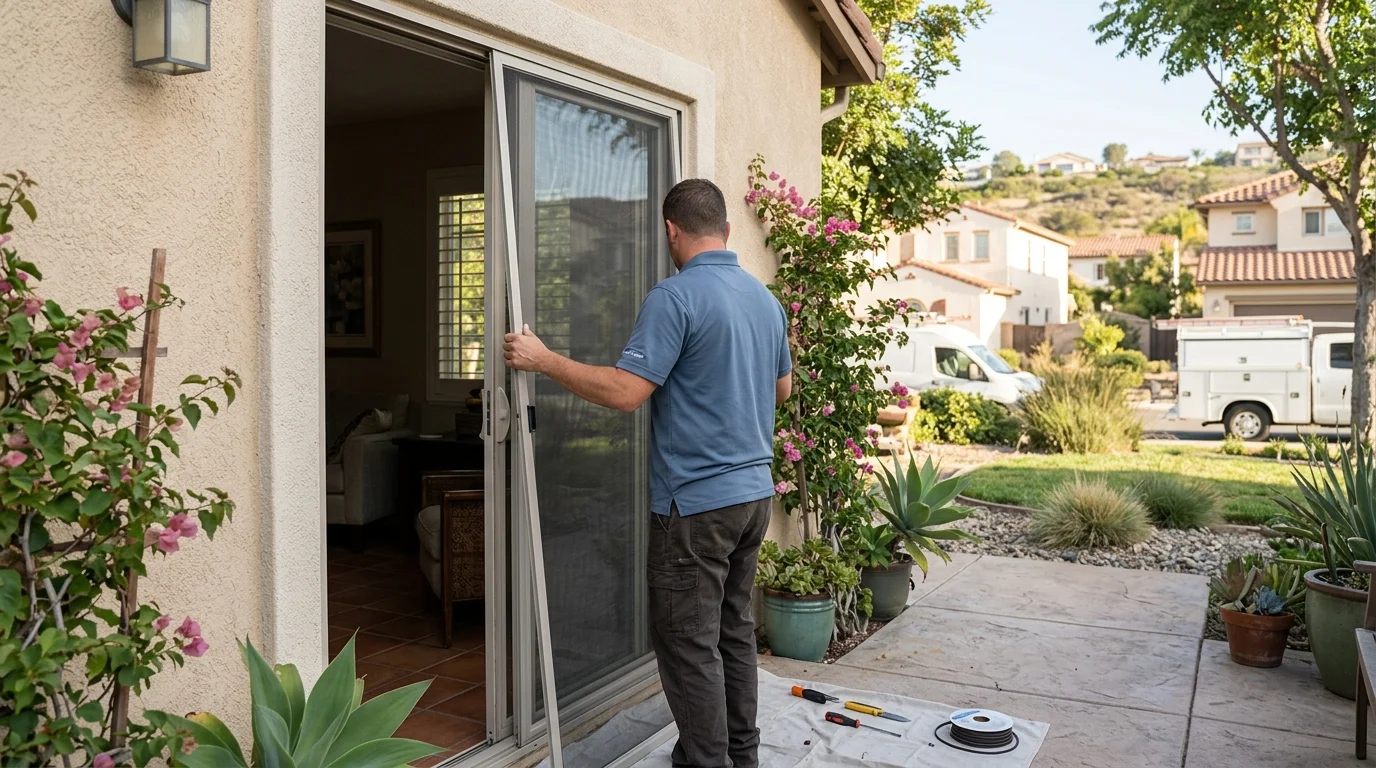
A sliding screen door screen replacement usually means installing new mesh in the existing panel. If the panel is bent or still drags after its rollers and track are checked, replacing the complete screen panel may make more sense.
The key is identifying which part has failed. Mesh, rollers, tracks, frames, and handles create different symptoms, even when every problem feels like a stubborn screen door.
Why sliding screens fail first on patio doors here
A patio screen gets direct contact throughout the day. People push the handle, pets lean against the mesh, and the panel travels across an exposed lower track. A small problem can quickly make the whole door feel worn.
San Diego County also has several distinct exposure patterns. A patio near the coastal strip may need a different inspection than an inland North County opening. The same applies between the central city, East County, and the South Bay.
For an Oceanside, Encinitas, or Point Loma patio, look closely at metal parts. If you see residue around the rollers, fasteners, or frame corners, document it before ordering mesh. New screen material won’t correct a roller housing that no longer holds its position.
Around Escondido, San Marcos, El Cajon, or Lakeside, inspect a sun-facing panel at different points during the day. If the frame appears straight at one time but rubs later, record when and where it binds. That detail can help a local pro separate a panel issue from a track or opening problem.
In central San Diego and the South Bay, don’t assume a familiar-looking panel uses familiar parts. Save any labels, corner markings, handle details, and roller photos. A small difference in the frame profile can affect how a replacement fits.
Start with the visible symptom. Torn or loose mesh points toward rescreening. Scraping, jumping, or tilting calls for a closer look at the moving parts.
Rollers, track wear, and bent frames: what is actually broken
Watch the panel move before removing anything. Note whether it drags along the entire opening or catches at one spot. Also check whether its top edge remains parallel with the upper track.
Mesh damage is usually easy to see. Look for tears, pulled edges, loose spline, or an opening between the screen and frame. If the frame remains straight and moves correctly, the mesh may be the only part needing attention.
A roller problem feels different. One corner may sit lower, the panel may rock, or an adjustment may not hold. Don’t keep forcing the door when it jumps from the track. Repeated pushing can hide the original symptom and add more damage.
Loose dirt can also interfere with the panel. Inspect the lower track for packed debris, damaged surfaces, or a section that no longer matches the rest. Cleaning loose material helps reveal the track beneath it, but cleaning won’t restore a deformed rail.
Check the frame on a flat surface when practical. Look across each side rather than judging one corner alone. Separated joints, twisted rails, and a crushed spline channel all affect whether rescreening will hold.
Make sure the problem belongs to the screen panel. If the glass door also sticks, locks poorly, or leaves its track, the opening needs a wider assessment. Our guide to a sliding window that’s stuck or hard to open explains a similar process for separating track, roller, and frame symptoms.
Rescreen vs new door panel
Choose rescreening when the existing panel still fits and travels correctly. The frame should sit square in its tracks, its corners should remain secure, and the spline channel should accept the screen material without obvious damage.
This path preserves the existing frame while replacing torn, loose, or unsuitable mesh. The contractor can also inspect the rollers and handle while the panel is accessible. Ask which parts are being retained and which are being replaced.
A complete screen panel becomes the stronger candidate when the frame itself causes the trouble. Examples include a rail that won’t sit straight, corners that separate, damaged roller housings, or a spline channel that can’t hold the screen edge. New mesh can’t correct those conditions.
Don’t confuse the screen panel with the sliding glass door. A complete screen replacement covers the lightweight outer panel. Replacing the glass door, its structural frame, or the surrounding opening is a different project.
That distinction matters when comparing recommendations. One pro may be discussing a mesh-only repair, while another means a fabricated screen panel. A third may have found a problem with the patio door assembly. Get the exact scope in writing so you’re comparing the same work.
Our window repair versus replacement guide offers a broader way to weigh repairable parts against damaged frames. For the screen itself, focus on fit and operation. A sound frame can support new mesh. A distorted panel will still be distorted afterward.
Pet mesh and heavy-use households
Mesh selection should match how the doorway is used. A quiet balcony door has different demands than a patio entrance shared by children, dogs, groceries, and backyard equipment.
Pet-oriented mesh is one option for households concerned about clawing or pushing. Ask to see and handle an actual sample before choosing it. Compare visibility, airflow, texture, and how the material sits inside your panel’s spline channel.
Don’t assume the strongest-looking mesh will suit every frame. Material weight, frame condition, roller operation, and panel size should be considered together. A local pro can check whether the current frame and hardware are suitable for the proposed screen.
Household habits matter too. A dog that presses against the bottom section creates a different problem than a cat climbing near a corner. A protective grille or other barrier may be worth discussing, but it shouldn’t interfere with panel travel, the handle, or the door’s normal use.
Think about the actual opening. A National City kitchen patio may serve as a busy daily entrance. An Encinitas balcony screen may see lighter foot traffic but more exposure around the exterior hardware. These examples call for different inspections, not automatic product choices.
Ask how the chosen mesh will affect the view and airflow you want. Also decide whether insect exclusion, pet resistance, or easy operation is the leading priority. There isn’t one material choice for every San Diego household, and Window Pro SD doesn’t represent a specific screen manufacturer or dealer.
Measuring the panel before you order
Measure the existing screen panel when it still represents the original fit. The patio opening alone may not show the panel’s overlap, frame profile, or roller arrangement.
Use a rigid tape and record each result as measured. Don’t round the figures or subtract a guessed clearance. A manufacturer, fabricator, or local pro should decide how the measurements translate into the finished panel.
-
Identify the screen panel’s operating side. Photograph how its top and bottom edges sit in their tracks.
-
Measure the panel width across the top, center, and bottom. Keep all three readings if they differ.
-
Measure the height along the left side, center, and right side. Record where each measurement was taken.
-
Note the frame thickness and profile. Include close photos of the top rail, bottom rail, and both corners.
-
Photograph the rollers and adjustment points. Record their location rather than assuming a replacement uses the same setup.
-
Document the handle position, latch details, and any label or part marking. Include a photo showing the full panel beside the patio opening.
A badly bent panel shouldn’t be your only measuring reference. In that case, measurements from the opening, tracks, overlap, and any matching panel may all be needed. Let the person supplying the replacement confirm which dimensions control the order.
Condos, townhomes, and older patio openings can also have appearance or building-specific considerations. Before ordering, check any documents that apply to your property and confirm the expected frame color and profile.
If the issue reaches beyond the screen, review our patio and sliding glass door service. A contractor can assess the screen panel separately from the glass door and surrounding frame.
When to call us
Call when the screen won’t stay in its track, the frame is bent, or the damage extends to the sliding glass door. You can confirm a contractor’s license record through the CSLB license check.
Call us at (858) 400-6418 and we’ll connect you with a licensed local window contractor.