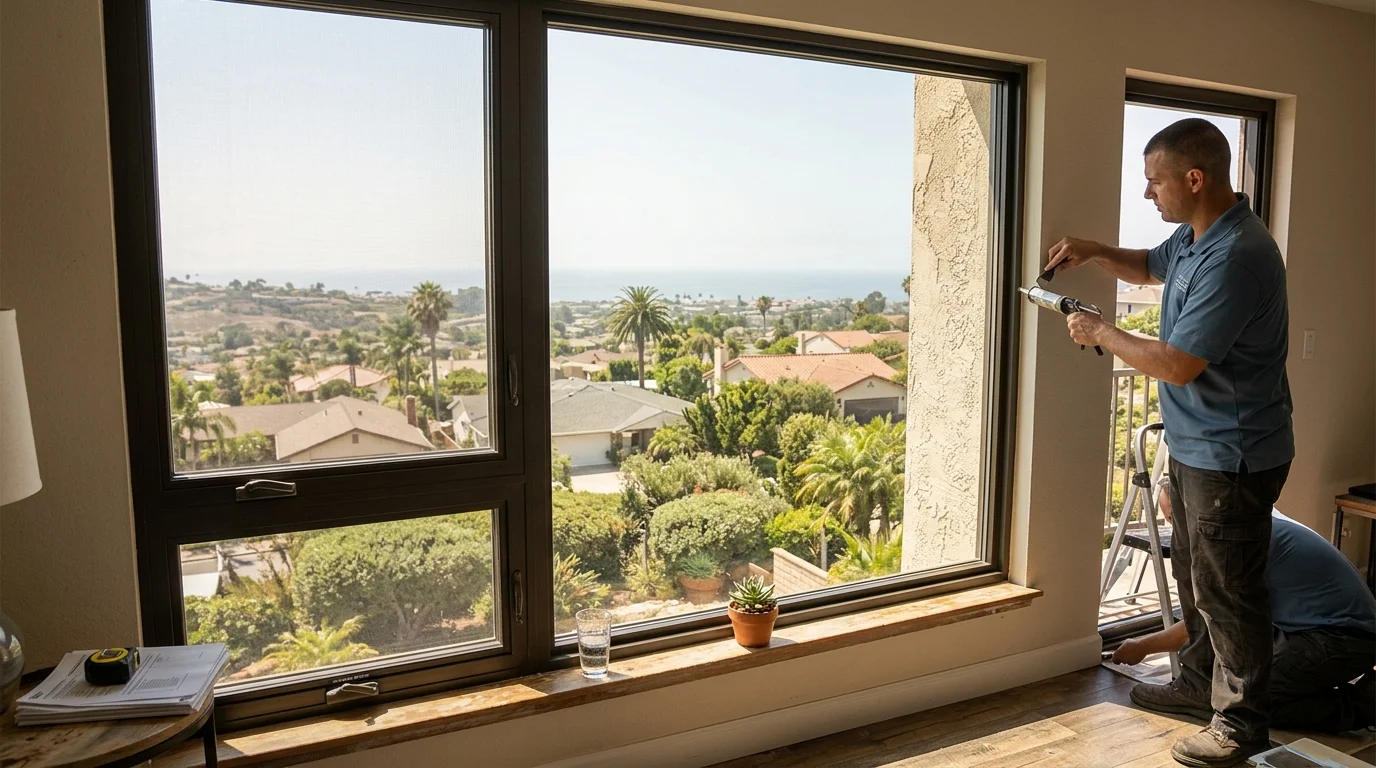
Picture windows are fixed panes designed around an uninterrupted view. They simplify the frame, but they give up ventilation, and west-facing glass still needs a heat-control plan. In San Diego County, the right choice depends on orientation, nearby shade, room use, and whether another opening can provide airflow or emergency escape.
Code also narrows the choices. Where the 2022 California Residential Code requires an emergency escape opening, Section R310 calls for a 5.7-square-foot net clear opening, or 5.0 square feet at grade floor or below grade. Sections R310.2.2 and R310.2.3 also set a 24-inch minimum clear height, 20-inch minimum clear width, and 44-inch maximum opening height above the floor. A fixed picture window can’t provide that opening. For energy performance, the 2025 Title 24 standards took effect January 1, 2026. San Diego County spans Climate Zones 7 and 10, where the prescriptive maximum fenestration U-factor is 0.30.
Why a fixed window costs less per square foot
A picture window doesn’t have a sash that slides, swings, or tilts. It also leaves out the locks, operators, balances, tracks, and weather seals needed to support that movement. When two quoted windows have comparable glass, frame material, size, and installation scope, that simpler construction can make the fixed unit less expensive per square foot.
That isn’t a published San Diego price rule. We couldn’t confirm a reliable local per-square-foot figure from an approved source, so compare written quotes for the actual opening. The frame condition can change the scope more than the window style does.
A sound comparison should keep these details consistent:
- The exact width and height
- Glass configuration and performance ratings
- Frame material and finish
- Retrofit or full-frame installation
- Interior and exterior trim work
- Access around the opening
- Any permit or structural work
Large panes can also change the quote. Glass specifications, handling, access, and the condition of the existing frame all belong in the contractor’s written scope. Don’t compare one fixed unit with a smaller operating window and treat the difference as a style premium.
The biggest savings opportunity often comes from using picture windows only where they add value. A broad fixed center pane can preserve a canyon, yard, bay, or skyline view. Smaller operating units can handle ventilation beside it. That approach keeps moving parts away from the main sightline without turning every opening into fixed glass.
Window Pro SD doesn’t sell or install a particular product. We connect homeowners with independent local contractors who can measure the opening and price the same scope.
The ventilation you give up and how to get it back
A picture window stays closed. That works in a room with other useful openings, but it can feel restrictive when the fixed pane replaces the room’s main source of fresh air.
Start with how the room works now. Open each existing window and note which opening you actually use. A fixed pane makes more sense when another window can provide ventilation without forcing you to rearrange furniture or reach across a counter. It makes less sense when the selected opening is the only practical way to move air through the room.
Several combinations can preserve most of the view:
- A fixed center pane with casement windows on both sides
- A picture window above a smaller awning window
- One fixed unit paired with a nearby sliding window
- Fixed glass beside an operating patio door
The right layout changes across San Diego County. A coastal Encinitas room may depend on regular cross-ventilation. A central San Diego home near a busy street may keep one side closed more often. In East County, a homeowner may prefer controlled ventilation during cooler hours while limiting afternoon exposure. A South Bay room may need airflow from a different wall because furniture blocks the best view opening.
The operating style matters too. Casement, sliding, and double-hung units open differently, so the available wall space and furniture layout should guide the pairing. Our guide to casement versus sliding windows in San Diego explains those practical differences.
Test the proposed arrangement on paper before ordering. Mark every fixed pane and every operable sash. Then confirm which units provide ventilation and which opening, if any, must satisfy emergency escape rules.
West-facing glass and afternoon heat gain here
A west-facing picture window can frame a strong sunset view. It can also expose a room to direct afternoon sun. Because the pane doesn’t open, ventilation can’t be added through that unit when the room warms.
Orientation matters more than a countywide label. A shaded coastal opening in Carlsbad isn’t the same design problem as exposed glass facing west in Escondido. A central-city window may receive shade from nearby buildings. A canyon-facing home may have little afternoon obstruction. In Chula Vista or National City, a roofline, patio cover, tree, or neighboring structure can change the exposure across the same wall.
Check the room during the hours that create the problem. Note when direct sun reaches the glass, how far it extends across the floor, and whether exterior shade interrupts it. Photos taken at different afternoon hours can help a contractor understand the exposure.
Glass selection should follow that observation. Solar heat gain coefficient, called SHGC, describes how much solar heat passes through a window product. Lower isn’t automatically right for every opening. The goal is to manage the exposed wall without making shaded rooms unnecessarily dark or changing every window to match one difficult elevation.
Interior shades can control glare and privacy, but exterior conditions still belong in the plan. Overhangs, existing patio covers, neighboring shade, and the direction of the view should be documented before product selection.
Our guide to reducing west-facing heat gain in San Diego walks through the decision in more detail. Ask the matched contractor to identify the proposed glass package and show its labeled U-factor and SHGC before you approve it.
Glazing choices that keep the view and cut the load
Picture windows put glass performance front and center. The frame takes up less visual attention, so tint, reflectivity, visible distortion, and screen placement can become more noticeable.
Start with the product label, not a broad phrase such as “energy-efficient glass.” The U-factor addresses heat transfer through the window assembly. SHGC addresses solar heat passing through it. Visible transmittance helps describe how much visible light comes through. A contractor should explain the actual ratings for the exact size and configuration being quoted.
For San Diego County’s Climate Zones 7 and 10, the current prescriptive maximum fenestration U-factor is 0.30. The 2022 Energy Code’s Section 150.2(b) provided a replacement exception for no more than 75 square feet of vertical fenestration. That text allowed a U-factor no greater than 0.40 and an SHGC no greater than 0.35 in the applicable climate zones. The approved ledger couldn’t confirm the verbatim exception in the 2025 edition, so check the current requirement with the building department or the California Energy Commission before selecting a product.
Those values are compliance limits, not a promise about comfort or utility savings. Actual results depend on the existing window, wall exposure, shade, HVAC system, insulation, and household use. We don’t publish a savings percentage because no approved source supports one for a typical San Diego picture window.
Multi-pane configurations can also be compared for sound control, but don’t accept a generic noise-reduction claim. Ask for the tested rating of the exact assembly. Glass composition, pane thickness, spacing, frame construction, and installation details can change the result.
A local contractor can help you compare labeled energy-efficient window options without sacrificing the intended view. Our San Diego Title 24 window guide provides more context on current compliance questions.
Sizing, egress, and tempered-glass locations
Measure the view opening and the code constraints separately. A broad pane may fit the wall while failing the room’s emergency escape needs. Rough-opening dimensions also aren’t the same as the net clear opening created when an operable window is fully open.
Under 2022 CRC Section R310, the emergency escape figures are cumulative. A qualifying opening needs the required net clear area, clear height, clear width, and opening height above the floor. Meeting the 20-inch width doesn’t cancel the 24-inch height or area requirement. Since picture windows don’t open, they can’t serve as the required emergency escape opening.
That doesn’t rule out fixed glass in a bedroom wall. It means the complete room layout needs another compliant opening where R310 applies. Have the contractor identify that opening on the proposal and confirm the current code edition with the local jurisdiction.
Permit rules also depend on jurisdiction. In the City of San Diego, window replacement requires a building permit. Development Services Information Bulletin 203 allows a No-Plan Building Permit when replacement doors or windows remain the same size and type, with no change to the existing opening. A No-Plan permit is still a permit. The structure must also have been legally permitted, built, and passed final inspection.
City historical review adds another checkpoint. A designated historical resource or property inside an adopted historic district requires review. A building 45 years or older also requires plans submitted for historical review unless the work qualifies for an exemption. Confirm the property and proposed scope with City of San Diego Development Services. We couldn’t confirm the window-replacement requirements for other incorporated cities or unincorporated San Diego County. Ask the building department that governs the property whether the project needs a permit and whether changing the opening affects the required submittal.
Safety glazing is a separate issue. California’s code identifies hazardous locations near features such as doors, tubs, showers, and stairs, but the specific California distance thresholds weren’t verified for this article. Ask the building department: “Does this exact pane location require safety glazing, and which current code section applies?”
Wildfire provisions may also affect some properties. Where California Building Code Chapter 7A applies, Section 708A.2 allows two paths for exterior glazing. The unit can be multi-pane with at least one tempered pane meeting the safety-glazing section, or it can be an assembly tested to SFM Standard 12-7A-2. Don’t treat one tempered pane as the only compliance path.
When to call us
Bring in a licensed window contractor when picture-window sizing affects egress, permits, safety glazing, energy compliance, or the wall opening. Call us at (858) 400-6418 and we’ll connect you with a licensed local window contractor.