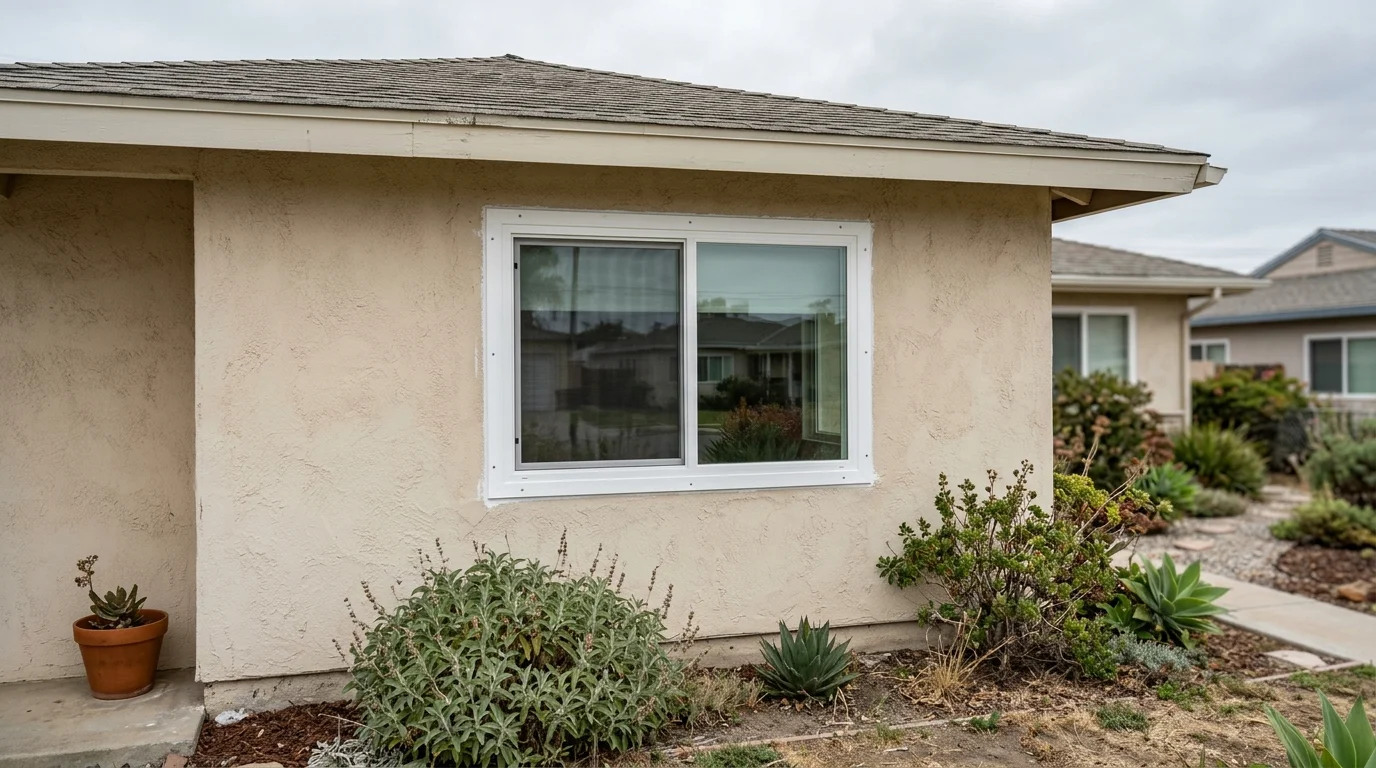
On a Chula Vista ranch, the new vinyl unit usually lands on the stucco. That thin exterior lip is a flush fin, also called a stucco flange or flush flange. It is the hardware that makes a retrofit insert window work on an existing plaster return, and it is the line on the quote that gets mixed up with a nail fin or a block-frame unit.
A flush fin sits on the stucco face. A nail fin does not
A flush fin is an integral exterior flange on a replacement window. After the old sashes come out and the existing frame stays, the new unit slides into that frame. The flange then lies on the stucco around the opening. Sealant at that face joint is what you see from the sidewalk. Fasteners typically go through the new frame into the old one. The plaster, lath, and weather-resistive barrier behind the stucco stay closed.
A nail fin is a different flange on a different job. It is a nailing flange meant to land on the wood of a rough opening, then disappear under cladding. That is how a new-construction window is set when the wall is open. On a finished San Diego house, getting a nail fin onto framing means cutting the stucco back, exposing the original opening, tying new flashing into the existing paper or wrap, and patching plaster. That is full-frame replacement, the tear-out method. The insert-versus-tear-out choice lives on our retrofit versus full-frame page. This page is about the flange itself.
You can stand in the yard and tell them apart. A flush-fin retrofit shows a slim vinyl or fiberglass lip on the stucco, usually with a continuous caulk joint. A nail-fin reset shows a stucco patch around the opening, often a slightly different color or texture until it weathers. A block-frame unit, covered next, may show almost no exterior lip at all.
Mira Mesa and Kearny Mesa tract homes from the 1960s through the 1980s were built with aluminum sliders in stucco returns. The original nail fin is already buried. The flush fin is the product built to leave that wall alone when the old frame is still sound.
Block frame, flush fin, and nail fin are different products
Quotes in San Diego often collapse three factory options into the word “retrofit.” They are three products.
A block-frame window has no nailing flange and no flush flange. It is a rectangular box sized to the existing opening. The installer sets it in the old frame, screws through the jambs, foams the gap, and seals the perimeter. Exterior coverage then depends on exterior window trim or a heavy sealant joint. On brick or a deep stucco return, that can be the right box. On a typical South Bay stucco face, the joint is doing a lot of weather work with little metal or vinyl covering it.
A flush-fin, or stucco-flange, window is still a replacement unit that sits in the existing frame. The difference is the integral exterior flange. That flange covers the old frame edge and a strip of stucco. It is the product most San Diego stucco quotes mean when they say retrofit. Some orders also list a Z-bar or stucco key as a separate cover piece. Ask which one is on the unit, factory-extruded or an add-on.
A nail-fin window is the new-construction product. The flange is for framing, not for a finished plaster face. Putting a nail-fin unit into a closed stucco wall without opening that wall leaves the flange with nowhere honest to land.
The same series can ship all three ways. Vinyl and fiberglass both come as block frame, flush fin, or nail fin. The glass package can be identical. The flange is what changes the opening, the water path, and the stucco repair. If two quotes are hundreds of dollars apart on the same house, check the flange before you check the glass.
Because a flush-fin or block-frame unit sits inside the existing frame, the clear glass is smaller than a full-frame reset in the same hole. A nail-fin tear-out can recover that glass size. That is a product trade, not a quality ranking.
Why South Bay and Mira Mesa openings get this flange
Chula Vista, National City, Mira Mesa, and Kearny Mesa share a housing type: one- and two-story stucco, aluminum sliders, shallow exterior returns, and openings that have already been painted and recaulked for decades. Cutting those returns to expose framing is a plaster job as much as a window job. When the old aluminum frame is square, solid, and dry, a flush-fin retrofit is the flange that matches that wall.
South Bay stucco sees marine air off the bay and the Tijuana River Valley. Mira Mesa and Kearny Mesa sit inland, hotter, with more thermal movement in dark frames on west walls. The flange choice does not change those climates. It changes whether the installer opens the drainage plane. On a National City bungalow with a tight stucco return, a flush fin keeps the plaster intact. On a Mira Mesa two-story where the sill is soft, the flange on the face will not fix wood that is already wet in the wall.
Many of these streets were built before 1978. EPA’s Lead Renovation, Repair, and Painting Rule treats whole-window replacement as a renovation. The small-area exemption (6 square feet interior, 20 square feet exterior) does not cover window replacement, even when the unit itself is smaller than 6 square feet. Replacing only a pane of glass is a different EPA category. A mil-finish aluminum swap that disturbs no paint can fall outside RRP. The licensed pro should say which of those applies before the first sash comes out.
Inside the City of San Diego, window replacement needs a building permit. Same-size, same-type replacement can use a No-Plan Building Permit under Development Services Information Bulletin 203: the new doors or windows must be the same size and type, with no change to the opening. Only legally permitted buildings that passed final inspection may use that path. A building 45 years or older, or a designated historic resource, needs historic review unless the scope is exempt. Census housing already on this site puts about half of San Diego stock before 1978, so that 45-year trigger is common.
Chula Vista is its own city. IB 203 does not speak for it. Ask the City of Chula Vista building department two exact questions: whether same-size replacement in an existing opening needs a permit, and whether a flush-fin vinyl unit in an old aluminum opening counts as the same type.
Water at the flange versus water in the wall
Rain on a flush-fin retrofit is supposed to shed at the stucco face. Water hits the flange, the exterior sealant joint, and the window’s own weeps. It should stay on the plaster and run off. The old frame, still in the wall, is still the backup. If that frame is open at the sill, or the original paper is split, water that gets past the face joint is in the same cavity it always used.
A nail-fin reset is supposed to manage water in the wall. The stucco is cut back, the old frame comes out, and new flashing is integrated with the existing weather-resistive barrier. The nailing flange is then part of that drainage plane, under the new plaster. That is a different water path. It is also a different mess on a finished Kearny Mesa elevation.
Neither path should be treated as a flashing recipe. Manufacturer instructions and the licensed installer set the sealant, the fasteners, and any pan or tape. What you can inspect from the yard is simpler. Look at the existing sill and the stucco below the corners. Dark staining, soft stucco, or bubbling paint under an aluminum slider is wall water. A flush fin on that opening leaves the wet wood in place. A full-frame reset is the method that opens the wall and replaces the frame.
Look at the face joint too. A flush flange with a split, dirt-packed bead will leak at the plaster long before the insulated glass fails. Recaulking a sound flange is maintenance. Recaulking a rotten aluminum frame is buying time. If interior drywall is staining at the stool, the problem has already moved past the flange.
Weep holes on the new unit have to stay open. A flush flange that sits in a heavy stucco texture can bury those weeps if the installer beds the unit in a fat bead. That is an installation detail, and it is one reason the flange on the order and the flange on the truck need to match.
How to read which fin is actually on the quote
Read the unit description, not the sales heading. Words that usually mean a flush-fin retrofit: flush fin, flush flange, stucco flange, stucco fin, retrofit flange. Words that usually mean no exterior flange: block frame, pocket, box frame. Words that usually mean a new-construction unit: nail fin, nailing flange, new construction, NC. If the page says “retrofit” and the line item says “nail fin,” stop and ask which product ships.
Ask to see the configuration on the shop drawing or the order acknowledgment: series, frame type, and whether a Z-bar or stucco accessory is included. Two quotes can use the same glass and a different frame. The cheaper one is sometimes a block-frame unit with more exposed caulk. The dearer one is sometimes a nail-fin unit that quietly assumes stucco cutback. Neither is a trick by itself. An unmatched flange is.
California law requires a contractor license when the aggregate contract price for labor, materials, and all other items is $1,000 or more (Business and Professions Code section 7048, threshold amended effective January 1, 2026). Window and glazing work sits inside the C-17 Glazing Contractor classification. California Code of Regulations title 16, section 832.17, says a glazing contractor selects, cuts, assembles, and installs glass and glass-substitute materials, fabricates and glazes frames, sashes, and doors, and installs those items in a structure. Confirm the company on the CSLB license check. Window Pro SD is a referral service. The homeowner contracts with the licensed independent pro.
Energy rules still apply to the glass, whatever the flange. The 2025 Building Energy Efficiency Standards took effect January 1, 2026. San Diego County sits in Climate Zones 7 and 10, where the prescriptive maximum fenestration U-factor is 0.30. The mandatory maximum U-factor is 0.40 in every climate zone. California Energy Code section 150.2(b) allows replacement of vertical fenestration no greater than 75 square feet with a U-factor no greater than 0.40, and a SHGC no greater than 0.35 in Climate Zones 2, 4, and 6 through 15. That exception text was read from the 2022 edition; confirm the current edition with the building department. Do not treat a flange upgrade as an energy upgrade on its own. Check the NFRC label. ENERGY STAR is a separate product listing. The federal 25C window credit is terminated for property placed in service after December 31, 2025, so a 2026 install does not qualify.
Inside the City of San Diego, also ask whether the flush-fin unit is the same size and type as what is coming out, which is the IB 203 test for a No-Plan permit. In Chula Vista, take that same-size, same-type question to the city building department. National City and the unincorporated county each set their own permit rules. Name the city on the quote, then ask that city’s building department.
When to call us
Call when the quote lists retrofit, the house is stucco, and you still cannot tell whether the unit is a flush fin, a block frame, or a nail fin that needs the wall opened. A licensed window contractor should inspect the existing frame, name the flange, and say when the stucco has to come off. Call us at (858) 400-6418 and we’ll connect you with a licensed local window contractor.