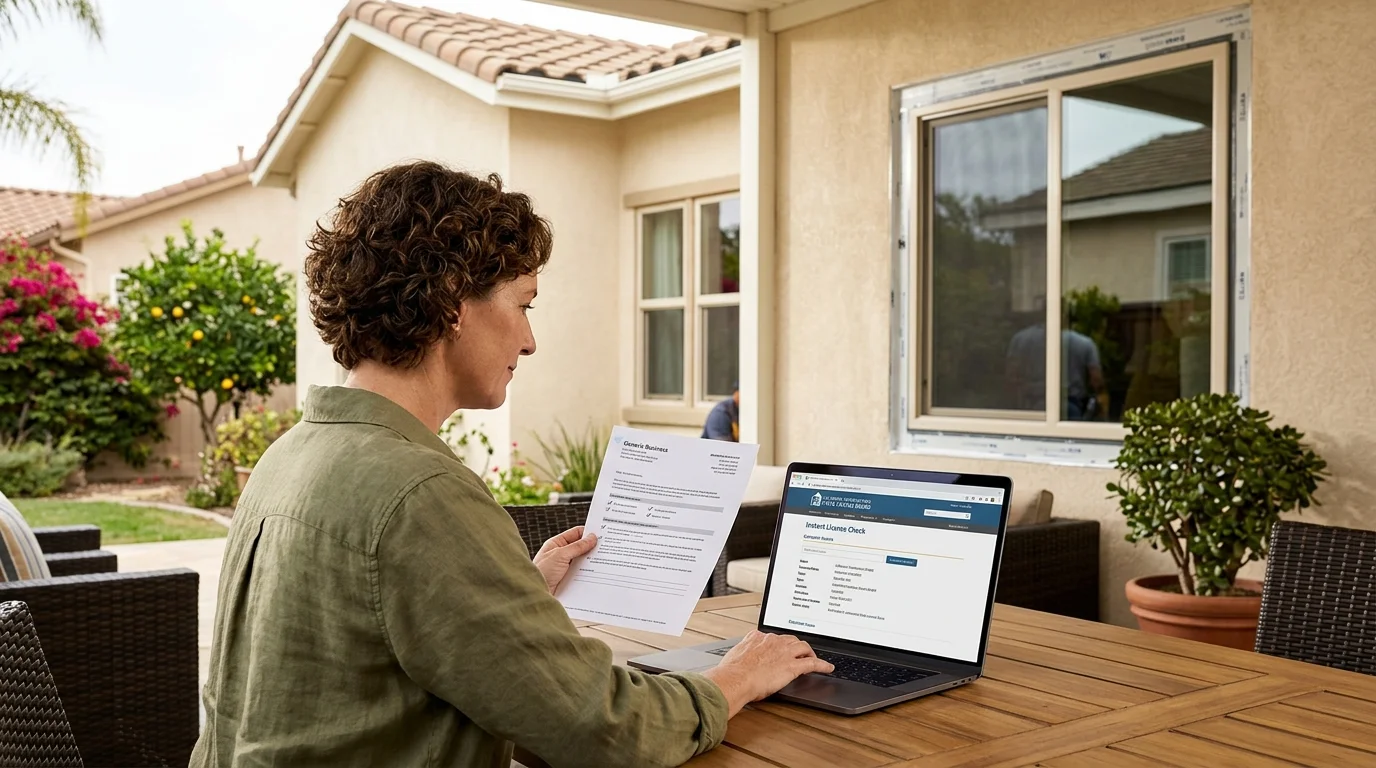
Before signing a window quote, check the contractor through California’s official license lookup. Compare the state record with the name, license number, and proposed work in front of you.
California’s C-17 glazing classification covers window and glazing work under 16 CCR 832.17. Business and Professions Code section 7048 generally requires a valid contractor license when the aggregate project price reaches $1,000.
The two-minute check anyone can do before signing
Start with the written quote. Copy the business name and license number exactly as shown. Don’t correct spelling, remove initials, or assume two similar names represent the same business.
Open the CSLB Check a License tool yourself. Enter the number from the quote and review every field the state returns. Compare the business identity, license status, and listed classification with the information you received.
A matching number alone isn’t enough. The name attached to that number also needs attention. If the lookup returns another person or business, stop before signing or paying. Ask the person who prepared the quote to explain the difference in writing.
Next, review the classification shown in the record. For window and glazing work, C-17 is the state’s glazing classification. Another classification may appear, including a B general contractor classification. The available verified material doesn’t establish that C-17 is the only classification allowed for every window project. Ask CSLB which classification covers the exact work listed on your quote.
Save or print the lookup result with the quote. That gives you a dated record of what the state displayed when you checked.
Window Pro SD isn’t the licensee and doesn’t perform the installation. We match San Diego County homeowners with licensed, independent local window professionals.
What a C-17 Glazing license actually covers, in the state’s own words
California defines the C-17 classification in 16 CCR 832.17:
“A glazing contractor selects, cuts, assembles and/or installs all makes and kinds of glass, glass work, mirrored glass, and glass substitute materials for glazing; executes the fabrication and glazing of frames, panels, sashes and doors; and/or installs these items in any structure.”
That language matters because it covers more than replacing a pane of glass. It expressly includes glazing frames, panels, sashes, and doors. The plain reading is that window and glazing work falls within the C-17 scope.
Still, don’t turn that statement into a rule the source doesn’t establish. The verified record doesn’t say C-17 is the only classification that may cover window replacement. A B general contractor may also be licensed for the proposed work. Ask which classification appears on the license and how it covers the written scope.
The scope on a quote also matters. Glass replacement, sash work, frame removal, and changes to an opening aren’t identical projects. Describe the actual work when asking CSLB about classification coverage.
License verification is one part of contractor selection. For broader questions about written scope and comparing installers, read our guide to choosing a window installer in San Diego.
Why the license number on a truck is not the check
A license number printed on a truck, advertisement, business card, or proposal gives you something to research. It doesn’t replace the research.
Type the number into the CSLB tool yourself. Don’t depend on a screenshot or link supplied by the person selling the project. You want the current state result tied to the exact number on your quote.
Then compare names character by character. If the quote names one business while the lookup names another, don’t create your own explanation. Ask why they differ and request supporting details in writing. Rerun the lookup using the clarified information.
Labels such as “window repair company,” “window supplier,” or “window specialist” don’t answer the license question. The proposed work and the state record deserve separate review. A business description can tell you what someone markets. It doesn’t tell you whether a particular license matches that business and project.
This distinction also matters for smaller jobs. A failed seal, damaged sash, broken pane, or faulty operator may lead to different proposed work. Review the window repair service before comparing scopes, then verify the company connected to the quote.
If the state lookup doesn’t return a clear match, pause. Ask CSLB what the record means instead of relying on the salesperson’s interpretation.
The $1,000 threshold that decides whether a license is required at all
California Business and Professions Code section 7048 sets a $1,000 threshold. A valid contractor license is required when the aggregate contract price for labor, materials, and all other items is $1,000 or more.
The under-$1,000 exemption is narrow. The work must be casual, minor, or inconsequential. It must not require a building permit, form part of a larger operation, or be performed by someone who advertises as a contractor or employs other people. Dividing a larger project into smaller contracts doesn’t create the exemption.
This threshold took effect January 1, 2026. When reviewing a proposal, look at the total project price. Don’t examine labor and materials separately or treat each window as its own unrelated job.
Permits can also change the analysis. In the City of San Diego, window replacement requires a building permit. Same-size, same-type replacement can qualify for a No-Plan Building Permit under Information Bulletin 203, but that’s still a permit rather than an exemption.
Only legally permitted structures that passed final inspection can use that No-Plan path. Work involving a changed opening doesn’t fit the bulletin’s same-size, same-type condition. Our guide to San Diego window replacement permits explains the verified city rule.
Other San Diego County jurisdictions set their own permit procedures. Ask the relevant building department: “Does this exact window scope require a permit?” City of San Diego homeowners can confirm current procedures with Development Services.
Workers’ comp and bond status are separate lookups
A license result shouldn’t end your review. Workers’ compensation and bond records are separate questions that need their own answers.
No single CSLB rule governing what those entries must show for every contractor could be verified. Current bond amounts, coverage limits, and exemptions also couldn’t be confirmed. Ask CSLB what applies to the exact license instead of accepting an invented number or assuming a valid license answers either issue.
Review any workers’ compensation and bond information provided through the state lookup. If a field is missing, unclear, or appears inconsistent, ask CSLB for an explanation. Keep the question tied to the exact license and business name.
Useful questions include:
- What is the current workers’ compensation status attached to this license?
- What dates apply to the displayed record?
- Does the bond record match the license and business on my quote?
- Is any missing entry expected for this specific license?
- Where can I verify the current record directly?
Ask the contractor for documents only after checking what the state displays. Then compare the names, dates, and license number without assuming that similar information is identical.
Don’t let an insurance certificate, bond document, or license printout stand in for the others. Treat each as its own record. When something isn’t confirmed, say so plainly and ask the authority that maintains it.
What to do when the lookup does not match the name on the quote
A mismatch is a reason to pause, not a reason to guess. Don’t sign, schedule work, or pay while the business identity remains unclear.
First, show the contractor the exact difference. Ask which legal business will contract with you and which license covers the work. Request the answer in writing.
Next, rerun the CSLB lookup using the corrected number or business information. Compare the new result against the quote. If the explanation involves another company, ask why that company isn’t named consistently in the paperwork.
Then ask CSLB direct questions:
- Does this license belong to the business named on my quote?
- Is the displayed classification appropriate for the stated window work?
- What does the current status shown on the record mean?
- Where should I verify workers’ compensation and bond information?
- What should I do if the person offering the work isn’t listed?
Keep copies of the quote, revised documents, and lookup results. If the names still don’t align, choose another licensed professional rather than trying to reconcile the mismatch yourself.
Window Pro SD is a referral service. We don’t hold the contractor’s license, sign the construction contract, set the contractor’s price, or provide the workmanship warranty. Your agreement and payment are made directly with the independent professional.
When to call us
Call when window replacement or repair needs a licensed local professional and you want help finding one in San Diego County. Resolve any license-record mismatch before accepting a proposal.
Call us at (858) 400-6418 and we’ll connect you with a licensed local window contractor.