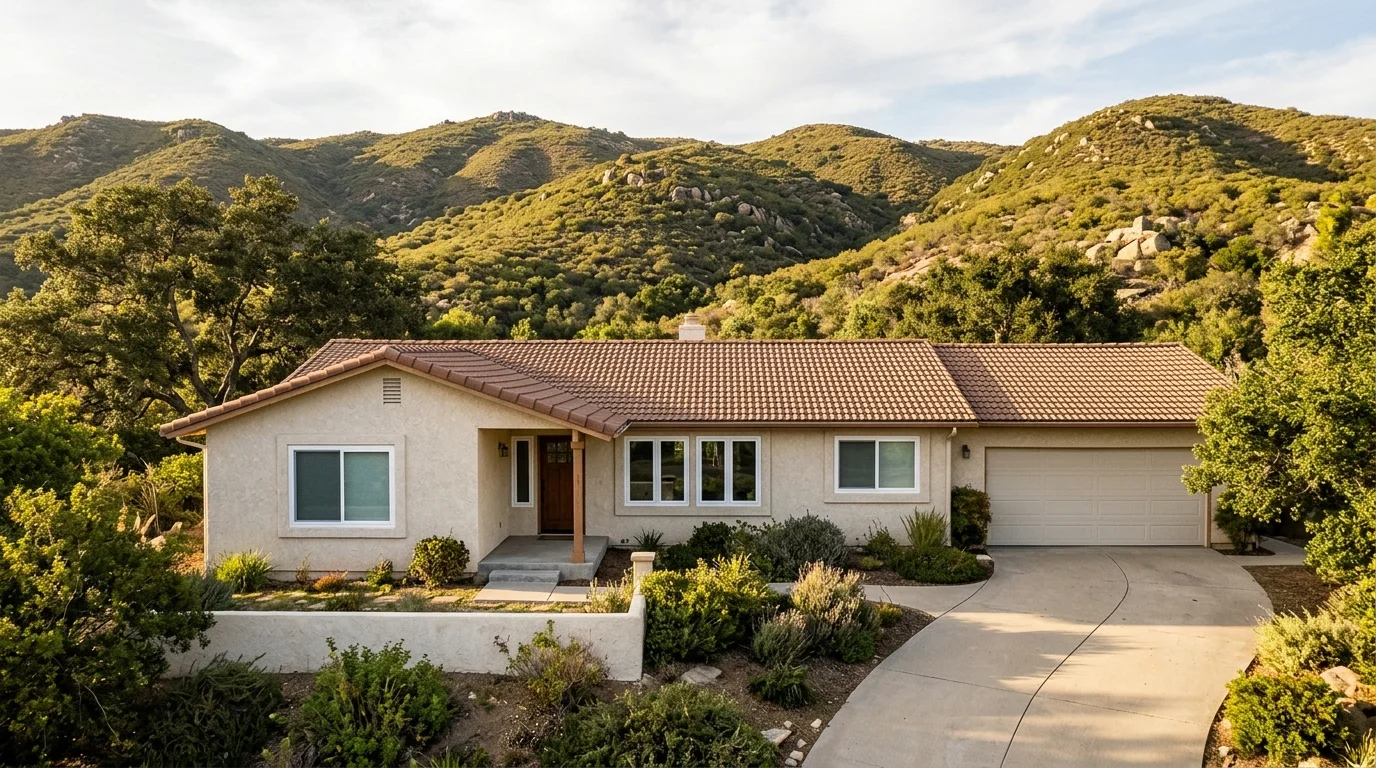
Two quotes land on the same Poway kitchen table, one stamped Pella, one stamped Milgard. The folders look like a brand contest. The decision is which unit, which glass, and which install method belong on that stucco wall.
Two companies, two service networks, one San Diego wall
Pella and Milgard make windows. They do not cut your stucco, flash your opening, or stand on your ladder. Window Pro SD is not a dealer for either brand. We match homeowners with licensed, independent local window replacement pros. Those pros pick the catalog they bid from. You contract with the pro, not with a logo.
Milgard is headquartered in Tacoma, Washington. If a pitch still calls it a California factory brand, that talking point is stale. Pella shows up in San Diego as a national line next to vinyl and fiberglass options from other makers. Neither company holds the trade license for the work on your house. Neither company is the permit applicant unless the local pro writes that into the contract.
The license that matters sits on the installer. California Code of Regulations title 16, section 832.17, is the C-17 glazing contractor scope. A glazing contractor selects, cuts, assembles, and installs glass and glazing, and fabricates and installs frames, panels, sashes, and doors. Window replacement sits inside that reading. Confirm the company on your contract with the CSLB license check. California Business and Professions Code section 7048 requires a contractor license when the aggregate contract price for labor, materials, and all other items is $1,000 or more. That threshold was amended effective January 1, 2026. Breaking a whole-house job into smaller tickets to dodge licensing does not work.
A Pella unit set by an unlicensed bidder is still an unlicensed job. Same for Milgard. The brand on the glass does not fix that.
On a typical San Diego stucco wall, the sharper fork is often retrofit versus full-frame. Retrofit keeps the existing frame and sets a new unit into it. Full-frame opens the wall and rebuilds the opening. One bid may want to sit in old aluminum. The other may want to flash from the sheathing. Ask which method each quote uses at each opening, and what happens to the old frame, the paper, and the stucco returns. The manufacturer name does not settle that.
If a third folder drops Andersen or Anlin next to these two, that comparison lives on our Milgard vs Andersen vs Anlin page. This page stays on Pella versus Milgard.
Where each brand actually shows up in local quotes
In San Diego County, both names usually arrive through a local pro’s book. You might see them on vinyl windows and fiberglass windows. You might see only one name, because that contractor stocks it, trained on it, or can size it for your openings. We do not publish dealer maps, lead times, or which plant builds which line. Those facts were not verified for this page. Ask the pro in front of you what they can actually order for your sizes.
Two quotes with different logos are not yet a comparison. One bid may be a vinyl slider in a common series. The other may be a fiberglass casement with a different glass package. Read the series name, the frame material, the operating style, and the NFRC numbers. Then line them up.
Searchers ask about Pella Reserve versus Pella Lifestyle, and about Milgard V250 versus V300, because those names print on paperwork. A series name is not a performance rating. Ask the pro to write the exact product line, the NFRC U-factor, the SHGC, the glass makeup, and the hardware finish on the quote. If two Pella lines are on the table, ask what actually changes: frame material, interior finish, glass, or hardware. If two Milgard vinyl lines are on the table, ask the same list. Do not let a brochure grade stand in for those numbers.
National roundups will tell you which brand is the “premium” pick. They are writing for a generic U.S. house. A Mira Mesa tract home with original aluminum sliders is not that house. A 1960s Clairemont two-story with west glass is not that house. A Coronado cottage in salt spray is not that house.
Window Pro SD does not sell Pella. We do not sell Milgard. The independent pro you hire sources the product, sets it, and covers the work under that pro’s own written terms. Ask for those terms on paper. We do not restate manufacturer warranty language here. Coverage varies by line, by who installs it, and by the booklet that ships with the unit you buy. Get that booklet before you sign.
For a job in the City of San Diego, a building permit is required for window replacement. Same-size, same-type replacement can qualify for a No-Plan Building Permit under Development Services Information Bulletin 203. That is still a permit, not a pass. The doors or windows must be the same size and type as what is there, with no change to the opening size. Only structures that were legally permitted, built, and passed final inspection may use that path. Historical review is required for a designated historical resource or a parcel inside an adopted historic district. A building 45 years or older needs plans submitted for historic review unless the scope is exempt. Confirm the current bulletin with City of San Diego Development Services. The other incorporated cities and the unincorporated county each set their own rules. Those rules were not confirmed for this page, so ask that building department which permit applies.
Coastal hardware versus East County heat
San Diego County is not one climate with a city name on it.
From Imperial Beach through Coronado, Ocean Beach, Pacific Beach, La Jolla, Del Mar, Encinitas, Carlsbad, and Oceanside, the enemy is salt. Hardware pits. Finishes chalk. Weep holes clog with grit. Casement operators take the hit first. If you live on that strip, read windows for coastal salt air in San Diego before you pick a dark hardware kit from a catalog photo. Ask both the Pella bid and the Milgard bid which locks, rollers, and operators they are specifying for marine air. Ask how those parts get replaced later. Ask whether a coastal finish is in the quote or sitting in a footnote nobody read.
Inland north county and East County are a different beating. Poway, Rancho Bernardo, Scripps Ranch, El Cajon, Santee, Lakeside, and Ramona bake on west and southwest walls. A stucco ranch with a long slider facing the afternoon sun will punish a weak glass package even if the frame brand is famous. Dark frames on that exposure run hotter. If you want a black or bronze exterior, ask both quotes how that finish is treated for a west wall inland, and look at the SHGC on that elevation. Do not average the whole house and call it done.
Vinyl, fiberglass, and aluminum do not move the same way in heat. Vinyl is common on replacement jobs here because it does not need paint. Fiberglass stays more dimensionally stable as temperatures swing, which matters on a west wall in Poway more than on a shaded north opening in Point Loma. That is not a claim that one brand’s vinyl beats the other’s. It is a reason to match material to the wall, then pick the manufacturer that can deliver that material in your size, with the glass you need.
Coastal fog and inland heat also change how the window has to operate. A slider in salt spray needs rollers you can service. A casement on a baked west wall needs an operator that still cranks in August. Ask to see the hardware, not a rendering.
If the house sits in a Very High Fire Hazard Severity Zone, brand logos do not finish the fire path. The California FAIR Plan raised its bar in 2025: homes seeking new coverage in a Very High zone must show multi-pane windows or functional shutters. That is an eligibility condition, not only a discount. California Building Code section 708A.2 says exterior windows, skylights, and glazed door assemblies must be multi-pane with at least one tempered pane meeting the safety-glazing section, or an assembly tested to SFM Standard 12-7A-2. Both paths have to be on the table. Ask the pro which path the quoted unit uses. Check your parcel against current Cal Fire maps rather than guessing from a city name.
Compare the glass package, not the brochure
The sticker on the glass is the comparison. The brochure is a sales piece.
California’s 2025 Building Energy Efficiency Standards took effect January 1, 2026. They are the edition in force now. San Diego County sits in Climate Zones 7 and 10. The prescriptive maximum fenestration U-factor for those zones is 0.30. The mandatory maximum U-factor is 0.40 in every climate zone.
Many replacement jobs here are smaller than a full elevation rebuild. California Energy Code section 150.2(b), quoted from the 2022 edition (the 2025 edition is reported to carry the same exception; confirm the current text with your building department), allows replacement of vertical fenestration no greater than 75 square feet with a U-factor no greater than 0.40 in Climate Zones 1 through 16, and a SHGC no greater than 0.35 in Climate Zones 2, 4, and 6 through 15. A small replacement can use that path. A larger job in this county meets the prescriptive U-factor of 0.30. Prescriptive SHGC values by San Diego zone were not verified for this page, so we are not publishing them. Ask for the NFRC SHGC on the unit, and ask the building department which SHGC path your permit uses. Title 24 detail also lives on our energy-efficient windows and Title 24 guide.
ENERGY STAR is a separate check. Numeric Southern-zone ENERGY STAR thresholds are not on our verified list, so we will not invent them. Look up the specific model on the ENERGY STAR residential windows page. Confirm energy-code questions through the California Energy Commission.
When two quotes disagree, line up the same fields:
- NFRC U-factor
- NFRC SHGC
- pane count and what is in the airspace
- Low-E described as a coating package, not a slogan
- frame material and color, especially on west glass
- operating style: slider, hung, or casement
- retrofit insert versus full-frame
- flashing and exterior finish on stucco
“Both are dual pane” is not a tie. Dual pane is the starting point on most replacement work here.
If a bedroom opening changes size or style, California Residential Code section R310 still governs the escape opening. Minimum net clear opening is 5.7 square feet, or 5.0 square feet for grade-floor or below-grade openings (R310.2.1). Minimum net clear height is 24 inches and minimum net clear width is 20 inches (R310.2.2). The bottom of the clear opening can sit no more than 44 inches above the floor (R310.2.3), measured to the actual opening, not the rough sill. A hung window and a slider with the same overall frame size can fail that test in different ways. Put the clear-opening math on the quote.
Federal 25C window credits are closed for property placed in service after December 31, 2025. A window installed in 2026 does not qualify. Do not let last year’s folder budget a credit you cannot take.
If the house was built before 1978, EPA’s Lead Renovation, Repair, and Painting Rule treats window replacement as a renovation. The minor-repair exemption (6 square feet interior / 20 square feet exterior) does not include window replacement, even if the window itself is smaller than 6 square feet (40 CFR 745.83). Census figures already used on this site put 49.6% of San Diego housing before 1978. Ask whether the crew is set up for RRP. Replacing a pane of glass or a balancer is not “window replacement” under that EPA reading, but it is still covered unless it meets the minor-repair test.
Questions that make two quotes comparable
Write these down. Use the same list on both appointments.
- Exact product line name, frame material, and color, written on the quote.
- NFRC U-factor and SHGC for each opening, or at least by elevation.
- Glass package: coatings, what is in the airspace, and whether the west wall matches the north wall.
- Hardware finish and coastal parts if you are anywhere from Imperial Beach to Oceanside.
- Retrofit or full-frame at each opening, and what happens to the existing aluminum or wood frame.
- Who pulls the permit in the City of San Diego, and whether IB 203 No-Plan applies because the openings stay the same size and type.
- Whether the building is 45 years or older, a designated historic resource, or inside a historic district.
- CSLB license number of the company on the contract, checked on the CSLB site. C-17 glazing work falls under 16 CCR 832.17.
- Who you call if a sash, roller, or insulated-glass unit fails, and whether that path runs through the installer.
- For pre-1978 homes: RRP method and the records they will keep.
- For bedroom openings: net clear width, height, area, and sill height against CRC R310.
“What are the best Pella replacement windows” is the wrong first question. The right Pella unit for a shaded north bedroom in North Park is a poor match for a west slider on a Poway ranch. “Pella or Milgard replacement windows” is only answerable after the glass, the frame material, the install method, and the hardware are in writing. If Andersen is actually on your bids, use the three-brand page instead of forcing that question onto this one.
Keep the quotes in the same scope. Ten openings versus twelve is not a brand test. Vinyl versus fiberglass is not a brand test. A casement package versus all sliders is not a brand test. Normalize those first. Then pick the bid that names the wall you actually have, from the coast to East County.
When to call us
If you are lining up Pella versus Milgard for a San Diego replacement, you need a licensed local window contractor to measure the openings, set the method, and put real product data on paper. Call us at (858) 400-6418 and we’ll connect you with a licensed local window contractor.