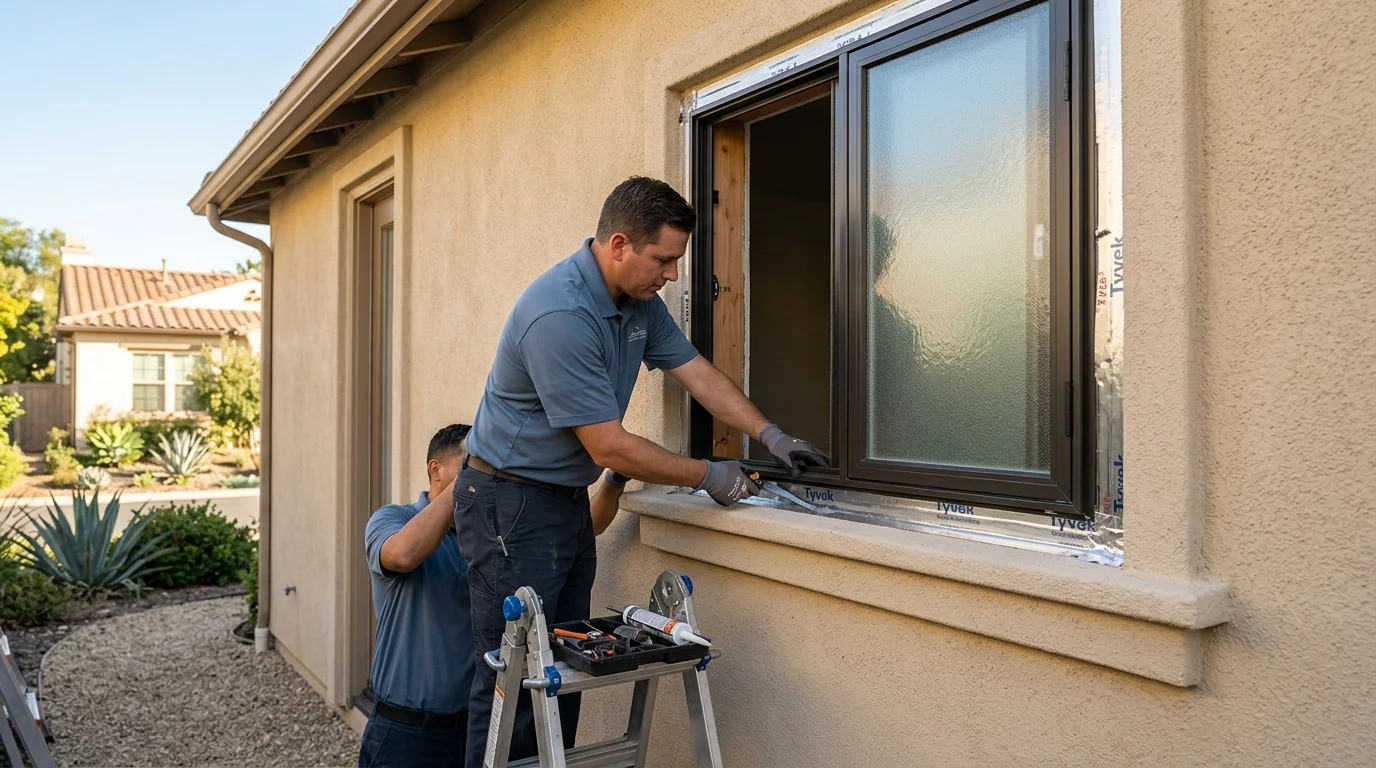
The best bathroom window options balance privacy, ventilation, moisture exposure, and safe placement. Obscure glass in an awning or casement frame is often a practical starting point. It admits daylight, limits direct views, and still opens for airflow.
Inside the City of San Diego, window replacement requires a building permit. Same-size, same-type work may qualify for a No-Plan Building Permit under Information Bulletin 203. That means no plan review, not no permit. Properties elsewhere in San Diego County need a separate jurisdiction check.
The three problems a bathroom window has to solve at once
A bathroom window must handle privacy, light, and operation together. Choosing for appearance alone can leave the room exposed or make the sash awkward to use.
Start with the sightline. Look through the opening from the tub, shower, toilet, and doorway. Then check the outside view from the sidewalk, neighboring windows, and side yard. A ground-floor Point Loma bathroom facing a walkway needs a different privacy plan than an upstairs room in Poway.
Test the view during daylight and after dark. Interior lighting can change what someone sees through privacy glass. Don’t rely on a small catalog image. Ask for a full-size sample or inspect the proposed glass under similar lighting.
Next, decide whether the window must open. A fixed window provides light but no adjustable airflow. An operable sash adds ventilation, though its handle and opening path must remain reachable.
Finally, consider what surrounds the opening. Tile, a shower panel, a tub deck, or deep trim can interfere with the hardware. The window should be planned as part of the whole wall, not dropped into the remaining space.
Our San Diego window styles guide covers the broader style choices. For a bathroom, narrow that list by privacy, reach, and wet-area placement.
Obscure, frosted, and textured glass compared
Obscure, frosted, and textured glass all limit a clear view. They don’t always mean the same thing across manufacturers, so treat each label as a starting point.
Obscure glass distorts shapes through a pattern or uneven surface. Frosted glass usually has a soft, matte appearance. Textured glass can include subtle ripples or more visible decorative patterns. The exact appearance and privacy level depend on the specific product.
Privacy also isn’t simply on or off. Distance, viewing angle, exterior shadows, and interior lighting affect what remains visible. A pattern that hides facial details may still show movement or a silhouette. Request a sample instead of choosing from a pattern name alone.
A full obscure pane works well when privacy matters across the entire opening. Another option is privacy glass below with clearer glass above. That arrangement can preserve a view of the sky while blocking lower sightlines. Confirm that the selected window manufacturer offers the configuration you want.
Privacy glass and safety glazing answer different questions. A pane can obscure the view without meeting the safety requirement for its location. Keep those decisions separate when reviewing the proposal.
For a closer look at patterns and visibility, see our guide to obscure and frosted glass windows.
Awning and casement: why they win in a small wet room
Awning and casement windows belong near the top of many bathroom shortlists. Both provide controlled openings without requiring the sash to slide past another pane.
An awning window is hinged at the top and opens outward from the bottom. That format fits naturally in a wide, short opening placed above a tub or shower surround. Handle access still matters, especially across a deep tub deck.
A casement window is hinged at the side. The sash turns outward as the handle operates it. Casement windows in a bathroom can work well where the opening is narrow and vertical. The contractor should confirm the swing direction, exterior clearance, and handle position.
Don’t choose either style from a floor plan alone. Stand where you’ll operate the window. Check whether the crank is reachable without leaning over a tub or bumping a faucet. If shower glass will sit nearby, include its frame and door swing in the test.
Sliding and double-hung windows can still fit some bathrooms. Their operating direction may suit an opening with limited exterior clearance. Compare the actual open area, screen location, and hardware access for each proposed unit.
See our service overview for sliding, casement, and double-hung windows before comparing configurations.
Ventilation and the moisture that ruins the wrong frame
Bathroom steam and splashing affect more than the glass. The frame, sill, hardware, trim, sealant, and wall finish all need attention.
Inspect the existing opening before selecting a replacement. Look for peeling finishes, soft areas, staining, corrosion, failed seals, or hardware that binds. These signs don’t identify one universal repair. They show where the contractor needs to investigate.
No frame material is automatically right for every San Diego bathroom. Product construction, finish, installation details, and exposure all matter. Ask the contractor to identify the proposed frame material and explain its care requirements. Request the manufacturer’s written maintenance instructions for that exact product.
Location matters too. If the home sits near the coast in Imperial Beach or Oceanside, describe that exposure when comparing hardware and finishes. Ask which option the manufacturer approves for the address. Don’t accept a general material claim without product documentation.
An operable bathroom window can support airflow, but it shouldn’t be treated as proof that the room meets every ventilation requirement. Ask the contractor or permitting authority whether the project needs anything beyond the proposed window.
If the glass remains sound but the sash, lock, or seal needs attention, compare window repair versus replacement before replacing the complete unit.
The safety-glazing question to put to your contractor
The California Building Code identifies hazardous locations where safety glazing may be required, including areas near bathtubs and showers. The specific California dimensional thresholds for bathroom openings couldn’t be confirmed from the accessible primary code text used for this page. Don’t rely on measurements copied from another state’s code or an undated diagram.
Put this exact question to the contractor: “Does this opening fall within a hazardous location under the current California code, and what glazing are you specifying for it?”
Then ask the contractor to show where that answer appears in the proposal or product documentation. Privacy glass alone doesn’t settle the issue. “Frosted,” “obscure,” and “tempered” describe different characteristics.
The permitting authority also depends on the address. For a property inside city limits, City of San Diego Development Services handles the permit question. Ask whether the location, glass type, and proposed operating style affect the submittal.
California’s C-17 glazing scope, defined in 16 CCR 832.17, includes selecting, cutting, assembling, and installing glass, frames, panels, sashes, and doors. That doesn’t establish that C-17 is the only possible classification for every project. Verify the specific professional through the CSLB license check before signing a contract.
Sizing around a tub or a shower surround
Bathroom window sizing starts with the finished wall, not an empty opening on a sketch. Tile thickness, trim, ledges, shower panels, and tub decks can change reach and clearance.
Ask the contractor to map the proposed frame on the wall. Mark the sash edges, handle, and opening path. Then test the layout from the floor and from any safe operating position outside the tub.
Check these details before approving the order:
- Can you reach the lock and handle comfortably?
- Will the sash clear exterior walls, screens, and nearby fixtures?
- Does a shower door or fixed glass panel block operation?
- Does the privacy pattern cover the needed sightline?
- Can the screen and hardware be accessed for cleaning?
- Has the contractor confirmed the safety-glazing question?
Changing the opening size also changes the permit conversation. In the City of San Diego, Information Bulletin 203 limits the cited No-Plan condition to replacement windows with the same size and type, with no change to the existing opening. A resized opening doesn’t meet that condition. Ask Development Services what submittal applies before finalizing the design.
Outside the City of San Diego, don’t assume the same process applies. Give the local permitting authority the project address, existing opening size, proposed size, operating style, and distance from the tub or shower. Ask: “What permit path and safety glazing standard apply to this exact opening?”
When to call us
Bring in a licensed window replacement professional when the opening sits near a tub or shower, the frame shows damage, or you want a different size or operating style. Call us at (858) 400-6418 and we’ll connect you with a licensed local window contractor.