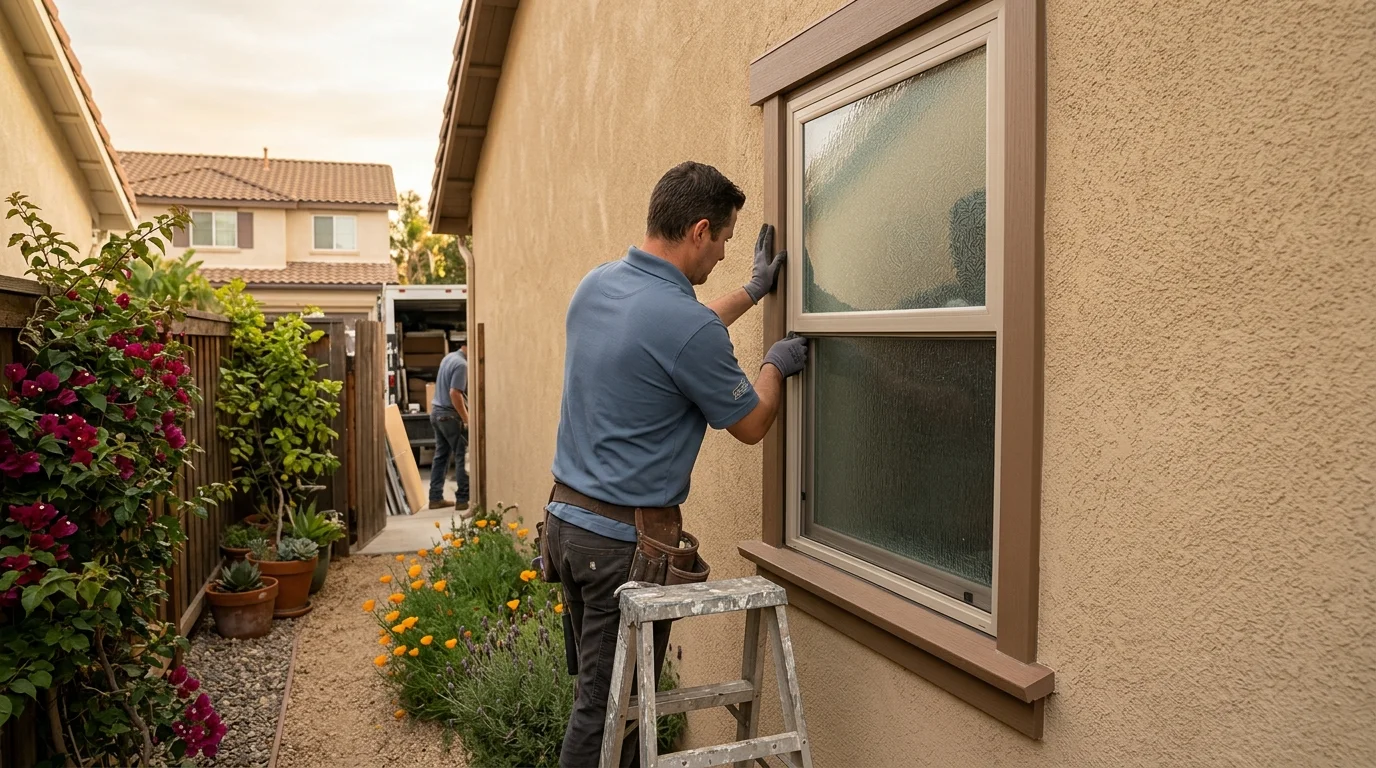
Frosted windows can add privacy, but that label alone isn’t enough for a clear quote. Ask whether you’re getting obscure glass, a frosted glass finish, or applied film, then have the exact selection written into the proposal.
Within the City of San Diego, window replacement requires a building permit. Information Bulletin 203 says same-size, same-type replacement can qualify for a No-Plan Building Permit. That means no plan review, not an exemption from permitting.
Obscure glass, frosted glass, and applied film are three things
Treat these as three separate choices when comparing proposals. A salesperson may use “privacy glass” as a broad label, so the quote should explain what will actually be installed.
- Obscure glass should identify the selected glass or pattern.
- Frosted glass should identify how the frosted appearance is produced.
- Applied film should appear as a separate material placed on a pane.
Don’t accept a proposal that lists only “frosted windows.” Ask for the manufacturer, product name, pattern, finish, and glass-unit description. If a physical sample is available, view that exact selection before signing.
Applied film deserves its own questions. Ask whether it will be installed on existing glass or included with a new window. Confirm who supplies it, who applies it, and what written product terms apply. Don’t assume those terms come from Window Pro SD. We connect homeowners with independent local window professionals and don’t sell products or provide warranties.
The condition of the existing window also matters. Privacy alone doesn’t decide whether to keep the current unit. A damaged frame, failed glass unit, or hard-to-operate sash creates a separate choice between window repair and replacement.
If the work includes removing the existing frame, compare the proposed scope with full-frame window replacement. The privacy selection should remain a distinct line item. That makes it easier to compare proposals without confusing glass appearance with installation method.
Privacy levels and how they are described on a quote
A useful quote describes what “privacy” means for that exact product. It shouldn’t rely on a vague label such as light, medium, or maximum privacy.
Ask the contractor to record the product name and viewing conditions discussed. Look at the sample from both sides. Check it with daylight behind you, daylight behind the glass, and interior lights turned on. Repeat the test from the distance that matters at home.
For a bathroom, that might mean standing near the shower and viewing from the side yard. For a street-facing room, compare the sample from the sidewalk and from inside. If shapes, colors, or movement remain visible, decide whether that result fits the room.
No verified countywide privacy scale could be confirmed for frosted windows. If a supplier uses a numbered rating, ask who created that scale and request the matching product sheet. A rating without a named source isn’t enough for a purchasing decision.
The quote should also separate privacy from operation. A fixed picture window, sliding window, casement, and awning window solve different ventilation and access needs. The San Diego window styles guide can help you compare those operating styles before choosing the glass.
Write the final selection into the contract. Include the room, opening, product, finish, and which pane receives any applied material. That protects against a showroom conversation being reduced to one unclear phrase.
Bathrooms, side yards, and tight lot lines in older neighborhoods
Privacy decisions should start with the actual view. A bathroom facing a narrow side passage needs a different review than a clerestory window above eye level. Stand inside each room and note who can see the opening from neighboring homes, walkways, alleys, and the street.
San Diego County isn’t one uniform market. A coastal opening in Oceanside or Encinitas shouldn’t be specified from assumptions about an East County home in El Cajon. The same applies across inland North County, the central city, and the South Bay. Record the opening’s direction, surrounding structures, shade, and viewing distance.
In central neighborhoods such as North Park, City Heights, and Logan Heights, the age of the building can affect the permit path. City of San Diego rules require historical review for a designated historical resource or a parcel within an adopted historic district. A building 45 years or older also requires plans submitted for historical review unless the proposed scope is exempt.
That review trigger applies within the City of San Diego. It shouldn’t be presented as the rule for Chula Vista, National City, La Mesa, Escondido, or another jurisdiction. The window replacement rules for those cities and unincorporated San Diego County couldn’t be confirmed. Ask the city’s building department, or the County of San Diego for an unincorporated address, whether the project requires a permit, plans, or historical review.
Ask the authority one precise question: “Does this like-for-like window replacement require a permit, plans, or historical review at this address?” For property inside the city, start with City of San Diego Development Services. Also ask whether changing the glass, sash operation, frame, or opening size changes the permit path.
Light transmission: what you keep
The goal is privacy without giving up more daylight than necessary. The exact result depends on the selected product, so compare documented product information and a physical sample.
No verified light-transmission percentage could be confirmed for a generic “frosted window.” That phrase covers too many selections to support one number. Ask the manufacturer or supplier for the published light-transmission information for the exact glass or film on the quote.
Use the room itself as the test location when possible. Hold the sample at the opening during the hours when that room is normally used. Check whether the surface spreads light evenly, creates unwanted glare, or makes the room feel dim. Then repeat the check after sunset with the interior lights on.
Don’t let privacy glass distract from the rest of the window specification. Ask for separate documentation covering the frame, operating style, glass unit, privacy finish, and installation scope. A statement about privacy doesn’t confirm thermal performance, sound control, safety glazing, or code compliance.
Room use matters too. A bathroom may need stronger visual screening than a laundry room. A high transom may need less screening than glass beside a walkway. Choose based on the real sightline, not a pattern name viewed on a screen.
For several openings, label each sample and photograph it beside the matching window. This gives the contractor a room-by-room reference and reduces the risk of one privacy selection being applied everywhere without discussion.
Combining obscure glass with tempered requirements
Privacy and safety glazing are separate specifications. A frosted appearance doesn’t establish whether a window meets the safety rule for its location.
California building codes identify hazardous locations where safety glazing may be required, including areas near doors, bathtubs, showers, and stairways. The exact dimensional thresholds for those locations couldn’t be confirmed from the California Building Standards Commission. Ask the local building department which current section applies and whether the proposed opening requires safety glazing.
Have the contractor identify both requirements on the quote. One line should name the privacy product or finish. Another should state the safety-glazing specification, when required. Ask for product documentation showing that the proposed selection satisfies both parts.
Wildfire requirements create another review point in some projects. If the permitting authority says California Building Code Chapter 7A applies, Section 708A.2 provides two exterior-glazing paths. The assembly must be multi-pane with at least one tempered pane meeting the safety-glazing section, or it must be an assembly tested to SFM Standard 12-7A-2.
Don’t assume the tempered-pane route is the only Chapter 7A option. Don’t assume an obscure appearance proves either route. Ask which path the proposed assembly uses and request the matching documentation.
California Code of Regulations, Title 16, Section 832.17 places selecting, cutting, assembling, and installing glass, frames, panels, sashes, and doors within the C-17 glazing scope. That doesn’t establish that C-17 is the only contractor classification allowed for every window project. Verify the specific contractor and project scope before signing.
When to call us
Call when privacy glass is part of a full window replacement, a changed opening, or a project involving permits, historical review, or safety glazing. Call us at (858) 400-6418 and we’ll connect you with a licensed local window contractor. Before signing a contract, verify the contractor through the CSLB online license check.