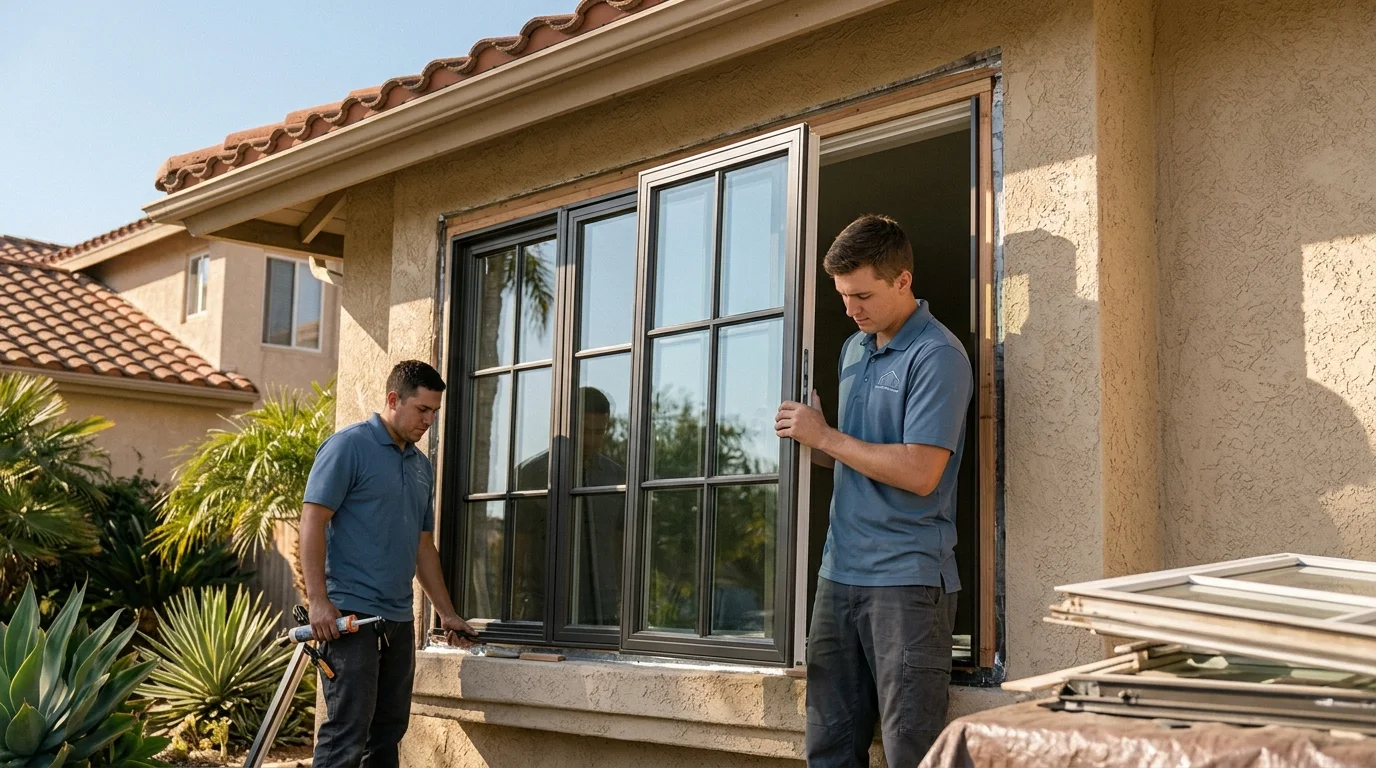
Windows with grilles can sharpen a home’s character or make the glass feel crowded. For most San Diego replacements, pick between-glass grids for easier cleaning, applied grilles for stronger texture, and true divided lites when an exact architectural match matters most.
The right answer depends on the house, not a trend board. Compare the pattern against the exterior, the room, and the actual sunlight before ordering.
Grids between the glass vs applied grilles vs true divided lite
Window sellers don’t always use “grid” and “grille” the same way. Ask to see a corner sample or product drawing. You need to know where the bars sit, whether they’re removable, and whether each opening contains separate glass.
Grids between the glass sit inside the insulated glass unit. Both exposed glass surfaces stay flat. That makes this construction appealing in kitchens, children’s rooms, and other spaces where quick cleaning matters. The tradeoff is visual depth. From close range, the pattern can look flatter than bars placed on the glass.
Applied grilles sit on an interior or exterior glass surface. Some products use bars on both sides to imitate divided panes. A spacer inside the glass may add more depth. This arrangement is often called a simulated divided-lite design, but names vary. Confirm the exact construction instead of relying on the label.
True divided-lite construction uses separate pieces of glass within the sash. It creates real divisions rather than a pattern placed over one larger pane. That distinction may matter when matching an older window. It also creates more edges and smaller glass areas to clean.
Don’t select from a small brochure image. Request a full-size corner sample showing the frame color, bar profile, and connection points. View it from the sidewalk and from inside the room. A grille that looks delicate in your hand can become visually heavy across several openings.
The frame matters too. If you’re still comparing materials and configurations, review the available considerations for vinyl windows before settling on a grid pattern.
Cleaning and glare, honestly
Between-glass grids give you uninterrupted interior and exterior glass surfaces. A cloth can move across each pane without meeting raised bars. That’s the simplest choice when low-effort cleaning ranks above dimensional detail.
Applied grilles add edges where dust, moisture, and cleaning residue may collect. Removable interior grilles can offer access to the glass, but removal methods vary. Ask the window professional to demonstrate the process on the exact product. Don’t assume a grille snaps out because a showroom sample does.
True divided lites require attention around every muntin and glass edge. That may be acceptable on a small front-facing window. It can become tedious across a wall of windows or a bank of doors.
Glare deserves an honest test. Raised bars can cast small shadows and create repeated highlights. Dark grilles can appear crisp in bright light, while light grilles may blend into the glass from farther away. The effect changes with the viewing angle, wall color, landscaping, and time of day.
Take the sample to the actual opening if possible. Check an east-facing room in the morning and a west-facing room later. View it with interior lights on after sunset too. A pattern that looks balanced at a coastal Oceanside property may read differently on an inland Escondido elevation.
There isn’t one glare result that applies to every grille. No verified product-independent glare figure was available for this page. The useful test is the exact sample, on the exact window, under the home’s real lighting.
Matching a Spanish, craftsman, or mid-century elevation
Start with the whole elevation. Window grilles should support the front door, roofline, trim, and spacing between openings. They shouldn’t become the first thing visible from the street unless that’s a deliberate design choice.
For a Spanish-influenced house in Kensington, Chula Vista, or another San Diego neighborhood, restrained patterns often make the stronger starting point. Test a simple vertical division or a limited upper-sash pattern before covering every pane with small squares. Deep exterior trim and arched openings already provide visual detail.
For a craftsman-style elevation in North Park or South Park, compare the grille pattern with porch posts, eaves, and existing woodwork. An upper-sash pattern may preserve a clearer view through the lower glass. Keep the bar width consistent across windows that share the same facade.
A mid-century elevation near the College Area, Point Loma, or La Mesa usually calls for a different conversation. Large glass areas and strong horizontal lines can be part of the design. Adding grids to every opening may fight that composition. Start by testing no grids, then compare one simple pattern if the exterior needs more definition.
San Diego County shouldn’t be treated as one design market. A coastal North County remodel, an inland North County house, an East County ranch, and a South Bay infill property can have very different elevations. Match the building in front of you.
Grid color also needs a full-window check. A dark exterior frame with matching dark bars creates a stronger outline. A light interior finish may reduce the pattern’s presence inside. Split-finish availability depends on the exact product, so confirm it before making the exterior design depend on that option.
Our San Diego window styles guide can help you compare the sash and opening style first. Choose the window operation before treating the grille as the main decision.
HOA and historic-district expectations
An HOA review and a city historic review are separate matters. Don’t treat an HOA approval as confirmation that the city has approved the project. Don’t assume a city permit settles an association’s design requirements either.
Before ordering, ask the HOA or property manager for the current architectural guidelines. Use a direct question: “Does changing the grid pattern, bar profile, frame color, or divided-lite configuration require written approval?” Request the answer in writing and submit the manufacturer’s drawing for the exact window.
Inside the City of San Diego, the permit rule is settled. City Development Services Information Bulletin 203 states that window replacement requires a building permit. A same-size, same-type replacement can qualify for a No-Plan Building Permit when the opening size doesn’t change. No-Plan means the permit is issued without plan review. It doesn’t mean the work is permit-exempt.
That route applies only to structures that were legally permitted, built, and passed final inspection. The City also requires historical review for a parcel containing a designated historical resource or located within an adopted historic district. A building that’s 45 years old or older requires plans submitted for historic review unless the scope is exempt. Confirm the current process with City of San Diego Development Services.
Rules outside the City of San Diego couldn’t be confirmed from the approved source material for this page. Encinitas, Escondido, La Mesa, Chula Vista, and other jurisdictions set their own review processes. Ask the relevant building department: “Does this replacement qualify for a no-plan process, and does changing the grille pattern trigger design or historic review?”
A contractor’s product match still needs scrutiny. Bring clear exterior photographs and measurements to each discussion. Our guide to choosing a window installer in San Diego explains what to compare before signing a contract.
What grids do and do not do to the energy numbers
A visible grid pattern isn’t an energy rating. Don’t infer Title 24 compliance from the number of squares, the grille material, or a sales description. Ask for the performance documentation tied to the exact configured window.
California’s 2025 Building Energy Efficiency Standards took effect January 1, 2026. San Diego County spans Climate Zones 7 and 10. The prescriptive maximum fenestration U-factor for those zones is 0.30, while the mandatory maximum is 0.40 in every California climate zone. The California Energy Commission publishes the standards and current compliance resources.
The replacement-window exception needs careful wording. Section 150.2(b) of the 2022 Energy Code allows replacement of no more than 75 square feet of vertical fenestration with a maximum U-factor of 0.40 in Climate Zones 1 through 16. It also states a maximum SHGC of 0.35 in Climate Zones 2, 4, and 6 through 15.
The verbatim exception available for this page came from the 2022 edition. The 2025 edition is now in force, but its matching text wasn’t reached through the available primary source. Ask the building department to confirm the current edition and whether the exception applies to your project.
No verified product-independent figure was available showing that one grille style raises or lowers U-factor by a set amount. That means a generic energy penalty or savings claim shouldn’t drive your choice. Compare the certified figures for the exact window, glass package, frame, size, and grille configuration being quoted.
A product family may contain several configurations. Don’t assume the showroom label covers every version. Ask the professional to identify the documentation for the unit you’ll receive, then keep it with the contract and permit records.
When to call us
Call when grille selection overlaps with window replacement, historic review, or a difficult architectural match. Window Pro SD is a referral service that matches homeowners with licensed, independent local window replacement pros. Call us at (858) 400-6418 and we’ll connect you with a licensed local window contractor.