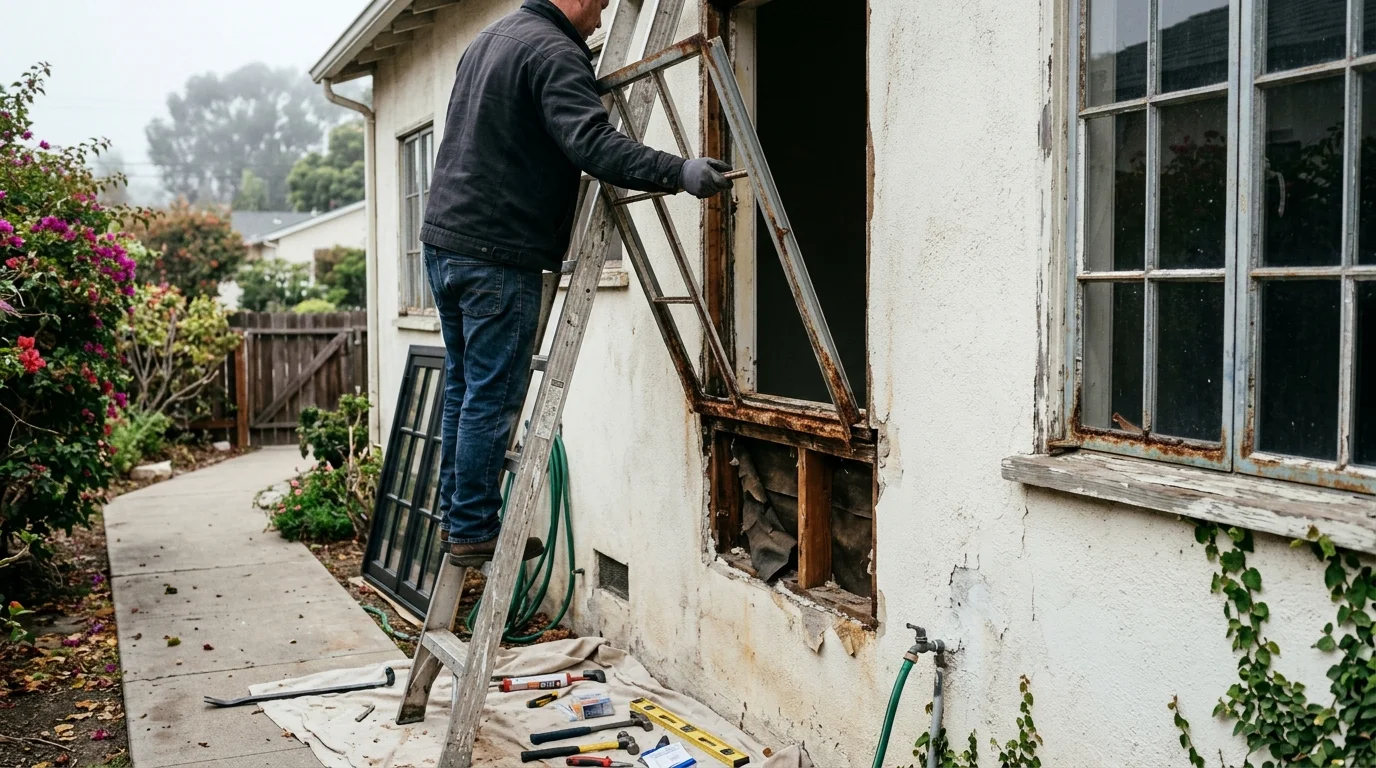
The skinny steel sash on a Point Loma bungalow is the window. So is the same sash on an older Coronado cottage. When the lower rail flakes, and the operator no longer pulls the leaf against the frame, you’re past a paint weekend. Steel casement window replacement in this county is almost always a full-frame job, because that metal frame is built into the stucco.
What a steel casement is, and where it still sits in this county
A steel casement is a slim metal sash that hinges at the side and swings out. The glass sits in putty, not a vinyl bead. Many original units mix an operable leaf with a fixed light in the same grid. A casement is the hinged sash you crank or push. A fixed light in that same steel assembly stays shut.
This is older housing stock. You’ll still find these frames in Point Loma and Loma Portal, where the marine layer sits on the metal all morning. Mission Hills kept them on street elevations. So did the older flats toward Bankers Hill. Kensington and Talmadge show them on smaller Tudor and Spanish houses. Older Coronado cottages, off Orange Avenue and toward the Glorietta side, still have original steel in the stucco. Some pre-war apartments in University Heights and North Park kept the same narrow bars on the street and the alley.
Coastal steel lives a harder life than inland steel. Salt air on Coronado and the Point Loma peninsula attacks the lower rail and the hinge knuckles. Inland Kensington still rusts at the sill. The sun cooks the putty there. The look is the same either way: a thin sightline, divided lights, a crank at the jamb. The wall around it is usually stucco over wood frame. On some Coronado and central-city buildings it is masonry.
That sightline is why people keep them. The glass area is large for the opening. A modern unit can match the swing. Matching that thin steel bar is a different problem, and it is why casement windows on these houses get specified as custom or replica more often than as a catalog insert.
These openings are a different remnant from the painted wood hung sash on Craftsman streets. That stock is covered in wood window replacement in San Diego. South Bay courts still have jalousie and louvered windows, which leak at every slat. Steel casements leak where metal is supposed to meet metal. Clairemont and Mira Mesa aluminum sliders are later tract work. This post is the pre-war steel that those jobs do not touch.
Rust, putty, and operators that no longer pull the sash shut
Failure on these units comes in three parts, and they stack.
Rust starts at the bottom rail, the sill, and the hinge side. Water sits in the steel channel. Paint bridges the meeting faces. Then the sash stops closing square. You can grind paint off a tight meeting rail. Structural rust in the rail is a different condition. Weep slots, if they were ever punched, clog with flakes. The sill then holds water against the stucco.
Putty is the glazing. Original steel used a face putty over a back bed. It shrinks, cracks, and lets the pane rattle. A glass shop can pull a broken lite and reset glass in a sound sash. EPA treats replacing a pane of glass, or fixing a balancer, as something other than “window replacement” under the Lead Renovation, Repair, and Painting Rule when the work stays inside the minor-repair limits and skips prohibited practices (40 CFR 745.83, EPA RRP FAQs). Whole-window replacement is a renovation. The minor-repair exemption does not cover replacing the window, even if the unit itself is small. On a pre-1978 house, confirm the matched firm’s RRP certification on epa.gov before anyone scores paint. EPA does not publish a fine amount in our claims ledger, so we do not invent one. Certification status is the check that matters.
The operator is the third failure. Original steel used a crank, a sliding stay, or a simple handle. When the gears strip or the arm bends, the sash no longer pulls into the frame. A stiff crank on a 1990s vinyl casement is often a hardware job. That is casement window crank repair. Original steel operators sit in a rusted stile. A new crank on a racked sash still leaks.
Glass-only work is possible on a sash that is still true, with hinges that still bite. Insulated glass in an old steel pocket is a custom conversation with the glass shop and the energy code. It is not a standard dual-pane swap. If the rail is scabbed, the putty is gone, and the sash no longer meets the frame, new glass leaves the draft. The metal-on-metal close these windows were built for is already gone.
Why this is almost always a full-frame job
The steel frame is the window. There is no wood jamb waiting behind a stop that you pop and reuse. The metal is lagged or nailed to the rough opening, then stuccoed to the flange or the brick mold. An insert that sits inside that rusty channel keeps the failed frame. It keeps the rust line. It also shrinks glass that was already tight to the bar.
Full-frame window replacement means the matched pro removes the sash and the steel frame, down to the rough opening. A new unit goes in. Exterior and interior finishes get rebuilt. That is how you get a nailing flange, a pan, and a seal that is not caulk over scale. Retrofit has a place on later aluminum and vinyl. It is the wrong picture for a steel casement that has become part of the wall.
Openings on these houses are often out of square. Settling on Point Loma slopes and old Coronado fill will rack a rigid steel sash. A restoration shop can realign some leaves. Once the bottom rail is thin, the honest path is to pull the frame and build a square opening. New casements then get ordered to the true rough opening, not to the rusted daylight size.
Same-size, same-type replacement is the permit path you want when you can keep it. In the City of San Diego, Information Bulletin 203 says a building permit is required for window replacement. Same-size, same-type work with no change to the opening can qualify for a No-Plan Building Permit. That is a permit issued without plan review. It is not a skip. Only structures that were legally permitted, built, and passed final inspection may use it. Changing the opening size or the window type leaves that path.
Coronado is its own city. Unincorporated county pockets are another jurisdiction. IB 203 is a City of San Diego bulletin. Do not take it as Coronado’s rule or the County’s. Ask that city, or the County, before anyone cuts stucco.
If the opening is a bedroom escape window, 2022 California Residential Code section R310 still applies after the swap. Net clear opening is 5.7 square feet, or 5.0 square feet at grade floor (R310.2.1). Minimum clear height is 24 inches. Minimum clear width is 20 inches (R310.2.2). The bottom of the clear opening can sit no more than 44 inches above the floor (R310.2.3). Divided-light steel casements often miss those numbers with the sash open. The replacement has to pass them, and also look like the old grid.
Matching a vintage elevation without copying the drafts
The job people want is the old elevation without the old air leak. Narrow sightlines. A casement swing. Divided lights that line up with the stucco score. That is a product and detailing problem.
Replica steel and thermally broken steel exist. So do aluminum and fiberglass casements with simulated divided lites. Vinyl can swing like a casement and still read heavy on a 1920s Coronado cottage. The matched pro should mock the sightline against the existing stucco band. Keep the exterior putty line or the brick-mold profile close. Move the performance into the glass and the new frame.
California’s 2025 Building Energy Efficiency Standards took effect January 1, 2026. They are the edition in force now. San Diego County sits in Climate Zones 7 and 10. The prescriptive maximum fenestration U-factor there is 0.30. The mandatory maximum U-factor is 0.40 in every climate zone. California Energy Code section 150.2(b) gives a replacement exception: replacing vertical fenestration no greater than 75 square feet with a U-factor no greater than 0.40 in Climate Zones 1-16, and a SHGC no greater than 0.35 in Climate Zones 2, 4, and 6-15. A small cottage job may fit that exception. A whole-elevation swap on a Kensington house may not. Those 150.2(b) words were read from the 2022 edition. The 2025 edition is reported to carry the same exception. Confirm the current edition with the building department, and read the California Energy Commission standards page with the contractor.
ENERGY STAR is a separate product check, not a stand-in for Title 24. Look the unit up on energystar.gov rather than taking a brochure at its word. Skip a federal 25C window credit on a 2026 install. Section 25C is terminated for property placed in service after December 31, 2025.
If the parcel uses California Building Code Chapter 7A, section 708A.2 requires exterior windows to be multi-pane with at least one tempered pane meeting the safety-glazing section, or an assembly tested to SFM Standard 12-7A-2. Both paths count. Multi-pane glass is also a listed home-hardening measure under Safer from Wildfires (10 CCR 2644.9). That rule is about the wildfire portion of a premium, and about FAIR Plan eligibility in Very High zones. It is not a promise about the whole bill.
Match the elevation. Leave the single-pane steel leak in the dumpster.
What a quote has to solve before anyone cuts the opening
A useful quote is a work plan.
It has to name the method: full-frame removal of the steel, flashing, stucco patch, interior casings, and who paints the new exterior. It has to state whether the new unit is a casement, a mixed fixed-and-casement assembly, or a replica steel product. It has to show U-factor on an NFRC label, and whether the job is using the 150.2(b) 75-square-foot path or the prescriptive 0.30 U-factor. Cost follows the opening, the stucco repair, and the product family. Ask for those line items. A round number with no method behind it is not a quote.
Inside the City of San Diego, it has to say who pulls the permit. IB 203 still requires one. If the parcel has a designated historical resource, sits in an adopted historic district, or the building is 45 years or older, historic review can apply, and plans may have to go in for that review unless the scope is exempt. Census figures already used on this site put 49.6% of San Diego housing before 1978, so the 45-year trigger is common. Those bulletin facts are City of San Diego facts. They do not travel to Coronado or to the County. Start at San Diego Development Services for city parcels.
On a pre-1978 house, the quote should show EPA RRP firm certification. Window replacement disturbs paint. Check the firm on epa.gov. A glass-only line item is not the whole job if the frame is the failure.
The contractor doing the work needs a California license when the aggregate contract is $1,000 or more (Business and Professions Code 7048). Window and glazing work sits inside the C-17 glazing contractor scope in Cal. Code Regs. tit. 16, sec. 832.17: selecting, cutting, assembling, and installing glass and frames, and installing those items in a structure. Verify the number on the CSLB license check. Window Pro SD is a referral service. We match you with licensed independent local pros. We do not mill sash, weld frames, or install.
Measure twice. Steel openings lie. The daylight size is not the rough opening. Out-of-square needs a number. Screens, cranks, and divided-lite alignment with the neighboring windows belong in the quote, before the stucco is cut.
If two bids disagree on full-frame versus setting a new sash in the old steel, the full-frame bid is answering the actual window.
When to call us
When the steel rail is rusted through, the sash no longer pulls shut, or the elevation has to stay and the drafts cannot, you need a licensed window replacement pro. Call us at (858) 400-6418 and we’ll connect you with a licensed local window contractor.