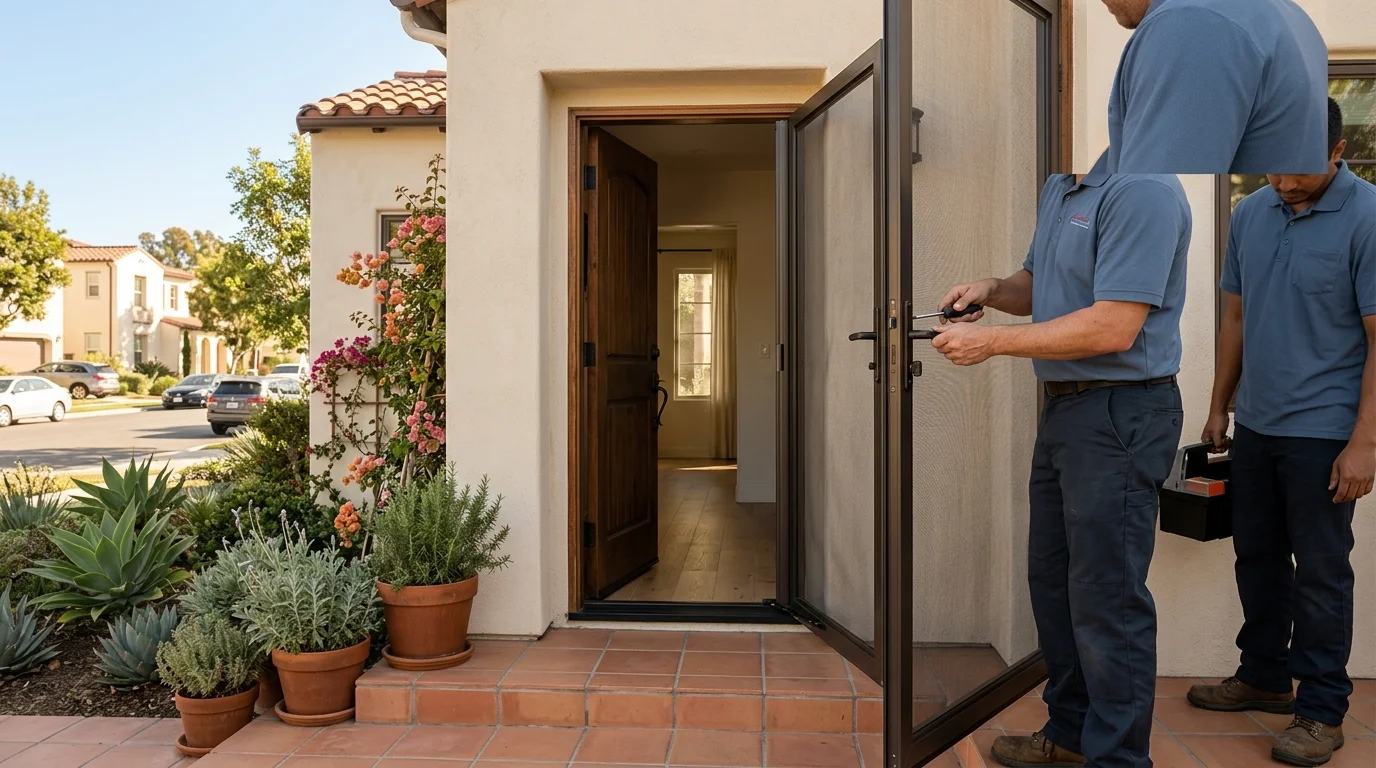
Choose a screen door when airflow and insect mesh are the job. Choose a storm door when the entry needs an added exterior panel for a defined exposure. If security is the priority, compare security products separately instead of assuming either label covers it.
That distinction matters across San Diego County. A sheltered porch in North Park presents a different decision from an exposed entry in Oceanside, Escondido, El Cajon, or Chula Vista.
Storm door versus screen door, and why the difference matters here
A screen door usually puts mesh between the home and the outdoors. It can let the main door stay open while the outer door remains closed. The shopping decision centers on airflow, visibility, insects, pets, operation, and the condition of the existing frame.
A storm door adds an outer panel to the entry. Depending on the product, that panel may be glazed, screened, solid, or adjustable. Don’t treat that label as proof of performance. Ask what the exact model is designed to do and request its written specifications.
Start by naming the job in one sentence. “I want airflow without leaving the opening uncovered” points toward a screen door. “I want an extra exterior panel because this entry receives direct exposure” points toward a storm door. “I want resistance to forced entry” starts a different conversation about security construction, locking points, frame attachment, and documented testing.
The existing opening matters too. Check whether the entry is square, whether the trim is sound, and whether the main door swings freely. Note nearby lights, handles, mail slots, steps, and railings. An outer door that conflicts with existing hardware won’t become a good fit through better marketing language.
No San Diego County price range, installation time, or warranty term could be confirmed for screen and storm doors. Compare written proposals instead. Each proposal should identify the product, frame work, hardware, finish, labor, exclusions, and who provides any warranty.
Our climate rarely needs a storm door, and the exception
A storm door shouldn’t be the automatic choice for every San Diego address. First identify what the outer panel must accomplish at that specific opening. Countywide labels such as coastal, inland, north, central, or South Bay aren’t detailed enough on their own.
Walk the entry at different times. Note direct sun, shade, wind-driven debris, rain reaching the threshold, and any water marks around the trim. Compare the front entry with other openings on the same home. A sheltered porch and an uncovered side door can present different conditions even at one address.
The exception is an entry with a clear, repeatable exposure that the selected product is documented to handle. That could make an outer panel worth comparing. The product literature should address the installation location, ventilation, glass or panel configuration, and attachment method. Ask the seller or installer to put the recommendation in writing.
Don’t assume a storm door will correct damage in the main door, sill, trim, or wall. If the opening sticks, leaks, or shows damaged material, identify that issue first. The useful comparison may be repair versus replacement, not screen versus storm. Our guide to window repair versus replacement explains the same decision principle for nearby window openings.
A storm-door-specific permit rule could not be confirmed with City of San Diego Development Services. For property within the City of San Diego, ask Development Services this exact question: “Does adding an exterior screen, storm, or security door at this opening require a permit or review, and would changing the frame or opening change that answer?” Outside the city, ask the authority responsible for the property address.
Heat trap risk on a south-facing entry
Don’t choose an enclosed outer panel for a sunny entry without checking the product documentation. No San Diego-specific temperature threshold, heat limit, or finish-performance figure could be confirmed for storm doors. Any contractor or seller giving one should identify the source and exact product.
Begin with orientation and shade. Record when direct sun reaches the door and when it leaves. Include roof overhangs, porch walls, nearby buildings, and seasonal shade in the discussion. A compass direction alone doesn’t describe the whole opening.
Next, review the main door. Note its material, color, glazing, finish condition, and any instructions from its manufacturer. Ask whether adding an outer panel is permitted with that door. Get the response in writing, especially when someone ties the recommendation to a warranty. Window Pro SD doesn’t issue product or labor warranties. Those terms come from the manufacturer and the independent professional involved.
Ventilation deserves the same attention. If a storm door can switch between glass and screen, ask how that change is made and whether the chosen configuration fits the entry’s sun exposure. Don’t accept “it should be fine” as a product specification.
South-facing isn’t the only condition to inspect. West-facing entries can also receive strong afternoon exposure, while porch depth may keep another opening shaded. Compare the actual doorway in Clairemont, Poway, La Mesa, or San Ysidro instead of relying on a regional rule.
If heat at adjacent windows is also part of the project, read our guide to reducing west-facing heat gain in San Diego. Keep the door and window recommendations tied to their own documented products.
Salt air and hardware finishes near the coast
Don’t treat “coastal grade” as a complete specification. Ask what material, coating, hardware, and maintenance instructions support that description. No verified distance-from-coast threshold or service-life figure could be confirmed for screen and storm door hardware.
Inspect the hardware already at the home. Look at hinges, fasteners, handles, locks, closers, thresholds, and nearby window hardware. Photograph visible rust, pitting, discoloration, flaking, or powdery residue. Those observations give a local pro something concrete to assess.
This approach is more useful than grouping every coastal address together. An opening in Imperial Beach, Point Loma, Encinitas, or Oceanside still needs its own inspection. Exposure can differ between the street side and ocean side of one building. Shelter from a porch or neighboring structure also belongs in the product discussion.
Ask each bidder to identify the proposed hardware and finish in writing. The proposal should also state which fasteners are included, what cleaning the manufacturer calls for, and which conditions are excluded from warranty coverage. Don’t assume the frame, handle, hinges, and screws share the same finish or maintenance needs.
Our guide to windows for coastal salt air in San Diego offers a similar inspection framework for window frames and hardware. It avoids unsupported lifespan promises and focuses on visible conditions, written product details, and maintenance instructions.
Before approving work, confirm who will address damaged trim or an unsuitable mounting surface. A new outer door shouldn’t be used to hide an unresolved opening problem. Keep repairs, door installation, finish work, and disposal clearly separated in the proposal.
Security screen doors as the option people actually want
Some homeowners begin by searching for screen and storm doors when security is their real priority. Say that goal plainly. An ordinary mesh screen, an outer glass panel, and a security screen product aren’t interchangeable shopping categories.
Ask for documented details about the complete assembly. That includes the screen or grille material, frame, hinges, lock, strike area, fasteners, and attachment to the existing opening. A strong-sounding product name doesn’t show how the full assembly performs.
Avoid vague promises such as “break-in proof” or “maximum security.” Request the manufacturer’s written testing information for the exact model. Ask the installer to explain how the proposed attachment method fits the existing wall, trim, and door frame. Keep that answer with the proposal.
Daily use matters alongside the security goal. Test the handle location, closing action, view through the screen, threshold, and clearance around steps. Discuss how children, pets, visitors, and deliveries affect the chosen setup. Make sure the main entry can still operate as intended.
If the project includes a rear opening, compare the security screen decision with the condition of the patio or sliding glass door. A dragging patio panel, damaged frame, or failing lock needs its own assessment. Don’t assume an added screen resolves a problem in the primary door assembly.
Licensing depends on the work included, not the marketing label placed on the product. If a project expands into window, glazing, or glazed-door work, California’s verified C-17 scope covers the fabrication and glazing of frames, panels, sashes, and doors under 16 CCR 832.17. Check a proposed contractor through the CSLB license lookup, and confirm that the classification fits the complete scope.
When to call us
Call when the project involves a damaged opening, glazed door assembly, adjacent windows, frame changes, or uncertainty about repair versus replacement. Window Pro SD is a referral service, so the independent professional handles the inspection, proposal, contract, physical work, and any warranty.
Call us at (858) 400-6418 and we’ll connect you with a licensed local window contractor.