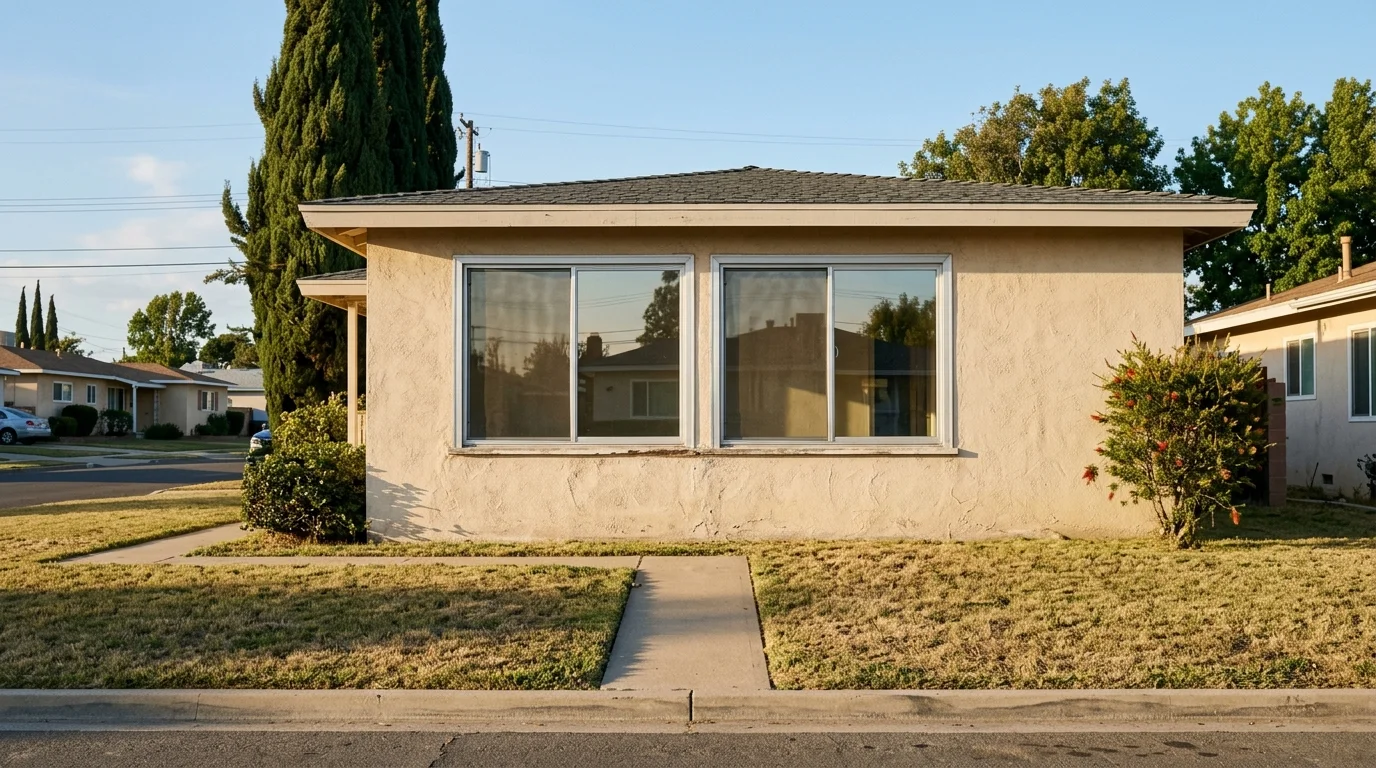
To replace aluminum windows in a San Diego tract home, you are taking original sliders out of a stucco wall, not picking a frame color in a showroom. The mill-finish aluminum that went in with the house is still the host in Mira Mesa, Clairemont-style ranchers, Kearny Mesa, and the same-era tracts in El Cajon and Chula Vista. The real decision is whether that aluminum stays in the opening or comes out with the glass.
This is not a vinyl vs fiberglass vs aluminum bake-off. That comparison lives on its own page. It is also not a recap of retrofit vs full-frame. This page is the aluminum opening itself: the nail fin in the stucco, the rollers in the track, and the conductive frame you either wrap or remove.
Why so many San Diego houses still have original aluminum sliders
Those sliders are still there because they were the production window for a whole generation of San Diego stucco tracts. Builders needed a light, nailable unit that went in fast on a wood-frame wall. Mill-finish aluminum did that. The sash slid. The screen sat in a second track. The fin disappeared under the stucco. The house closed, and the window stayed.
Clairemont ranchers from the postwar boom are full of them. So are Kearny Mesa streets that filled in the same decades. Mira Mesa’s 1970s and 1980s tracts repeated the pattern at larger scale: two-story stucco, a row of aluminum sliders on the street, another row on the back. Parts of El Cajon and Chula Vista used the same catalog. Different city, same opening.
Census figures already used on this site put 49.6% of San Diego housing before 1978. A large share of that stock still carries the first aluminum unit. In 2026, a house built in 1978 is already past the City of San Diego’s 45-year historic-review trigger. Clairemont ranchers are well past it. Confirm the current process with City of San Diego Development Services if the address is inside the city. El Cajon and Chula Vista run their own building departments. Do not assume the city’s Information Bulletin 203 path applies there.
The original unit is usually a single-pane slider in a continuous aluminum extrusion. There is often no separate interior frame worth saving as a modern window. The metal is the window. It conducts heat. It pits in salt. The sash drops when the rollers die. Homeowners live with it for a long time because the glass still looks like glass, and the stucco still looks finished.
A later “replacement” that left the aluminum in the wall is common too. Someone set a new sash or an early insert inside the old frame. From the street you still see aluminum. From the room you might see vinyl or a second aluminum channel. That host frame is the one this job has to judge.
Window and door glazing work sits inside California’s C-17 classification. Cal. Code Regs. tit. 16, sec. 832.17 covers selecting, cutting, assembling, and installing glass and glass work, and installing frames, panels, sashes, and doors in a structure. Confirm the person at the door on the CSLB license lookup. California Business and Professions Code section 7048 requires a valid contractor license when the aggregate contract for labor, materials, and all other items is $1,000 or more.
What fails first: rollers, the thermal break, and the glass
The sash usually complains first. Original aluminum sliders ride on small rollers in a bottom track. Dirt, sand, and dried lubricant pack that channel. The roller axles corrode. The sash drops, then scrapes, then takes two hands. Coastal houses from Imperial Beach through Ocean Beach, Pacific Beach, La Jolla, Encinitas, Carlsbad, and Oceanside see that hardware wear faster because salt sits on the metal. Inland heat in El Cajon dries the same rollers and bakes the track. Either way, the first symptom is a window that will not slide.
Hardware and insulated-glass repair on this site is published at $150-$450 per window. That band is for a repair, not a new unit. If the only problem is a roller or a lock, a licensed pro can say so. If the track is pitted, the corners are split, or the sash is racked in a banana-shaped frame, new rollers in the same aluminum are a delay.
The thermal path is next, and on a lot of these houses it was never a separate part. A thermal break is a non-metal strip, often polyamide or polyurethane, that separates interior aluminum from exterior aluminum so the frame is not one conductive piece. Most original tract sliders are a continuous extrusion. The interior metal follows the outside temperature. In East County sun the frame is hot to the touch. On a January inland night it is a cold strip next to the glass. Condensation can sit on the aluminum even when the lite is clear. That is the frame doing what aluminum does, not a mystery leak.
If a later aluminum unit was sold as thermally broken, ask the licensed pro to show the break in the actual frame. A brochure photo is not the opening in your wall. Isolators can crack, shrink, or get bridged by screws. We do not publish a year-count for that failure. Exposure, product, and installation all change it, and a single lifespan would not fit a shaded Clairemont north wall and a west wall in El Cajon.
The glass is the third failure, and it is easy to misread. Original single-pane aluminum has no sealed cavity. What you see on the room side is indoor moisture or dirt, not a failed insulated-glass unit. Some openings later got dual-pane glass in the old sash, or an insert with its own IGU. Fog that will not wipe off both faces is a failed seal in that newer glass. It is not proof the aluminum frame is finished, and it is not proof the frame can stay. A licensed glazing contractor has to look at the sash, the corners, and the sill before anyone orders glass-only work.
Do not treat a dropped sash, a hot frame, and cloudy glass as three separate weekend projects if they are the same opening. The quote should say which of those three is driving replacement, and which openings can still take a repair.
Retrofit insert vs full-frame on an aluminum opening
On an original aluminum opening, retrofit means the aluminum stays in the wall. The sashes come out. A new vinyl window or fiberglass unit is set inside the remaining host frame and sealed at the perimeter. The stucco face is not cut. The original nail fin stays buried. The weeps of that old frame still have to drain. The new unit is smaller than the daylight you had, because its frame sits inside the aluminum.
That path is only honest if the host is still a window: reasonably square, sound at the corners, not crumbled at the sill, not bowed so the new sash binds. The original flashing behind the stucco still has to work. If those things are true, an insert can change the glass without opening the wall. Published vinyl retrofit on this site is about $650-$1,200 installed. Dual-pane insert work is published at $400-$900. Those are per-window bands, not a whole-house lump sum.
What retrofit does not do is remove the conductive ring. The aluminum host remains around the new vinyl or fiberglass. Heat and cold still have a metal path at the perimeter. Coastal corrosion can still work on that hidden frame. If the old weeps clog, water still sits at the sill you did not replace. A retrofit sold as “the aluminum is gone” is not describing the wall.
Full-frame replacement is the job that actually takes the original slider out. The licensed pro cuts the stucco back, pulls the aluminum unit including the fin, inspects the rough opening, and installs a new flanged window with new flashing tied to the weather barrier. Then the stucco is patched and the interior is re-trimmed. Published full-frame on this site is $900-$1,600 per window installed. The extra money is the wall work, not a nicer sticker.
Full-frame is the cleaner call when the sill is pitted through, the corners have opened, the frame is out of square, stain lines run down the interior drywall, or a probe at the stool finds soft wood. It is also the call when you change size or operation. Bedroom openings still have to keep California Residential Code R310 emergency-escape dimensions: 5.7 square feet of net clear opening in general, 5.0 square feet at grade-floor or below-grade openings, at least 24 inches high and 20 inches wide, with the bottom of the clear opening no more than 44 inches above the floor (2022 CRC R310.2.1 through R310.2.3). A fat insert in a small original bedroom slider can steal the clear opening the room still needs.
Lead rules split on this same opening. EPA’s Renovation, Repair, and Painting rule treats window replacement as renovation, not minor repair. EPA has said replacing mill-finish aluminum windows is not an RRP job when the work does not disturb a painted surface. Painted interior stools, stops, or exterior trim take that exemption off the table. Full-frame work on a pre-1978 house often disturbs those painted parts. Newer windows in a pre-1978 house still need a lead-free determination on the components you will disturb. We do not publish fine amounts. Ask the contractor how they will document that determination. The EPA lead program is the authority.
Inside the City of San Diego, a building permit is required. Information Bulletin 203 allows a No-Plan Building Permit when the new windows are the same size and type, with no change to the existing opening size. That is a permit without plan review, not a skip. Changing a slider to a casement is a type change. Mira Mesa, Clairemont, and Kearny Mesa sit in the city. El Cajon and Chula Vista do not. Have the contractor write the jurisdiction and who pulls the permit.
Coastal corrosion vs East County heat on the same frame
Salt along the strand and inland heat do not fail the same parts. From Imperial Beach through Coronado, Point Loma, Ocean Beach, Pacific Beach, La Jolla, Del Mar, Encinitas, Carlsbad, and Oceanside, marine air leaves salt on tracks, screws, locks, and the aluminum itself. Hardware pits. Roller axles freeze. Screen frames chalk. The sill holds moisture against mill-finish metal. The frame can look dull and still be structurally there, or it can be white, flaking, and thin at the corners. Distance from the water is not a published cutoff. The opening’s actual exposure, overhang, and irrigation matter more than a mile marker.
Inland tracts in Kearny Mesa, Mira Mesa, El Cajon, and similar East County streets see less salt and more sun cycling. West and south walls take a long afternoon load. The glass and the metal expand, then drop at night. That movement works weatherstrip, any later thermal-break compound, and the IGU edge if dual-pane glass was added. Rollers dry out. Tracks get abrasive dust instead of salt crust. The interior aluminum runs hot in summer. That is a comfort problem even when the sash still moves.
The same original slider can sit in both climates because the county is not one weather. A Clairemont west wall is not an Oceanside west wall. A Chula Vista tract a few miles inland is not Imperial Beach. Ask the licensed pro to photograph the sill, the corners, the fasteners, and the weep path on your actual openings. A coastal hardware spec (stainless or a finish the manufacturer rates for salt) does not fix an East County heat problem, and a low-E glass package does not rebuild a pitted coastal sill.
Do not accept a lifespan story in place of that inspection. We could not confirm a standard year-count for aluminum sliders in San Diego County, and we will not invent one. What you can see is the failure mode: salt eating hardware and sills on the coast, heat cycling glass and frames inland, and rollers dying in both.
If the quote is for new aluminum instead of vinyl or fiberglass, treat that as a different product decision. Some contemporary and commercial openings still want a slim metal profile. Most original tract sliders are being retired, not remade. Send the material comparison to the vinyl, fiberglass, and aluminum guide and keep this job about the host frame in your wall.
What a quote must show so vinyl or fiberglass is a fair swap
A fair swap is a line-item scope, not a slogan that vinyl is better. A vinyl-only pitch does not tell you whether the aluminum host stays. A quote for new aluminum does not tell you whether the old fin is coming out. Make every bidder price the same openings the same way.
The written quote should show, per opening:
- Location in the house and current operation (usually an aluminum slider)
- Whether the aluminum host stays (retrofit) or comes out (full-frame)
- New frame material and product line, vinyl or fiberglass named, not “replacement window”
- New operation, and a flag if that operation is not the same type as the existing slider
- NFRC U-factor and SHGC for the unit being sold, copied from the label data, not a logo
- Glass package, grids, exterior color, interior color, and screen
- Hardware spec on coastal openings, including locks, rollers, and fasteners
- Stucco patch, interior trim, exterior sealant, and haul-away, each marked included or excluded
- Who pulls the permit, in which jurisdiction, and whether IB 203 even applies
- Historic review if the City of San Diego building is 45 years or older, designated, or in a district
- Lead determination method if the house is pre-1978 and painted surfaces will be disturbed
- Installed price against this site’s published bands: vinyl retrofit about $650-$1,200, dual-pane insert $400-$900, full-frame $900-$1,600
- The contracting company’s legal name and CSLB number, not Window Pro SD
California energy code applies when the new units are fenestration replacement. The 2025 Building Energy Efficiency Standards took effect January 1, 2026. San Diego County sits in Climate Zones 7 and 10, so the prescriptive maximum U-factor is 0.30. The mandatory maximum U-factor is 0.40 in every climate zone. California Energy Code section 150.2(b), as read from the 2022 edition, lets you replace no more than 75 square feet of vertical fenestration at U-factor no greater than 0.40, with SHGC no greater than 0.35 in the listed zones that include this county. Larger jobs meet the prescriptive U-factor. Confirm the current edition with the building department, because the 2025 verbatim exception text was not the copy we could reach. The California Energy Commission publishes the standards. We do not publish energy-bill percentages, and we do not state prescriptive SHGC by zone.
Federal 25C is terminated for property placed in service after December 31, 2025. A 2026 install does not get that credit. If a salesperson still sells it, the quote is wrong.
Window Pro SD does not install windows, pull permits, or warrant the work. We match you with a licensed local pro. You contract with that company. Any product or labor warranty is theirs, in writing.
When to call us
Original aluminum sliders that scrape, pit, fog, or cook a west room are a glazing job, not a track-spray project. If the host frame is the question, you need a licensed window replacement pro to say which openings can take an insert and which have to come out to the studs. Call us at (858) 400-6418 and we’ll connect you with a licensed local window contractor.