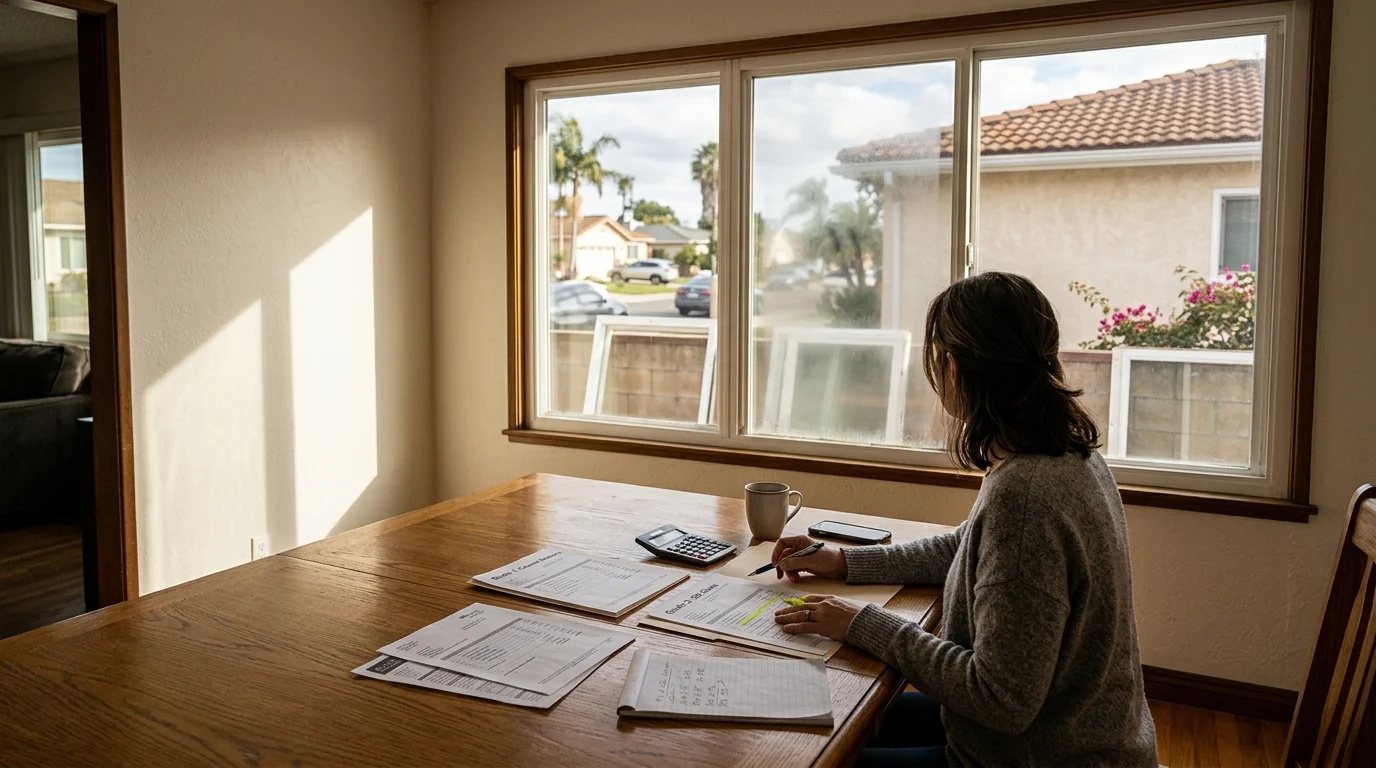
The best way to compare window replacement companies in San Diego is to make every bidder price the same written scope. A low total can hide different glass, missing trim, or a cheaper installation method. Compare the work behind the number, not just the number.
California’s C-17 glazing scope appears in 16 CCR 832.17. It covers selecting, assembling, and installing glass, frames, panels, sashes, and doors. That doesn’t establish C-17 as the only possible classification for every project. Check each bidder’s status and classification through the California Contractors State License Board.
Make the quotes comparable before you compare them
Start with one window schedule shared by every bidder. Give each opening a simple label, such as kitchen window or south bedroom window. Record the proposed operation, frame color, glass package, screen, and installation method. Note any opening that might change size.
The quotes should follow that same schedule. If one company proposes an insert and another proposes removing the existing frame, their totals aren’t measuring the same work. Our guide to choosing a window installer in San Diego explains what to verify before selecting a contractor.
Make the property conditions part of the scope. A coastal-strip quote near I-5 should address the proposed finish and hardware for that exposure. For an inland North County or East County property with strong afternoon sun, ask for the exact glass performance values. In the central city, identify older buildings that may need historic review. South Bay homeowners should also ask bidders to document the jurisdiction responsible for permits.
The City of San Diego requires a building permit for window replacement. Under Information Bulletin 203, same-size and same-type replacements can qualify for a No-Plan Building Permit. That’s a permit without plan review, not a permit exemption. Changes to an opening need a different review path.
The city also requires historic review for designated resources, properties inside adopted historic districts, and buildings at least 45 years old unless the work is exempt. A current permit fee couldn’t be confirmed from San Diego Development Services. Ask Development Services this exact question: “What permit and current fee apply to this window schedule at this address?”
Line items that must appear: install method, glass package, trim, haul-away
Every opening needs an installation method. The quote should say whether the existing frame stays or gets removed. If the old frame comes out, ask what surrounding materials are included in the full-frame replacement scope.
Don’t accept “replacement window” as a complete description. The quote should identify the manufacturer, product line, frame material, operating style, exterior color, interior color, glass configuration, grid pattern, and screen. If a feature was discussed during the sales visit, it belongs in writing.
Trim needs its own line. Ask what happens to interior casing, exterior trim, stucco, siding, drywall, paint, and sealant around each opening. The contractor should mark each item as included, excluded, or unchanged. This prevents a broad phrase such as “standard installation” from carrying several possible meanings.
Haul-away should also be explicit. Ask whether the scope includes removing old windows, discarded glass, frames, screens, packaging, and installation debris. The same line should identify any material the homeowner plans to keep.
Other useful line items include site protection, furniture-moving responsibilities, final cleaning, screen installation, and permit responsibility. Ask who submits permit documents and who answers correction notices. Don’t assume either task is included because a permit appears elsewhere in the quote.
Finally, compare the total against the written scope. The San Diego window replacement cost guide explains how installation type affects the published per-window ranges. Use it for context, then require each company to price your actual schedule.
Performance numbers on the sticker and why they belong in the quote
A glass description such as “energy efficient” isn’t specific enough. Ask the bidder to copy the proposed product’s U-factor and solar heat gain coefficient, or SHGC, into the quote. The product identifier and performance values should refer to the same configuration.
Those numbers matter because California’s energy rules distinguish between performance levels. The 2025 Building Energy Efficiency Standards took effect January 1, 2026. San Diego County spans Climate Zones 7 and 10. The prescriptive maximum fenestration U-factor for both zones is 0.30, while the mandatory maximum is 0.40.
California Energy Code Section 150.2(b), as verified from the 2022 edition, included a replacement exception for no more than 75 square feet of vertical fenestration. It allowed a U-factor no greater than 0.40 in all climate zones and an SHGC no greater than 0.35 in Climate Zones 2, 4, and 6 through 15. Larger jobs meet the prescriptive values.
The current edition is the 2025 standard, while the quoted exception text was verified from the 2022 edition. Ask the contractor and local building department to confirm how the current exception applies to your project. The California Energy Commission is the authority for the state energy standards.
Don’t let a salesperson substitute an ENERGY STAR logo for the actual product data. Ask for the exact certification and ratings tied to the quoted configuration. A brand may sell several window lines and glass packages. The quote should identify the one you’re buying.
No specific product can be called code compliant from a generic description. Compliance depends on the product, configuration, project size, climate zone, and current review requirements.
Labor warranty versus product warranty
A product warranty and a labor warranty answer different questions. Keep them separate in your comparison sheet. For each one, record the issuer and request the complete written terms before signing.
For the product warranty, ask which components are covered. The written document should address the frame, glass unit, hardware, finish, screens, and other quoted parts. It should also state exclusions, the claim process, and whether removal or reinstallation labor is covered. Don’t assume those details from a product name.
For the labor warranty, identify the contractor responsible for the installation. Ask what installation problems fall within its scope, what documentation a claim requires, and how repairs are handled. If the salesperson mentions a warranty term that isn’t in the contract, ask for the contract to be corrected.
Also check whether either warranty depends on registration, maintenance, ownership, or transfer conditions. You don’t need to interpret vague language during the sales meeting. Take the documents home and compare the exact wording.
Window Pro SD is a referral service. We match homeowners with licensed, independent local professionals. We don’t install windows, issue product warranties, or guarantee a contractor’s labor. The homeowner contracts with and pays the selected professional directly.
A bidder should never describe Window Pro SD as the dealer, manufacturer, installer, or warranty provider. Confirm the actual contracting company’s legal name before signing.
Red flags in the sales process
A quote becomes hard to trust when the product and scope stay vague. Watch for descriptions such as “premium glass,” “standard trim,” or “complete installation” without supporting details. The solution is simple: ask the company to name each product and included task.
Be cautious when a bidder won’t explain whether the existing frame remains. Retrofit and full-frame proposals shouldn’t be compared as if they’re identical. Ask what gets removed, what stays, and how the surrounding finish will be handled.
Permit claims deserve the same scrutiny. A company shouldn’t call a City of San Diego replacement permit-free when Information Bulletin 203 requires a permit. Same-size, same-type work may qualify for the No-Plan route, but that isn’t an exemption. Outside the city, ask the responsible city or San Diego County for the rule governing the project address.
Safety-glazing details can also expose weak proposals. The current California hazardous-location dimensions couldn’t be confirmed from the California Building Code. For windows near doors, tubs, showers, or stairs, ask the building department: “Does this opening require safety glazing under the current California code, and which section applies?”
Other warning signs include missing product identifiers, blank allowances, verbal promises excluded from the contract, and pressure to sign before reviewing documents. Confirm the contractor’s license record yourself. Make sure the business name on the quote matches the record and contract.
Ask how substitutions are approved. A quote should prevent an unspecified window, glass package, color, or hardware set from replacing the product you compared. Any change should be written before installation begins.
A careful company should be able to turn its proposal into a clear scope. If the answers remain verbal or inconsistent, don’t treat that quote as comparable.
When to call us
Call when you have a defined window schedule and want to compare licensed local professionals without treating the referral service as the installer. Call us at (858) 400-6418 and we’ll connect you with a licensed local window contractor.